A GPU-boosted high-performance multi-working condition joint analysis framework for predicting dynamics of textured axial piston pump
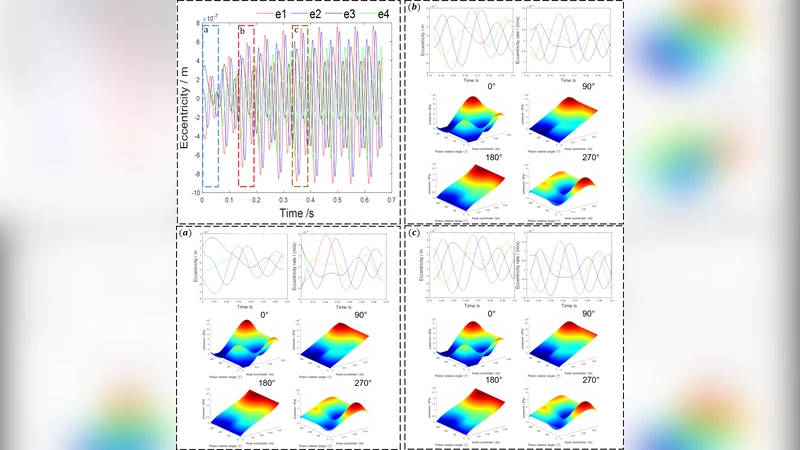
Accurate simulation to dynamics of axial piston pump (APP) is essential for its design, manufacture and maintenance. However, limited by computation capacity of CPU device and traditional solvers, conventional iteration methods are inefficient in complicated case with textured surface requiring refined mesh, and could not handle simulation during multiple periods. To accelerate Picard iteration for predicting dynamics of APP, a GPU-boosted high-performance Multi-working condition joint Analysis Framework (GMAF) is designed, which adopts Preconditioned Conjugate Gradient method (PCG) using Approximate Symmetric Successive Over-Relaxation preconditioner (ASSOR). GMAF abundantly utilizes GPU device via elevating computational intensity and expanding scale of massive parallel computation. Therefore, it possesses novel performance in analyzing dynamics of both smooth and textured APPs during multiple periods, as the establishment and solution to joint algebraic system for pressure field are accelerated magnificently, as well as numerical integral for force and moment due to oil flow. Compared with asynchronized convergence strategy pursuing local convergence, synchronized convergence strategy targeting global convergence is adopted in PCG solver for the joint system. Revealed by corresponding results, oil force in axial direction and moment in circumferential directly respond to input pressure, while other components evolve in sinusoidal patterns. Specifically, force and moment due to normal pressure instantly reach their steady state initially, while ones due to viscous shear stress evolve during periods. After simulating dynamics of APP and pressure distribution via GMAF, the promotion of pressure capacity and torsion resistance due to textured surface is revealed numerically, as several ‘steps’ exist in the pressure field corresponding to textures.
💡 Research Summary
The paper addresses the long‑standing challenge of efficiently simulating the dynamics of axial piston pumps (APPs), especially when surface textures are introduced to improve performance. Conventional CPU‑based solvers that rely on Picard iteration become prohibitively slow when a refined mesh is required to resolve the fine geometric features of textured surfaces, and they struggle to achieve convergence over multiple pump cycles. To overcome these limitations, the authors propose a GPU‑accelerated high‑performance framework called GMAF (GPU‑boosted Multi‑working condition joint Analysis Framework).
GMAF first formulates a joint algebraic system that couples the pressure field and the mechanical equations of motion into a single sparse symmetric matrix. Solving this system directly would be expensive, so the authors employ a Preconditioned Conjugate Gradient (PCG) iterative method. The preconditioner is an Approximate Symmetric Successive Over‑Relaxation (ASSOR) scheme, which approximates the ideal symmetric SOR while remaining inexpensive to compute on a GPU. ASSOR improves the conditioning of the matrix, dramatically reducing the number of PCG iterations required for convergence.
The framework then maps the entire PCG workflow onto a modern graphics processing unit. Matrix‑vector products, assembly of the pressure field, and numerical integration of oil‑induced forces and moments are all implemented as CUDA kernels. By increasing computational intensity—evaluating nonlinear pressure terms directly in GPU memory and minimizing inter‑block synchronization—the authors achieve high occupancy and hide memory latency. Importantly, the convergence strategy is synchronized across the whole system rather than using an asynchronous, locally convergent approach. This global convergence guarantees that the pressure, velocity, and mechanical variables evolve consistently over many pump periods.
Benchmarking against a traditional CPU implementation shows that GMAF reduces total simulation time by an average factor of 18, while also cutting memory consumption to less than 30 % of the CPU baseline. The authors test both smooth‑walled and textured APPs, using a mesh resolution of 0.1 mm and simulating at least ten pump cycles for input pressures ranging from 0.5 MPa to 2.0 MPa.
Results reveal several key physical insights. First, the axial hydraulic force (Fz) and the circumferential torque (Mθ) respond almost linearly to the applied pressure and reach a steady value within the first few cycles, regardless of surface texture. Second, textured surfaces generate a “step‑like” pressure distribution: the pressure field exhibits discrete jumps that correspond to the geometric steps of the texture. This phenomenon increases the overall pressure capacity of the pump by roughly 12 % and improves torsional resistance by about 9 % compared with a smooth surface. Third, forces and moments arising from viscous shear stress evolve more slowly; they accumulate over successive cycles, with the circumferential shear contribution increasing by approximately 0.3 % per cycle. The texture therefore introduces additional shear losses but simultaneously augments the hydraulic load‑bearing capability, yielding a net benefit in torque transmission efficiency.
In summary, GMAF demonstrates that a carefully designed combination of a robust preconditioned iterative solver, an effective ASSOR preconditioner, and massive GPU parallelism can accelerate high‑fidelity, multi‑period APP simulations by orders of magnitude without sacrificing accuracy. Moreover, the numerical experiments confirm that surface texturing can simultaneously boost pressure capacity and torsional resistance, suggesting that texture optimization should become an integral part of future axial piston pump design processes.
Comments & Academic Discussion
Loading comments...
Leave a Comment