Report from Workshop on Dialogue alongside Artificial Intelligence
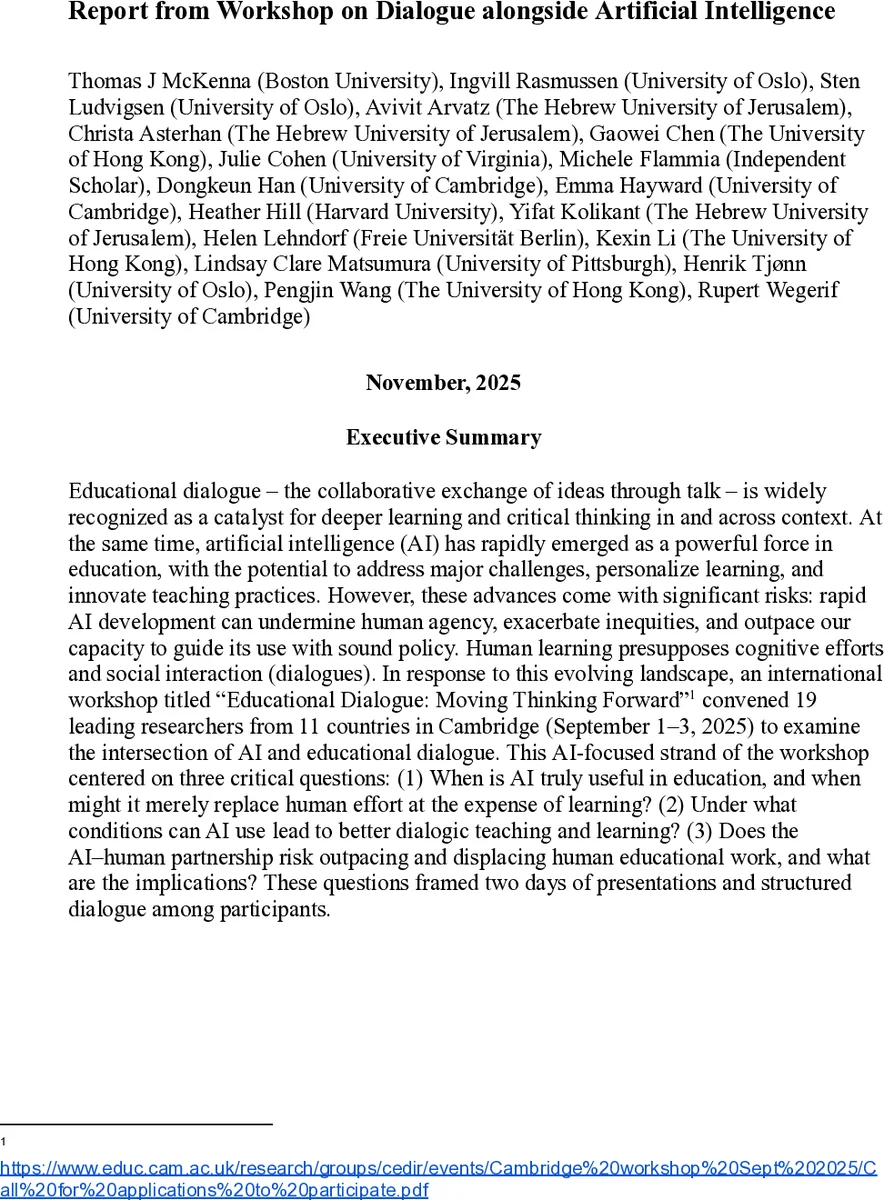
Educational dialogue – the collaborative exchange of ideas through talk – is widely recognized as a catalyst for deeper learning and critical thinking in and across contexts. At the same time, artificial intelligence (AI) has rapidly emerged as a powerful force in education, with the potential to address major challenges, personalize learning, and innovate teaching practices. However, these advances come with significant risks: rapid AI development can undermine human agency, exacerbate inequities, and outpace our capacity to guide its use with sound policy. Human learning presupposes cognitive efforts and social interaction (dialogues). In response to this evolving landscape, an international workshop titled “Educational Dialogue: Moving Thinking Forward” convened 19 leading researchers from 11 countries in Cambridge (September 1-3, 2025) to examine the intersection of AI and educational dialogue. This AI-focused strand of the workshop centered on three critical questions: (1) When is AI truly useful in education, and when might it merely replace human effort at the expense of learning? (2) Under what conditions can AI use lead to better dialogic teaching and learning? (3) Does the AI-human partnership risk outpacing and displacing human educational work, and what are the implications? These questions framed two days of presentations and structured dialogue among participants.
💡 Research Summary
The paper reports on the “Educational Dialogue: Moving Thinking Forward” workshop held in Cambridge from September 1‑3, 2025, which brought together 19 leading scholars from 11 countries to examine the intersection of artificial intelligence (AI) and educational dialogue. The workshop’s AI strand was organized around three pivotal questions: (1) When does AI genuinely add value to education, and when does it merely replace human effort at the cost of learning? (2) Under what conditions can AI use improve dialogic teaching and learning? (3) Does the AI‑human partnership risk outpacing and displacing human educational work, and what are the implications?
The opening sessions set the stage by reviewing the long‑standing recognition of dialogue as a catalyst for deeper cognition and critical thinking, while also acknowledging AI’s rapid emergence as a transformative force in education. Participants highlighted that AI’s promise lies not in automating routine tasks such as grading, but in fostering richer, more responsive conversational environments that can scaffold metacognition, provide personalized feedback, and simulate authentic discourse. Several case studies were presented, including language‑model‑driven tutoring agents that generate context‑sensitive prompts, and virtual debate platforms that allow learners to practice argumentation with AI‑mediated interlocutors. These examples demonstrated measurable gains in student engagement and higher‑order reasoning when AI was used to extend, rather than replace, human interaction.
The second set of discussions focused on the conditions required for AI to truly enhance dialogic pedagogy. Three inter‑related criteria emerged: (i) Design‑Technology Alignment – AI tools must be purpose‑built to support specific learning objectives and conversational structures; ad‑hoc or generic chatbots were deemed counterproductive. (ii) Teacher Mediation – AI‑generated data and suggestions should be interpreted and strategically employed by teachers, who retain the authority to pose probing questions, redirect discourse, and contextualize feedback. (iii) Learner Transparency and Agency – Students need clear explanations of how AI arrives at its recommendations and must retain the option to seek human clarification. When these conditions are met, AI functions as a catalyst that expands the depth and breadth of dialogue, enabling more frequent, timely, and differentiated interactions.
The third thematic block addressed the risks of an unchecked AI‑human partnership. Participants warned that rapid AI deployment could erode human agency, exacerbate digital inequities, and embed algorithmic biases into educational assessment. To mitigate these threats, the workshop proposed a multi‑layered governance framework: (a) Continuous Impact Evaluation – systematic monitoring of learning outcomes, equity metrics, and socio‑emotional effects before and after AI integration; (b) Professional Development – sustained training programs that build teachers’ AI literacy and pedagogical strategies for co‑teaching with machines; (c) Data Ethics and Transparency – clear standards for data collection, storage, and algorithmic explainability, coupled with independent audits. Moreover, participants emphasized that AI should be positioned as an assistive technology, not as an autonomous decision‑maker in curriculum design or policy formulation. Legal and ethical safeguards were recommended to prevent AI from unilaterally shaping evaluation criteria or replacing human evaluators.
In synthesizing the discussions, the authors conclude that AI and educational dialogue hold synergistic potential but require careful orchestration across technical, pedagogical, and policy domains. They outline concrete recommendations: develop prototyping protocols that test alignment between AI functionalities and dialogue goals; expand teacher‑centered AI training at institutional and national levels; codify international standards for AI transparency, fairness, and accountability in education; and invest in longitudinal research infrastructures that can track the long‑term effects of AI‑mediated dialogue on learner identity formation and social equity.
Future research directions identified include: creating robust metrics for assessing the quality of AI‑facilitated dialogue; investigating AI’s performance across multilingual and multicultural contexts to ensure fairness; and exploring the longitudinal impact of AI‑human co‑teaching on students’ critical thinking and civic engagement. The paper calls for ongoing dialogue among researchers, educators, policymakers, and technologists to ensure that AI serves as a partner that amplifies human strengths rather than a substitute that diminishes them.
Overall, the workshop report underscores that while AI can dramatically enrich educational dialogue when thoughtfully integrated, safeguarding human agency, equity, and ethical governance remains essential to realize its full promise.
Comments & Academic Discussion
Loading comments...
Leave a Comment