Retrofitters, pragmatists and activists: Public interest litigation for accountable automated decision-making
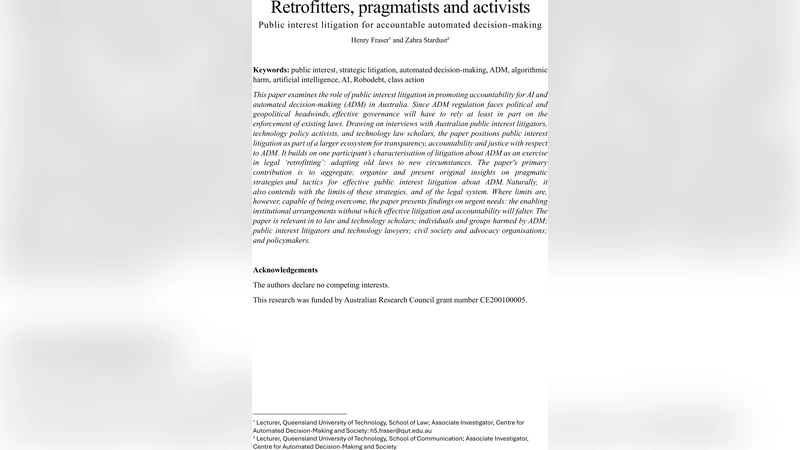
This paper examines the role of public interest litigation in promoting accountability for AI and automated decision-making (ADM) in Australia. Since ADM regulation faces geopolitical headwinds, effective governance will have to rely at least in part on the enforcement of existing laws. Drawing on interviews with Australian public interest litigators, technology policy activists, and technology law scholars, the paper positions public interest litigation as part of a larger ecosystem for transparency, accountability and justice with respect to ADM. It builds on one participant’s characterisation of litigation about ADM as an exercise in legal retrofitting: adapting old laws to new circumstances. The paper’s primary contribution is to aggregate, organise and present original insights on pragmatic strategies and tactics for effective public interest litigation about ADM. Naturally, it also contends with the limits of these strategies, and of the Australian legal system. Where limits are, however, capable of being overcome, the paper presents findings on urgent needs: the enabling institutional arrangements without which effective litigation and accountability will falter. The paper is relevant to law and technology scholars; individuals and groups harmed by ADM; public interest litigators and technology lawyers; civil society and advocacy organisations; and policymakers.
💡 Research Summary
This paper investigates how public‑interest litigation can be used to hold automated decision‑making (ADM) systems accountable in Australia, a jurisdiction where dedicated AI legislation is lagging behind global trends. The authors argue that, given the geopolitical headwinds that impede swift regulatory action, effective governance must rely at least in part on the enforcement of existing statutes through a process they term “legal retrofitting”—the adaptation of older laws to new technological contexts.
The empirical core of the study consists of semi‑structured interviews with fifteen key actors: public‑interest litigators, technology‑policy activists, and scholars of technology law. From these conversations three archetypal roles emerge. “Retrofitters” focus on doctrinal work, stretching anti‑discrimination, privacy, and administrative law to cover algorithmic harms. “Pragmatists” devise the tactical playbook—how to secure data access, structure class actions, enlist expert testimony, and seek injunctions—while balancing cost, evidentiary hurdles, and procedural timing. “Activists” mobilise public opinion, media, and civil‑society networks to amplify pressure on both courts and regulators.
The paper maps out four principal litigation strategies. First, data‑access requests under the Freedom of Information Act and the Privacy Act are used to compel disclosure of algorithmic inputs, training data, and decision logic, thereby creating the evidentiary foundation for claims of bias or unlawful discrimination. Second, expert testimony and technical audits translate complex machine‑learning outputs into legally recognizable facts. Third, class‑action mechanisms aggregate dispersed harms, allowing plaintiffs to seek damages, corrective orders, or declaratory relief. Fourth, coordinated engagement with regulatory bodies such as the Office of the Australian Information Commissioner (OAIC) can generate administrative investigations that complement court proceedings.
Despite these promising tactics, the authors identify three systemic constraints. Judicial unfamiliarity with AI technicalities often forces courts to rely heavily on expert witnesses, inflating costs and prolonging litigation. The existing statutes contain numerous exemptions—commercial‑secret, national‑security, and “reasonable‑effort” clauses—that limit the effectiveness of data‑access demands. Finally, the high financial burden of expert engagement and prolonged discovery makes sustained public‑interest actions difficult for smaller NGOs.
To overcome these barriers, the paper proposes a suite of institutional reforms. A standing “court‑technology advisory panel” would supply judges with independent expertise, reducing reliance on ad‑hoc experts. A dedicated public‑interest litigation fund, possibly administered through legal aid schemes, would underwrite the costs of data‑access motions and expert audits. Legislative amendments should impose a clear duty on public agencies and private entities that provide services to the public to share algorithmic data upon legitimate request, with enforceable penalties for non‑compliance.
In conclusion, the study positions public‑interest litigation not as a peripheral tactic but as a central pillar of an ecosystem that includes transparency, accountability, and justice for ADM. By retrofitting existing legal frameworks and deploying pragmatic, well‑coordinated strategies, litigants can achieve meaningful oversight even in the absence of comprehensive AI legislation. However, the durability of this approach hinges on the creation of supportive institutional arrangements—specialist judicial resources, financial backing, and robust data‑sharing obligations—that can sustain litigation over the long term. The authors argue that these insights are transferable to other common‑law jurisdictions facing similar regulatory gaps, offering a roadmap for leveraging the courts as a venue for AI accountability.
Comments & Academic Discussion
Loading comments...
Leave a Comment