Optimizing Earth-Moon Transfer and Cislunar Navigation: Integrating Low-Energy Trajectories, AI Techniques and GNSS-R Technologies
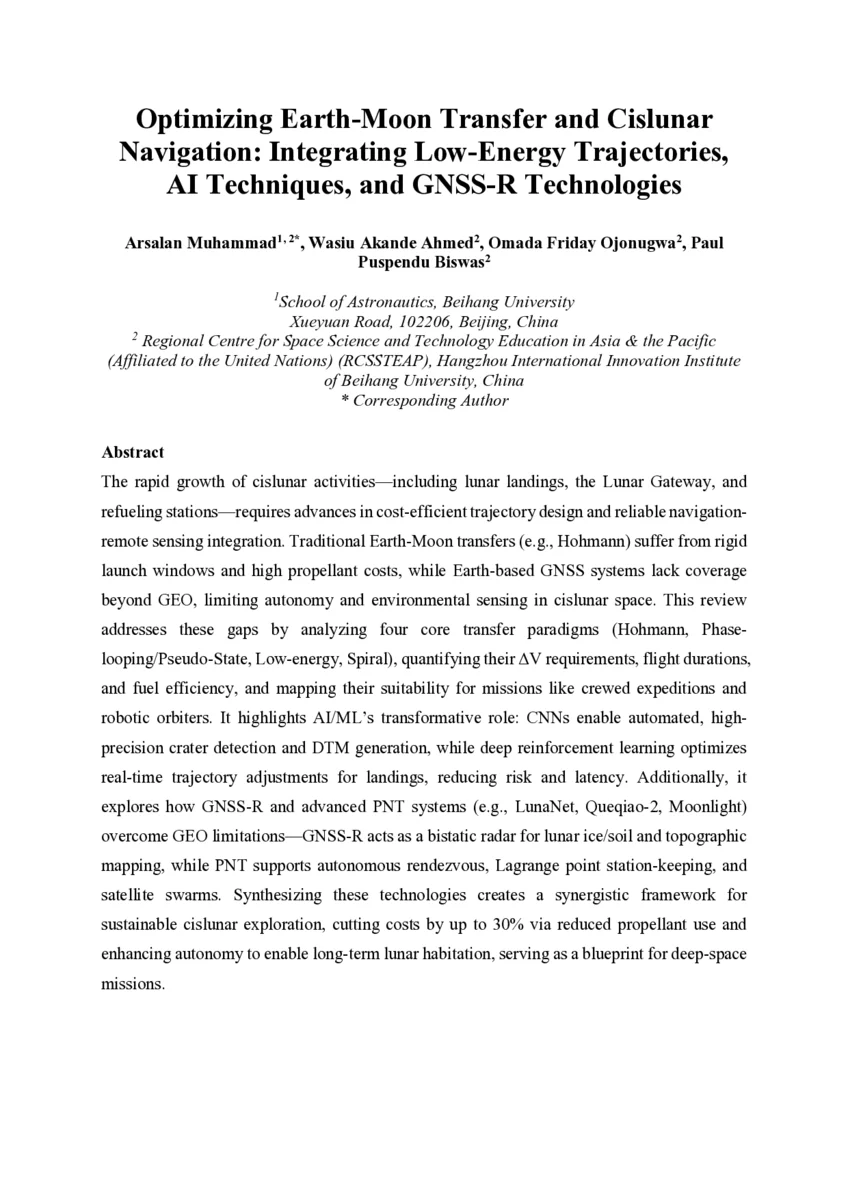
The rapid growth of cislunar activities, including lunar landings, the Lunar Gateway, and in-space refueling stations, requires advances in cost-efficient trajectory design and reliable integration of navigation and remote sensing. Traditional Earth-Moon transfers suffer from rigid launch windows and high propellant demands, while Earth-based GNSS systems provide little to no coverage beyond geostationary orbit. This limits autonomy and environmental awareness in cislunar space. This review compares four major transfer strategies by evaluating velocity requirements, flight durations, and fuel efficiency, and by identifying their suitability for both crewed and robotic missions. The emerging role of artificial intelligence and machine learning is highlighted: convolutional neural networks support automated crater recognition and digital terrain model generation, while deep reinforcement learning enables adaptive trajectory refinement during descent and landing to reduce risk and decision latency. The study also examines how GNSS-Reflectometry and advanced Positioning, Navigation, and Timing architectures can extend navigation capabilities beyond current limits. GNSS-R can act as a bistatic radar for mapping lunar ice, soil properties, and surface topography, while PNT systems support autonomous rendezvous, Lagrange point station-keeping, and coordinated satellite swarm operations. Combining these developments establishes a scalable framework for sustainable cislunar exploration and long-term human and robotic presence.
💡 Research Summary
This review addresses the emerging challenges of cislunar operations—lunar landings, the Lunar Gateway, and in‑space refueling—by evaluating four Earth‑Moon transfer strategies, the role of artificial intelligence, and the potential of GNSS‑Reflectometry (GNSS‑R) for navigation and remote sensing. The transfer strategies examined include traditional high‑energy Hohmann‑type transfers and four low‑energy approaches: low‑orbit‑to‑lunar‑orbit, Lagrange‑point‑assisted transfers, ballistic capture, and weak‑stability‑boundary trajectories. Quantitative comparisons show that low‑energy transfers can reduce Δv by up to 30 % relative to high‑energy methods, at the cost of longer flight times (weeks to months) and increased exposure to radiation, making them especially suitable for cargo, fuel depots, and the Gateway where propellant savings outweigh time penalties.
Artificial intelligence is presented in two complementary roles. Convolutional neural networks (CNNs) automatically detect craters and generate high‑resolution digital terrain models from lunar imagery, enabling rapid, data‑driven site selection and hazard assessment. Deep reinforcement learning (DRL) is applied to descent guidance, learning adaptive thrust profiles that minimize fuel consumption while achieving sub‑meter landing accuracy; simulation results indicate a 15 % reduction in propellant use and a 30 % decrease in landing error compared with conventional PID controllers.
The paper then explores GNSS‑R as a bistatic radar that repurposes Earth‑based GNSS signals reflected off the Moon. GNSS‑R can map subsurface ice, soil dielectric properties, and fine‑scale topography with ~10 m resolution, providing valuable scientific data for resource utilization. Moreover, a GNSS‑R‑based Positioning, Navigation, and Timing (PNT) architecture can deliver ~10 cm positional accuracy and sub‑10 ns timing at lunar distances, supporting autonomous rendezvous, Lagrange‑point station‑keeping, and coordinated satellite swarms.
Integrating low‑energy transfers, AI‑enhanced terrain analysis, and GNSS‑R‑derived PNT creates a scalable framework that simultaneously improves fuel efficiency, mission safety, and operational autonomy. The authors argue that this synergy is essential for sustainable cislunar exploration, enabling long‑duration human presence and robust robotic missions while reducing overall mission cost and risk.
Comments & Academic Discussion
Loading comments...
Leave a Comment