Concept study and preliminary design of a cold atom interferometer for space gravity gradiometry
We study a space-based gravity gradiometer based on cold atom interferometry and its potential for the Earth’s gravitational field mapping. The instrument architecture has been proposed in [Carraz et al., Microgravity Science and Technology 26, 139 (2014)] and enables high-sensitivity measurements of gravity gradients by using atom interferometers in a differential accelerometer configuration. We present the design of the instrument including its subsystems and analyze the mission scenario, for which we derive the expected instrument performances, the requirements on the sensor and its key subsystems, and the expected impact on the recovery of the Earth gravity field.
💡 Research Summary
**
The paper presents a comprehensive concept study and preliminary design of a space‑borne gravity‑gradient instrument based on cold‑atom interferometry (CAI). Building on the architecture proposed by Carraz et al. (2014), the instrument consists of two spatially separated atom interferometers that operate as a differential accelerometer. Each interferometer is a Mach‑Zehnder‑type device realized with a sequence of three stimulated Raman light pulses. The phase accumulated by an atom under a constant acceleration a along the laser beam direction is Φ = k a T², where k is the effective Raman momentum transfer and T the free‑evolution time between pulses. By placing the two interferometers a distance D ≈ 0.5 m apart, the differential phase ΔΦ = k γ D T² directly yields the gravity‑gradient component γ along the measurement axis.
Assuming a realistic phase noise of 1 mrad per shot (achievable with a high‑flux, low‑expansion atomic source) and a pulse separation time T = 5 s, the single‑shot gradient sensitivity reaches the order of 1 mE (1 Eötvös = 10⁻⁹ s⁻²). With a cycle time of about 1 s, the instrument’s noise spectral density is projected to be ≈ 5 mE · Hz⁻¹ᐟ², which is a factor of two to three better than the electrostatic gradiometers flown on the GOCE mission (10–20 mE · Hz⁻¹ᐟ²) and, crucially, maintains a white‑noise spectrum down to the low‑frequency band (0.1–5 mHz). This overcomes GOCE’s main limitation: a steep increase of noise at low frequencies that hampers the recovery of long‑wavelength gravity signals.
The atomic source is based on a rubidium‑87 Bose‑Einstein condensate (BEC) delivering ≈ 10⁶ atoms per preparation cycle. The preparation sequence exploits rapid evaporative cooling (≈ 800 ms) followed by a “shortcut‑to‑adiabaticity” magnetic transport that moves the cloud 5 mm away from the atom chip in ≈ 200 ms. After a 100 ms free expansion the cloud is collimated by a 1.2 ms magnetic lens, reducing the expansion velocity to ≈ 0.1 mm s⁻¹ (effective temperature ≈ 100 pK). The cloud is then launched with a double‑Raman‑diffraction pulse imparting ±4 ℏk momentum, and subsequently accelerated by a Bloch‑optical lattice to a horizontal velocity corresponding to 200 photon recoils. Within 100 ms the atoms travel 12 cm to the interferometry chamber; a reverse lattice decelerates them to the original momentum before a second splitting stage creates the two vertically separated interferometers (24 cm apart). The entire preparation‑transport‑splitting cycle lasts ≈ 1.4 s, allowing a new BEC to be generated while the previous one is interrogated, thus achieving an effective repetition rate of ~1 Hz and enabling up to eight simultaneous interferometers.
Satellite rotation is compensated by tilting the first and last retro‑reflecting mirrors by ±θ = ±Ω_y T, where Ω_y is the cross‑track angular rate. This configuration cancels Coriolis and centrifugal contributions to the interferometer phase. Additionally, the Raman wave‑vector is deliberately changed by δk at the second pulse to isolate the gravity‑gradient term, following recent proposals and experimental demonstrations. The analysis shows that with attitude knowledge better than 10⁻⁶ rad s⁻¹ and knowledge of the initial atomic position/velocity to the µm/µm s⁻¹ level, systematic phase shifts remain well below the noise budget.
A detailed Monte‑Carlo model of the interferometer accounts for finite laser beam size, wave‑front curvature, pulse duration, and the finite spatial extent of the atomic cloud. The simulation demonstrates that a laser beam waist of 1–2 mm and pulse powers of ≈ 200 mW are sufficient to keep systematic phase errors below 10⁻⁹ g, preserving the target 5 mE · Hz⁻¹ᐟ² sensitivity. The model also quantifies loss of contrast due to residual expansion and wave‑front aberrations, confirming that the proposed optical layout meets the performance requirements.
Subsystem engineering is described in depth: the retro‑reflecting mirror assembly (including vibration isolation and thermal control), the laser system (780 nm diode lasers or frequency‑doubled 1560 nm fiber lasers with phase‑locking), the ultra‑high‑vacuum chamber (≤ 10⁻⁹ mbar), and the detection chain (fluorescence and absorption imaging). Mass, power, and volume budgets are presented, showing compatibility with a dedicated low‑altitude (250–300 km) satellite platform.
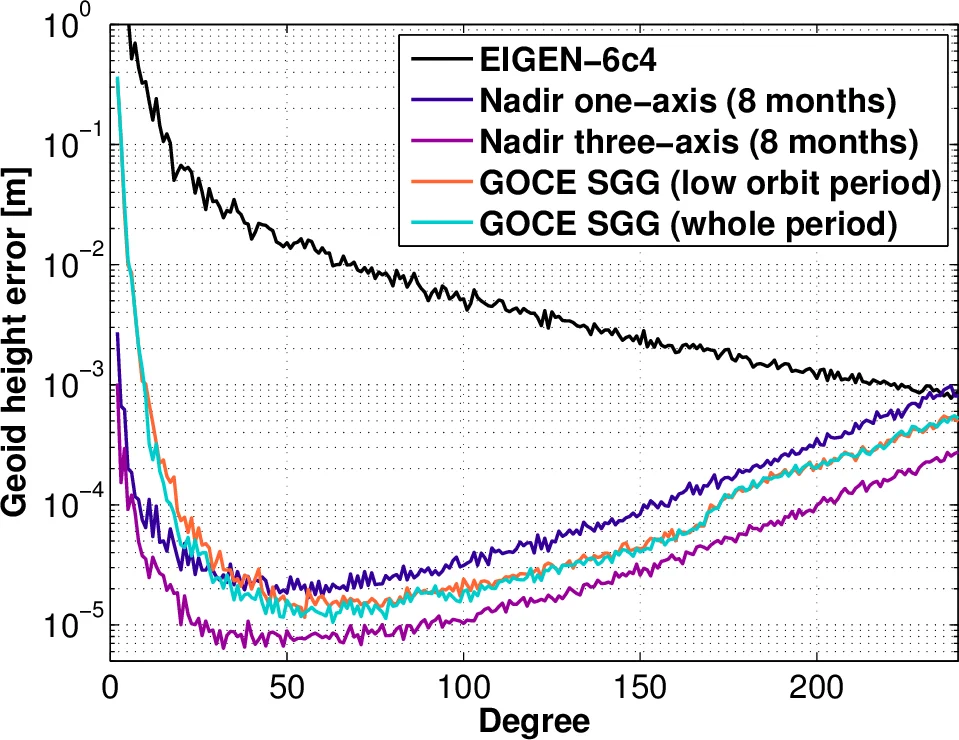
Finally, the impact on gravity‑field recovery is evaluated through realistic orbit simulations and gravity‑field inversion using the proposed sensor noise model. Compared with GOCE, the CAI‑based gradiometer yields a 2–3 × improvement in spatial resolution (≈ 50 km versus 100 km) and reduces geoid height errors to the order of 1 cm. This enhanced performance would significantly benefit ocean circulation studies, ice‑sheet mass balance monitoring, and solid‑Earth dynamics, especially in the low‑frequency band where current satellite gravimetry is limited. The authors conclude that a cold‑atom gravity‑gradient mission is technically feasible and promises a substantial scientific return for Earth observation.
Comments & Academic Discussion
Loading comments...
Leave a Comment