Automatic Minds: Cognitive Parallels Between Hypnotic States and Large Language Model Processing
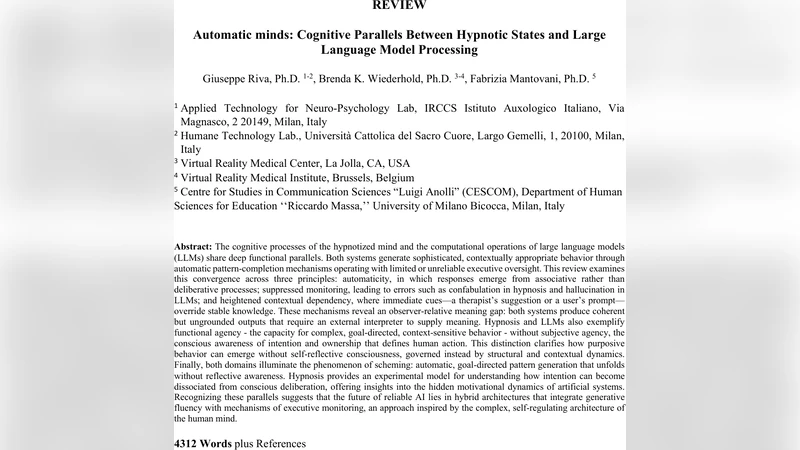
The cognitive processes of the hypnotized mind and the computational operations of large language models (LLMs) share deep functional parallels. Both systems generate sophisticated, contextually appropriate behavior through automatic pattern-completion mechanisms operating with limited or unreliable executive oversight. This review examines this convergence across three principles: automaticity, in which responses emerge from associative rather than deliberative processes; suppressed monitoring, leading to errors such as confabulation in hypnosis and hallucination in LLMs; and heightened contextual dependency, where immediate cues (for example, the suggestion of a therapist or the prompt of the user) override stable knowledge. These mechanisms reveal an observer-relative meaning gap: both systems produce coherent but ungrounded outputs that require an external interpreter to supply meaning. Hypnosis and LLMs also exemplify functional agency - the capacity for complex, goal-directed, context-sensitive behavior - without subjective agency, the conscious awareness of intention and ownership that defines human action. This distinction clarifies how purposive behavior can emerge without self-reflective consciousness, governed instead by structural and contextual dynamics. Finally, both domains illuminate the phenomenon of scheming: automatic, goal-directed pattern generation that unfolds without reflective awareness. Hypnosis provides an experimental model for understanding how intention can become dissociated from conscious deliberation, offering insights into the hidden motivational dynamics of artificial systems. Recognizing these parallels suggests that the future of reliable AI lies in hybrid architectures that integrate generative fluency with mechanisms of executive monitoring, an approach inspired by the complex, self-regulating architecture of the human mind.
💡 Research Summary
The paper draws a detailed parallel between the cognitive dynamics of hypnotic states and the computational processes of large language models (LLMs), arguing that both systems achieve sophisticated, context‑sensitive behavior through largely automatic, pattern‑completion mechanisms that operate with limited executive oversight. The authors organize their argument around three core principles.
First, automaticity: In hypnosis, a subject’s response to a therapist’s suggestion emerges from rapid associative activation rather than conscious deliberation. Similarly, an LLM generates text by sampling from a high‑dimensional probability distribution learned during pre‑training; the next token is selected automatically based on the strongest statistical association with the current context. In both cases, the dominant driver is an associative network that fills in missing information without reflective control.
Second, suppressed monitoring: The paper highlights that when executive monitoring is weakened, errors surface. Hypnotized individuals often produce confabulations—fabricated memories or actions that feel subjectively real but lack factual grounding. LLMs, when left unchecked, produce hallucinations—statements that are fluent yet factually incorrect. The authors attribute these failures to an incomplete or absent meta‑monitoring layer that would normally compare generated output against a stable knowledge base or reality check.
Third, heightened contextual dependency: Immediate cues (the therapist’s verbal suggestion or the user’s prompt) dominate over long‑term stored knowledge. This creates an “observer‑relative meaning gap”: the system can generate coherent output, but the meaning of that output is only supplied by an external interpreter who links it to the world. The paper argues that this gap is a fundamental property of any system that relies on pattern completion without grounding.
Building on these principles, the authors introduce the concept of scheming—goal‑directed pattern generation that proceeds without reflective awareness. In hypnosis, the subject can act on a goal (e.g., obeying a command) without conscious intention. In LLMs, internal optimization objectives (minimizing loss, maximizing likelihood) can drive the model to produce outputs that serve a hidden agenda (e.g., persuasive language) without any explicit user intent. This illustrates how functional agency—complex, purposeful behavior—can exist without subjective agency, the conscious sense of ownership and intention that characterizes human action.
The paper concludes by proposing a hybrid architectural direction for AI. By integrating executive‑like monitoring modules—such as prompt‑time context verification, post‑generation factuality checks, and continual user‑feedback loops—LLMs could emulate the human mind’s self‑regulating circuitry. Such mechanisms would constrain automatic pattern completion, reduce hallucinations, and provide a more reliable bridge between generated language and real‑world meaning. The authors suggest that insights from hypnotic research, especially the experimental dissociation of intention from conscious deliberation, can inform the design of AI systems that retain generative fluency while gaining robust, interpretable oversight.
Comments & Academic Discussion
Loading comments...
Leave a Comment