Spectre operator, achievement sets and sets of P-sums in a hyperspace of compact sets
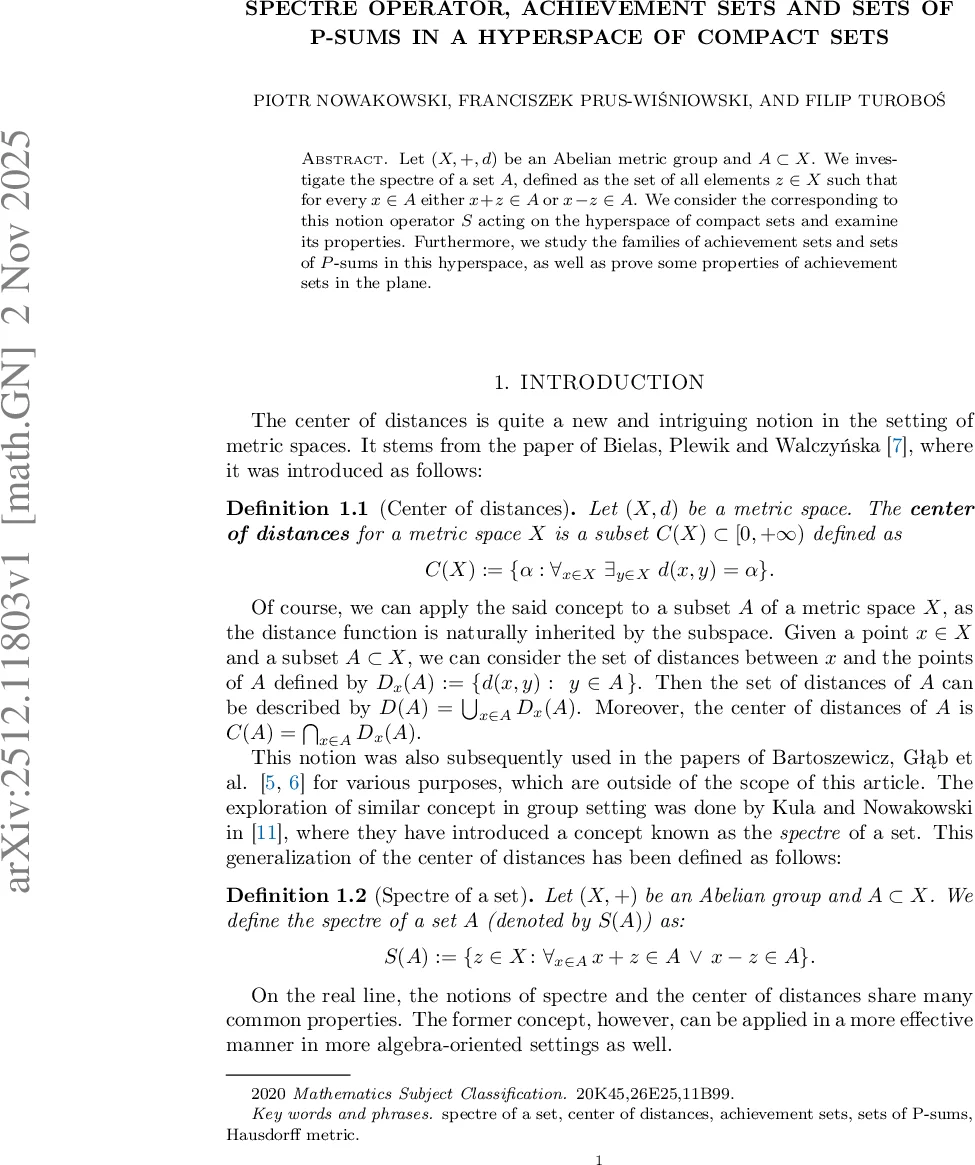
Let $(X,+,d)$ be an Abelian metric group and $A\subset X$. We investigate the spectre of a set $A$, defined as the set of all elements $z\in X$ such that for every $x\in A$ either $x+z \in A$ or $x-z \in A$. We consider the corresponding to this notion operator $S$ acting on the hyperspace of compact sets and examine its properties. Furthermore, we study the families of achievement sets and sets of $P$-sums in this hyperspace, as well as prove some properties of achievement sets in the plane.
💡 Research Summary
This paper conducts a comprehensive study of the “spectre” of a set, a novel concept defined within the framework of an Abelian metric group (X,+,d). The spectre of a set A, denoted S(A), is defined as the set of all elements z in X such that for every x in A, either x+z or x-z also belongs to A. This generalizes the known concept of the “center of distances” from metric spaces to a setting enriched with algebraic group structure.
The authors begin by establishing fundamental properties of the spectre operator. It always contains the group’s neutral element (0), is invariant under translations of the set A, and is symmetric (z ∈ S(A) implies -z ∈ S(A)). A key result shows that the spectre of a compact set is itself compact, allowing the definition of an operator S mapping the hyperspace of non-empty compact sets K(X) to the hyperspace of compact sets containing zero, K0(X).
The investigation then delves into the behavior of this operator. While the spectre of a subgroup Z is Z itself, the converse is not true, as demonstrated by counterexamples like the set {-1, 0, 1}. The operator S is shown to lack surjectivity in general; specific conditions are provided under which a compact set containing 0 cannot be the spectre of any set. However, under certain set-theoretic assumptions (involving the cardinality of a Hamel basis), the paper proves that for any set A containing 0 and closed under taking inverses, there exists some set B such that S(B) = A.
A significant portion of the work addresses the continuity of S with respect to the Pompeiu-Hausdorff metric on the hyperspace. The operator is generally not continuous. The authors provide a sufficient condition involving sequences converging to an element from outside its generated subgroup, which leads to discontinuity, illustrated with a concrete example on the real line. To contrast this, the paper introduces the concept of a “net-set”—a finite set where the differences (or their negatives) from any two distinct two-element subsets are disjoint. For any net-set A, S(A) is trivial, containing only {0}. Crucially, the spectre operator S is proven to be continuous at every net-set.
Furthermore, leveraging the density of finite sets in K(X), the authors prove that two specific families are also dense: the family of finite sets with non-trivial spectre (not just {0}) and the family of all net-sets. The paper’s title also mentions the study of families of “achievement sets” and “sets of P-sums” within this hyperspace, as well as properties of achievement sets in the plane, indicating these as related directions of research explored in the full manuscript.
In summary, this paper provides a deep functional-analytic and set-theoretic examination of the spectre operator. It successfully bridges metric and algebraic ideas, characterizes its fundamental properties, and carefully analyzes its limitations regarding surjectivity and continuity, while also identifying specific conditions (net-sets) that guarantee local stability. The work contributes to the theory of operators on hyperspaces of compact sets.
Comments & Academic Discussion
Loading comments...
Leave a Comment