A Decade of Solar High-Fidelity Spectroscopy and Precise Radial Velocities from HARPS-N
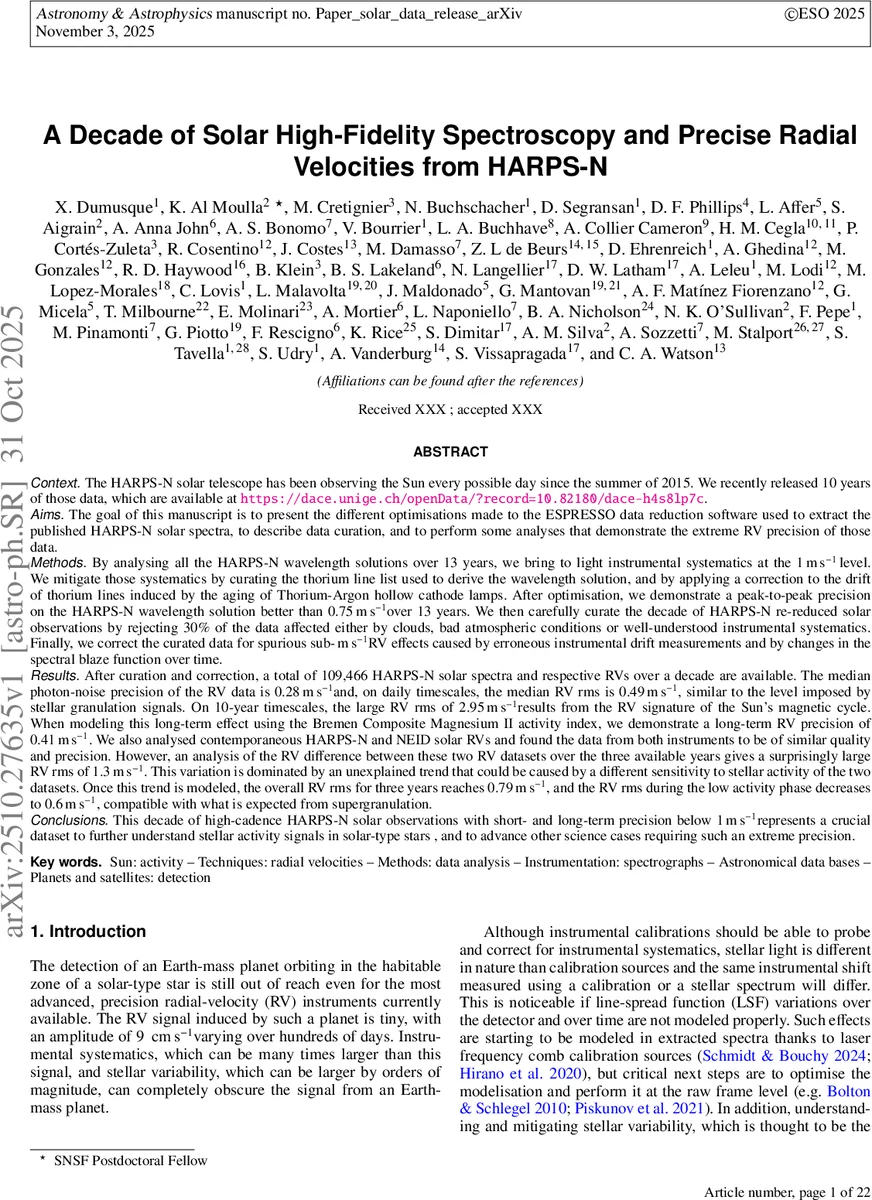
We recently released 10 years of HARPS-N solar telescope and the goal of this manuscript is to present the different optimisations made to the data reduction, to describe data curation, and to perform some analyses that demonstrate the extreme RV precision of those data. By analysing all the HARPS-N wavelength solutions over 13 years, we bring to light instrumental systematics at the 1 m/s level. After correction, we demonstrate a peak-to-peak precision on the HARPS-N wavelength solution better than 0.75 m/s over 13 years. We then carefully curate the decade of HARPS-N re-reduced solar observations by rejecting 30% of the data affected either by clouds, bad atmospheric conditions or well-understood instrumental systematics. Finally, we correct the curated data for spurious sub-m/s RV effects caused by erroneous instrumental drift measurements and by changes in the spectral blaze function over time. After curation and correction, a total of 109,466 HARPS-N solar spectra and respective RVs over a decade are available. The median photon-noise precision of the RV data is 0.28 m/s and, on daily timescales, the median RV rms is 0.49 m/s, similar to the level imposed by stellar granulation signals. On 10-year timescales, the large RV rms of 2.95 m/s results from the RV signature of the Sun’s magnetic cycle. When modelling this long-term effect using the Magnesium II activity index, we demonstrate a long-term RV precision of 0.41 m/s. We also analysed contemporaneous HARPS-N and NEID solar RVs and found the data from both instruments to be of similar quality and precision, with an overall RV differece rms of 0.79 m/s. This decade of high-cadence HARPS-N solar observations with short- and long-term precision below 1 m/s represents a crucial dataset to further understand stellar activity signals in solar-type stars , and to advance other science cases requiring such an extreme precision.
💡 Research Summary
This paper presents a comprehensive ten‑year data release of solar observations obtained with the HARPS‑N spectrograph, amounting to 109,466 high‑resolution spectra and associated radial‑velocity (RV) measurements. The authors re‑process the raw frames using an updated version (3.2.5) of the ESPRESSO Data Reduction Software (DRS), which has been specifically adapted for HARPS‑N. Key technical improvements include a refined Thorium‑Argon (Th‑Ar) line list, a new algorithm for deriving the wavelength solution, and a correction for the systematic drift of Th lines caused by lamp aging and the lamp replacement that occurred in May 2020. These changes reduce the long‑term scatter of the wavelength solution to better than 0.75 m s⁻¹ over a 13‑year baseline, a substantial improvement over the previous 0.8 m s⁻¹ scatter.
A rigorous data‑curation pipeline discards roughly 30 % of the raw observations that are affected by clouds, poor atmospheric conditions, or known instrumental systematics. After curation, the remaining spectra are further corrected for sub‑m s⁻¹ RV offsets arising from erroneous drift measurements and temporal variations of the spectrograph blaze function. The final, fully calibrated dataset exhibits a median photon‑noise RV precision of 0.28 m s⁻¹. On daily timescales the median RV root‑mean‑square (RMS) is 0.49 m s⁻¹, which matches the expected contribution from solar granulation. Over the full ten‑year span the RV RMS rises to 2.95 m s⁻¹, dominated by the solar magnetic activity cycle. By modelling this long‑term trend with the Bremen Composite Mg II activity index, the authors achieve a long‑term RV precision of 0.41 m s⁻¹.
The paper also compares the HARPS‑N solar RVs with contemporaneous measurements from the NEID solar telescope. Initially, the RV difference shows an RMS of 1.3 m s⁻¹, driven by an unexplained trend likely linked to differing activity sensitivities. After modelling and removing this trend, the combined three‑year RMS drops to 0.79 m s⁻¹, and during periods of low solar activity it reaches 0.6 m s⁻¹, consistent with expectations from super‑granulation noise.
Overall, the authors demonstrate that, after careful reduction, curation, and correction, HARPS‑N can deliver sub‑meter‑per‑second precision both on short (daily) and long (decadal) timescales. This dataset provides an unprecedented benchmark for studying stellar activity signals, testing instrumental stability, and developing mitigation techniques essential for the detection of Earth‑mass exoplanets with RV amplitudes of order 10 cm s⁻¹. The publicly available data set (via the DACE archive) is expected to become a cornerstone for the community, enabling advances in data‑driven activity correction, machine‑learning RV extraction, and cross‑instrument calibration strategies.
Comments & Academic Discussion
Loading comments...
Leave a Comment