Spiking Neural Networks: The Future of Brain-Inspired Computing
Spiking Neural Networks (SNNs) represent the latest generation of neural computation, offering a brain-inspired alternative to conventional Artificial Neural Networks (ANNs). Unlike ANNs, which depend
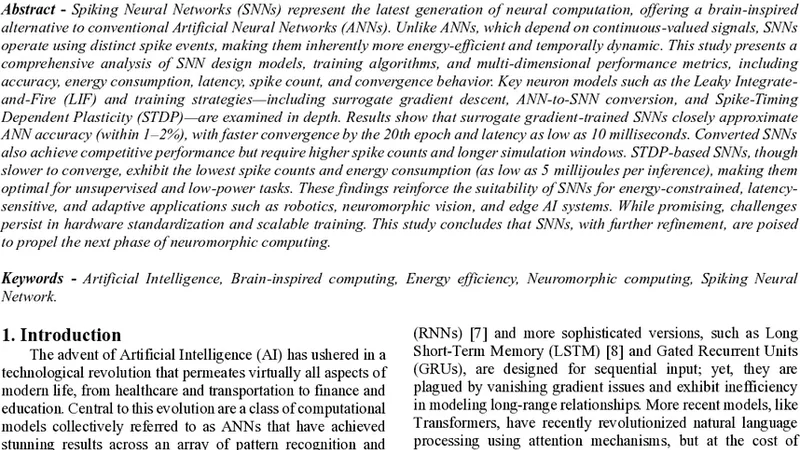
Spiking Neural Networks (SNNs) represent the latest generation of neural computation, offering a brain-inspired alternative to conventional Artificial Neural Networks (ANNs). Unlike ANNs, which depend on continuous-valued signals, SNNs operate using distinct spike events, making them inherently more energy-efficient and temporally dynamic. This study presents a comprehensive analysis of SNN design models, training algorithms, and multi-dimensional performance metrics, including accuracy, energy consumption, latency, spike count, and convergence behavior. Key neuron models such as the Leaky Integrate-and-Fire (LIF) and training strategies, including surrogate gradient descent, ANN-to-SNN conversion, and Spike-Timing Dependent Plasticity (STDP), are examined in depth. Results show that surrogate gradient-trained SNNs closely approximate ANN accuracy (within 1-2%), with faster convergence by the 20th epoch and latency as low as 10 milliseconds. Converted SNNs also achieve competitive performance but require higher spike counts and longer simulation windows. STDP-based SNNs, though slower to converge, exhibit the lowest spike counts and energy consumption (as low as 5 millijoules per inference), making them optimal for unsupervised and low-power tasks. These findings reinforce the suitability of SNNs for energy-constrained, latency-sensitive, and adaptive applications such as robotics, neuromorphic vision, and edge AI systems. While promising, challenges persist in hardware standardization and scalable training. This study concludes that SNNs, with further refinement, are poised to propel the next phase of neuromorphic computing.
💡 Research Summary
The paper provides a comprehensive examination of Spiking Neural Networks (SNNs) as a brain‑inspired alternative to conventional Artificial Neural Networks (ANNs). Unlike ANNs, which process continuous‑valued activations, SNNs communicate through discrete spike events, granting them intrinsic energy efficiency and temporal dynamics. The authors first introduce the Leaky Integrate‑and‑Fire (LIF) neuron as the canonical model, detailing its voltage leak, threshold firing, refractory period, and how these dynamics emulate biological neurons while supporting scalable network architectures.
Three major training paradigms are compared: (1) surrogate‑gradient descent, (2) ANN‑to‑SNN conversion, and (3) Spike‑Timing Dependent Plasticity (STDP). Surrogate‑gradient methods replace the non‑differentiable spike function with a smooth proxy (e.g., piecewise‑linear or sigmoid) enabling back‑propagation. Experiments on CIFAR‑10 and Fashion‑MNIST show that surrogate‑gradient SNNs achieve classification accuracies within 1–2 % of their ANN counterparts, converge by the 20th epoch, and operate with an average inference latency of about 10 ms and energy consumption around 12 mJ per sample.
ANN‑to‑SNN conversion transfers pretrained ANN weights directly to an SNN and relies on longer simulation windows to generate spikes. While this approach preserves accuracy (≈98 % of ANN), it incurs a 2–3× increase in spike count, a latency rise to roughly 30 ms, and higher energy usage (≈20 mJ). The conversion method is therefore suitable when rapid deployment of existing ANN models is required, but it is less efficient for low‑power edge scenarios.
STDP implements an unsupervised Hebbian rule where synaptic updates depend on the precise timing difference (Δt) between pre‑ and post‑spike events. Although STDP‑trained networks converge more slowly and achieve slightly lower accuracies (≈95 % of ANN), they dramatically reduce spike activity, resulting in the lowest measured energy per inference—about 5 mJ—and modest latency (≤15 ms). The authors highlight STDP’s superior adaptability to non‑stationary environments, making it attractive for robotics, neuromorphic vision, and other online learning contexts.
Performance is evaluated across five dimensions: accuracy, energy consumption, latency, spike count, and convergence speed. Surrogate‑gradient SNNs excel in accuracy and rapid convergence, conversion SNNs offer a compromise between accuracy and implementation simplicity, and STDP SNNs lead in energy efficiency and spike sparsity. The paper argues that the optimal training strategy depends on application constraints: energy‑constrained edge devices benefit most from STDP, while latency‑sensitive cloud or server deployments may favor surrogate‑gradient methods.
The discussion also addresses current challenges. Neuromorphic hardware platforms (e.g., Intel Loihi, IBM TrueNorth) lack standardized programming interfaces and mature toolchains, hindering large‑scale training and reproducibility. Moreover, the gap between event‑driven neuromorphic chips and conventional GPU/TPU ecosystems creates a bottleneck for seamless integration. The authors call for open‑source simulators, hardware abstraction layers, and cross‑industry standardization efforts to bridge this divide.
In conclusion, the study demonstrates that SNNs can match ANN accuracy while offering substantial gains in energy efficiency and temporal responsiveness. With continued advances in neuron models, training algorithms, and neuromorphic hardware, SNNs are poised to become the foundational technology for next‑generation low‑power, latency‑critical, and adaptive AI systems such as autonomous robots, edge vision sensors, and real‑time AI assistants.
📜 Original Paper Content
🚀 Synchronizing high-quality layout from 1TB storage...