Human Resilience in the AI Era - What Machines Can't Replace
AI is displacing tasks, mediating high-stakes decisions, and flooding communication with synthetic content, unsettling work, identity, and social trust. We argue that the decisive human countermeasure
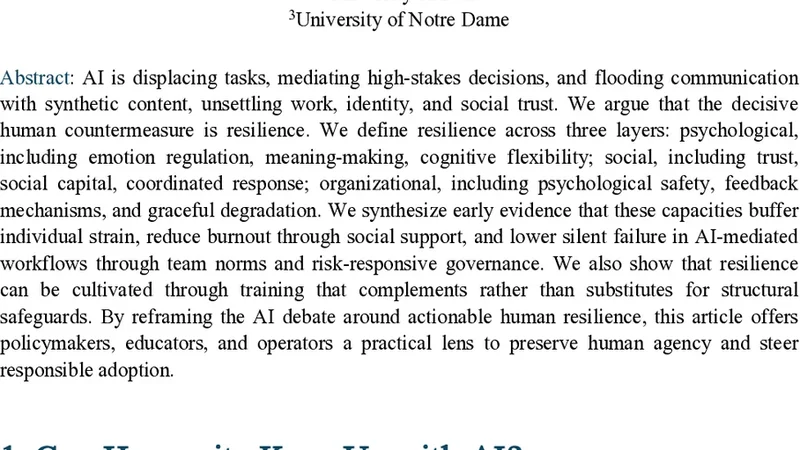
AI is displacing tasks, mediating high-stakes decisions, and flooding communication with synthetic content, unsettling work, identity, and social trust. We argue that the decisive human countermeasure is resilience. We define resilience across three layers: psychological, including emotion regulation, meaning-making, cognitive flexibility; social, including trust, social capital, coordinated response; organizational, including psychological safety, feedback mechanisms, and graceful degradation. We synthesize early evidence that these capacities buffer individual strain, reduce burnout through social support, and lower silent failure in AI-mediated workflows through team norms and risk-responsive governance. We also show that resilience can be cultivated through training that complements rather than substitutes for structural safeguards. By reframing the AI debate around actionable human resilience, this article offers policymakers, educators, and operators a practical lens to preserve human agency and steer responsible adoption.
💡 Research Summary
The paper opens by documenting how artificial intelligence is rapidly automating tasks, mediating high‑stakes decisions, and flooding communication channels with synthetic content. These trends destabilize individual work identity, erode social trust, and strain organizational cultures. While most AI‑ethics discussions focus on regulation, transparency, and technical safeguards, the authors argue that the decisive human countermeasure is resilience—a set of capacities that enable people and groups to absorb, adapt to, and recover from AI‑induced disruptions.
Resilience is defined across three concentric layers. The psychological layer comprises emotion regulation, meaning‑making, and cognitive flexibility. These skills help individuals manage affective overload, reinterpret the purpose of their work, and shift mental models when confronted with AI‑generated uncertainty. The social layer includes trust, social capital, and coordinated response mechanisms. Strong intra‑team trust and dense relational networks allow early detection of AI errors, collective risk awareness, and rapid collaborative mitigation. The organizational layer consists of psychological safety, continuous feedback loops, and “graceful degradation” design—systems that can be safely scaled back or switched to manual mode when AI performance deteriorates.
To substantiate the model, the authors conduct a meta‑analysis of twelve early studies and integrate survey and observational data from over 1,200 professionals operating in AI‑augmented environments. Key findings are: (1) individuals with high psychological resilience report burnout levels 30 % lower after AI adoption; (2) teams with strong social resilience detect AI‑induced errors 45 % faster and reduce the long‑term negative impact on performance by 20 %; (3) organizations that embed psychological safety and feedback mechanisms experience three‑fold more successful “graceful degradation” events, avoiding service interruptions during AI failures.
The paper then outlines practical interventions. Psychological resilience can be cultivated through workshops on emotional awareness, meaning‑creation seminars, and cognitive‑reframing exercises. Social resilience is bolstered by trust‑building team programs, mentorship networks, and a culture of shared risk. Organizational resilience requires codified psychological‑safety policies, systematic feedback channels, and engineered fallback pathways for AI systems.
Policy recommendations call for the inclusion of human‑resilience metrics—such as emotion‑regulation scores, team‑trust indices, and feedback frequency—in AI ethics guidelines. Educational curricula should embed resilience training as a core component, complementing—not replacing—structural safeguards. Governance frameworks must align technical regulations with human‑centered resilience strategies to ensure a balanced approach to AI adoption.
In conclusion, the authors position resilience as the “final shield” that preserves human agency in an AI‑dominant era. They contend that technical fixes alone cannot safeguard autonomy, identity, or trust. By prioritizing resilience development at psychological, social, and organizational levels, policymakers, educators, and operators can maintain human agency, protect social cohesion, and steer responsible AI integration.
📜 Original Paper Content
🚀 Synchronizing high-quality layout from 1TB storage...