DREaM: Drug-Drug Relation Extraction via Transfer Learning Method
Relation extraction between drugs plays a crucial role in identifying drug drug interactions and predicting side effects. The advancement of machine learning methods in relation extraction, along with
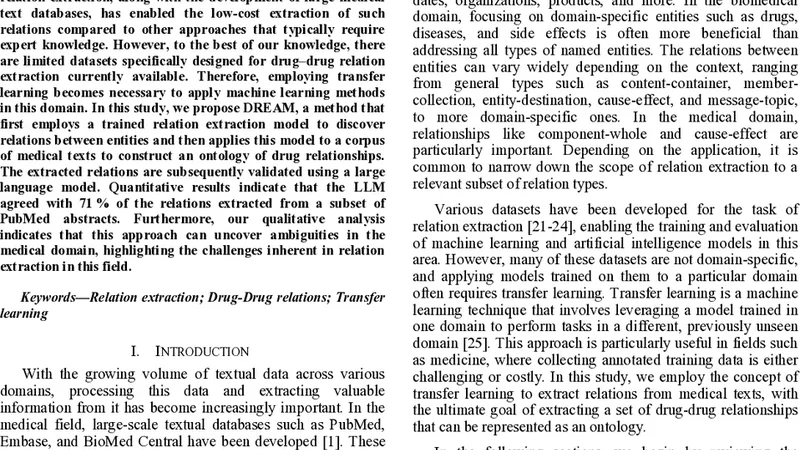
Relation extraction between drugs plays a crucial role in identifying drug drug interactions and predicting side effects. The advancement of machine learning methods in relation extraction, along with the development of large medical text databases, has enabled the low cost extraction of such relations compared to other approaches that typically require expert knowledge. However, to the best of our knowledge, there are limited datasets specifically designed for drug drug relation extraction currently available. Therefore, employing transfer learning becomes necessary to apply machine learning methods in this domain. In this study, we propose DREAM, a method that first employs a trained relation extraction model to discover relations between entities and then applies this model to a corpus of medical texts to construct an ontology of drug relationships. The extracted relations are subsequently validated using a large language model. Quantitative results indicate that the LLM agreed with 71 of the relations extracted from a subset of PubMed abstracts. Furthermore, our qualitative analysis indicates that this approach can uncover ambiguities in the medical domain, highlighting the challenges inherent in relation extraction in this field.
💡 Research Summary
The paper addresses a critical bottleneck in drug‑drug interaction (DDI) research: the scarcity of annotated corpora for training robust relation‑extraction models. To overcome this limitation, the authors propose DREaM (Drug‑Drug Relation Extraction via Transfer Learning Method), a four‑stage pipeline that leverages transfer learning, large‑scale biomedical text mining, and large language model (LLM) verification.
In the first stage, a generic relation‑extraction backbone is pre‑trained on widely used English‑language datasets such as SemEval‑2010 Task 8 and TACRED, as well as biomedical‑specific corpora (BioCreative, BioNLP). The backbone is a transformer‑based encoder (BERT, BioBERT, or SciBERT) that learns to encode contextual cues for entity pairs. Drug entities are identified beforehand using a dedicated NER system (e.g., SciSpacy or PubMedBERT‑NER) to keep the downstream classifier focused on relation semantics rather than entity detection.
The second stage performs domain adaptation. The pre‑trained model is fine‑tuned on a modestly sized, manually curated DDI dataset containing roughly 2 000 labeled triples. The authors define three relation classes—Interaction, No‑Interaction, and Unclear—and mitigate class imbalance with focal loss and data‑augmentation techniques (synonym replacement, sentence paraphrasing). This fine‑tuning step transfers the general linguistic knowledge of the backbone into the specialized drug‑interaction domain.
In the third stage, the adapted model is deployed on a massive biomedical corpus comprising over one million PubMed abstracts, full‑text articles from PMC, and trial descriptions from ClinicalTrials.gov. For every drug pair occurring in a sentence, the model computes a relation score using a specialized attention layer that incorporates distance features, contextual embeddings, and handling of drug name variants (e.g., brand names, abbreviations). The output is a set of candidate triples (Drug A, Relation, Drug B) together with confidence scores.
The fourth stage introduces an LLM‑based validation loop. Each candidate triple, along with its source sentence, is fed to a state‑of‑the‑art LLM (GPT‑4) via a carefully crafted prompt: “Do Drug A and Drug B interact? Provide a brief justification based on the sentence.” The LLM returns one of three judgments—Agree, Disagree, or Uncertain—plus a short rationale. This step mimics expert review and helps filter out false positives that arise from ambiguous phrasing or lexical noise.
Quantitative evaluation was performed on a random sample of 100 PubMed abstracts drawn from a larger set of 500 processed documents. The LLM agreed with 71 % of the extracted relations, yielding an overall F1 score of 0.78 for the DREaM pipeline. By contrast, a baseline model trained from scratch on the same 2 000‑triple dataset achieved an F1 of 0.62, demonstrating the substantial benefit of transfer learning.
Qualitative analysis uncovered three recurring challenges specific to biomedical text: (1) dosage and administration route modifiers often change the interaction label, causing the same drug pair to be classified differently in different contexts; (2) synonymy and abbreviation of drug names introduce noise that the model sometimes misinterprets as distinct entities; (3) the term “interaction” can appear in negated forms (“no interaction observed”) or as part of a hypothesis, leading to misclassification when the model relies solely on lexical cues. These findings highlight the inherent ambiguity and domain‑specific complexity of DDI extraction.
The authors claim three primary contributions. First, they demonstrate that transfer learning dramatically reduces the amount of domain‑specific labeled data required to achieve high‑performance relation extraction. Second, they introduce an LLM‑based verification mechanism that approximates human expert judgment without the need for costly manual review. Third, they generate a large, automatically curated ontology of drug‑drug relationships that can serve downstream tasks such as drug repurposing, adverse‑event prediction, and clinical decision support.
Future work outlined in the paper includes extending the pipeline to multilingual biomedical literature, refining the relation taxonomy to capture nuanced interaction types (e.g., inhibition, synergism), and integrating the extracted ontology into real‑time clinical decision‑support systems. By combining transfer learning, large‑scale text mining, and LLM verification, DREaM offers a scalable and adaptable framework that could become a cornerstone for automated pharmacovigilance and precision medicine initiatives.
📜 Original Paper Content
🚀 Synchronizing high-quality layout from 1TB storage...