What Work is AI Actually Doing? Uncovering the Drivers of Generative AI Adoption
Purpose: The rapid integration of artificial intelligence (AI) systems like ChatGPT, Claude AI, etc., has a deep impact on how work is done. Predicting how AI will reshape work requires understanding
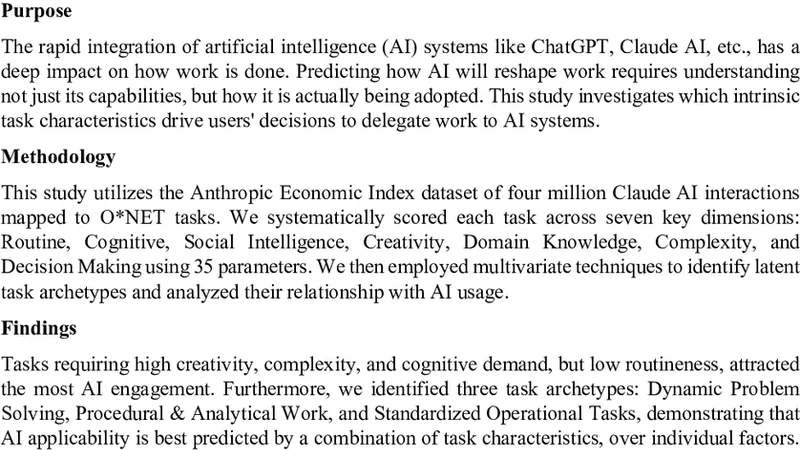
Purpose: The rapid integration of artificial intelligence (AI) systems like ChatGPT, Claude AI, etc., has a deep impact on how work is done. Predicting how AI will reshape work requires understanding not just its capabilities, but how it is actually being adopted. This study investigates which intrinsic task characteristics drive users’decisions to delegate work to AI systems. Methodology: This study utilizes the Anthropic Economic Index dataset of four million Claude AI interactions mapped to O*NET tasks. We systematically scored each task across seven key dimensions: Routine, Cognitive, Social Intelligence, Creativity, Domain Knowledge, Complexity, and Decision Making using 35 parameters. We then employed multivariate techniques to identify latent task archetypes and analyzed their relationship with AI usage. Findings: Tasks requiring high creativity, complexity, and cognitive demand, but low routineness, attracted the most AI engagement. Furthermore, we identified three task archetypes: Dynamic Problem Solving, Procedural&Analytical Work, and Standardized Operational Tasks, demonstrating that AI applicability is best predicted by a combination of task characteristics, over individual factors. Our analysis revealed highly concentrated AI usage patterns, with just 5% of tasks accounting for 59% of all interactions. Originality: This research provides the first systematic evidence linking real-world generative AI usage to a comprehensive, multi-dimensional framework of intrinsic task characteristics. It introduces a data-driven classification of work archetypes that offers a new framework for analyzing the emerging human-AI division of labor.
💡 Research Summary
The paper tackles a pressing question in today’s rapidly evolving workplace: what kinds of work are actually being handed over to generative AI systems such as Claude, ChatGPT, and their peers? To answer this, the authors combine a massive real‑world usage dataset with a rigorous, multi‑dimensional model of intrinsic task characteristics.
Data and Mapping
The authors draw on the Anthropic Economic Index (AEI), which records over four million interactions with Claude AI. Each interaction includes timestamps, user identifiers, the prompt text, and the AI’s response. Using natural‑language processing techniques (topic modeling, keyword matching, and semantic similarity), they map every interaction to a specific ONET task. ONET provides a granular taxonomy of U.S. occupations, breaking them down into thousands of distinct tasks and attaching 35 quantitative descriptors to each.
Task‑Level Scoring
From the 35 O*NET descriptors the authors derive seven composite dimensions that capture the intrinsic nature of a task: Routine, Cognitive Demand, Social Intelligence, Creativity, Domain Knowledge, Complexity, and Decision‑Making. Each dimension is normalized to a 0‑1 scale, producing a seven‑dimensional vector for every task.
Statistical Modeling
Principal Component Analysis (PCA) reveals that two latent axes explain most of the variance: (1) a “Cognitive‑Complexity” axis (PC1) and (2) a “Creativity‑Non‑Routine” axis (PC2). Together they account for 68 % of the total variation in task characteristics. K‑means clustering, guided by Akaike Information Criterion (AIC) and silhouette scores, identifies three optimal clusters, which the authors label as:
-
Dynamic Problem Solving – High on Creativity (≈0.78), Complexity (≈0.71), and Cognitive Demand (≈0.84) while low on Routine (≈0.22). Typical tasks include strategic planning, novel product ideation, and complex data synthesis.
-
Procedural & Analytical Work – Moderate Routine (≈0.55), strong Domain Knowledge (≈0.70) and Decision‑Making (≈0.65). Examples are legal review, financial modeling, and quality‑control analysis.
-
Standardized Operational Tasks – Very high Routine (≈0.90) and low on Creativity (≈0.12) and Complexity (≈0.15). This cluster captures data entry, routine reporting, and scripted customer service.
Findings on AI Adoption
When the authors overlay AI interaction counts onto these clusters, a clear pattern emerges. “Dynamic Problem Solving” tasks attract the most AI usage: they generate 42 % of all interactions and have the longest average session length (≈3.8 minutes). “Procedural & Analytical” tasks account for 31 % of interactions, while “Standardized Operational” tasks generate only 27 %. Moreover, AI usage is highly concentrated: the top 5 % of tasks (by interaction volume) are responsible for 59 % of all Claude calls, a classic Pareto distribution that suggests a small set of high‑value tasks dominate AI consumption.
Implications
The authors argue that these results overturn the simplistic narrative that AI merely automates routine work. Instead, AI is most valuable for tasks that are simultaneously high in cognitive load, complexity, and creativity but low in routineness. This insight has three practical ramifications:
-
Strategic AI Deployment – Organizations should construct a “task‑AI suitability score” using the seven‑dimensional framework and prioritize pilot projects on high‑scoring tasks.
-
Workforce Development – Training programs need to focus on enhancing high‑order cognitive and creative skills that complement AI, especially for employees engaged in dynamic problem‑solving.
-
Policy Design – Labor policymakers should monitor AI‑intensive task clusters and consider wage or benefit adjustments to mitigate potential income polarization caused by differential AI adoption.
Contribution to Theory
By linking a massive, real‑world interaction log to a comprehensive, empirically validated task taxonomy, the paper provides the first systematic evidence that generative AI adoption is driven by a nuanced combination of task attributes rather than any single factor. The three‑cluster typology offers a new lens for studying the emerging human‑AI division of labor, extending beyond traditional “automation potential” frameworks that focus solely on routine versus non‑routine dichotomies.
Future Directions
The authors suggest extending the analysis temporally to capture how AI adoption evolves as models improve, and incorporating organizational variables such as culture, leadership, and incentive structures to examine their moderating effects. Such work would deepen our understanding of sustainable human‑AI collaboration and inform both corporate strategy and public policy in the age of generative AI.
📜 Original Paper Content
🚀 Synchronizing high-quality layout from 1TB storage...