The Noncomputability of Immune Reaction Complexity: Algorithmic Information Gaps under Effective Constraints
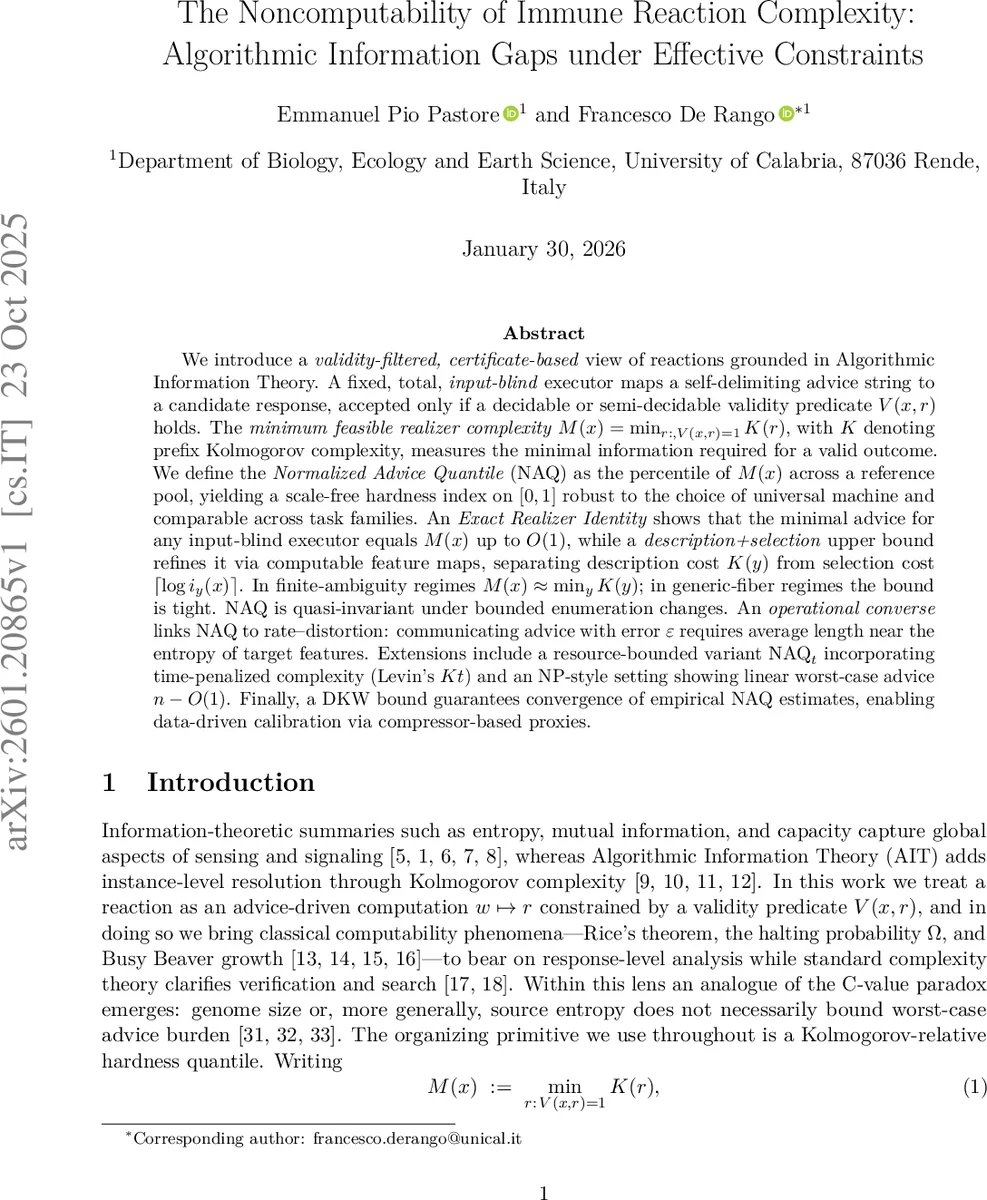
We introduce a validity-filtered, certificate-based view of reactions grounded in Algorithmic Information Theory. A fixed, total, input-blind executor maps a self-delimiting advice string to a candidate response, accepted only if a decidable or semi-decidable validity predicate V(x, r) holds. The minimum feasible realizer complexity M(x) = min_{r: V(x,r)=1} K(r), with K denoting prefix Kolmogorov complexity, measures the minimal information required for a valid outcome. We define the Normalized Advice Quantile (NAQ) as the percentile of M(x) across a reference pool, yielding a scale-free hardness index on [0, 1] robust to the choice of universal machine and comparable across task families. An Exact Realizer Identity shows that the minimal advice for any input-blind executor equals M(x) up to O(1), while a description plus selection upper bound refines it via computable feature maps, separating description cost K(y) from selection cost log i_y(x). In finite-ambiguity regimes M(x) approximately equals min_y K(y); in generic-fiber regimes the bound is tight. NAQ is quasi-invariant under bounded enumeration changes. An operational converse links NAQ to rate-distortion: communicating advice with error epsilon requires average length near the entropy of target features. Extensions include a resource-bounded variant NAQ_t incorporating time-penalized complexity (Levin’s Kt) and an NP-style setting showing linear worst-case advice n - O(1). Finally, a DKW bound guarantees convergence of empirical NAQ estimates, enabling data-driven calibration via compressor-based proxies.
💡 Research Summary
The paper presents a novel theoretical framework that treats immune reactions as advice‑driven computations and analyzes their intrinsic complexity using tools from Algorithmic Information Theory (AIT). The authors fix a total, input‑blind executor E that never reads the input x but maps a self‑delimiting advice string w to a response r = E(w). A validity predicate V(x, r) ∈ {0,1} decides whether a candidate response is acceptable; V may be computably enumerable (c.e.) or decidable. The central quantity is the minimal feasible realizer complexity
M(x) = min { K(r) | V(x, r)=1 },
where K denotes prefix Kolmogorov complexity with respect to a universal prefix machine. M(x) measures the smallest amount of algorithmic information that must be supplied to produce a valid immune response for a given instance x.
To obtain a scale‑free hardness measure, the authors introduce the Normalized Advice Quantile (NAQ). For a reference multiset T ⊆ D_V (the domain of inputs admitting at least one valid response), NAQ(x; T) is defined as the percentile rank of M(x) within the multiset {M(x′) | x′∈T}. Formally, they use a mid‑rank convention that yields a value in
Comments & Academic Discussion
Loading comments...
Leave a Comment