The 1979 Iranian Revolution and the Lost Decade of Science: A Counterfactual Scientometric Analysis
💡 Research Summary
The paper provides a quantitative, counterfactual assessment of how the 1979 Iranian Revolution reshaped Iran’s scientific output from 1960 to 2024. Using Scopus data (articles and reviews) complemented by Crossref records for the early decades, the author constructs annual publication counts for Iran and a carefully selected peer group of eight countries: South Korea, Taiwan, Singapore (the “Asian Tigers”), Israel and the Netherlands (regional and global leaders), Greece, Turkey, and China (alternative recovery models).
Three analytical steps are undertaken. First, the pre‑revolution period (1960‑1979) shows Iran as a scientific leader among its Asian peers, reaching 518 papers in 1978—more than South Korea and comparable to Taiwan and Turkey. Second, the “lost decade” (1980‑1999) captures a sharp collapse: university closures, a 50 % loss of faculty, and the Iran‑Iraq war drive output down to a low of 122 papers in 1984, with the 1978 peak not regained until 1995. In contrast, the Asian Tigers and China experience exponential growth, reaching tens of thousands of papers by the end of the century. Third, the recovery phase (2000‑2024) sees Iran’s volume surge to roughly 80,000 papers in 2022, driven by massive expansion of higher‑education and research infrastructure. However, quality metrics—Field‑Weighted Citation Impact (FWCI) and the share of papers in the global top‑10 % citation percentile—remain substantially below those of South Korea, Taiwan, Singapore, the Netherlands, and Israel. Iran’s FWCI approaches the world average (≈1.0) only by 2020, while peers stay above 1.2–1.5; its top‑10 % share climbs to about 12 % versus >25 % for the leading nations.
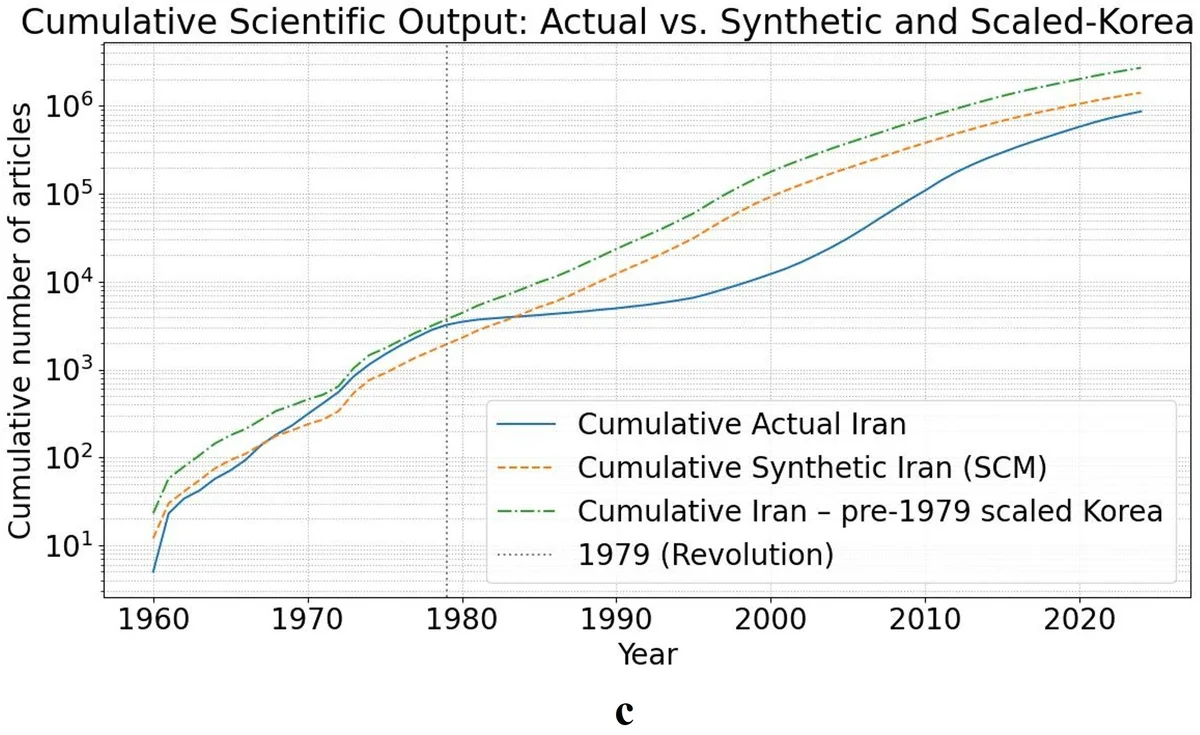
The core methodological tool is the Synthetic Control Method (SCM). By matching pre‑1979 Iran to a synthetic counterpart built from South Korea’s economic, educational, and research‑investment variables, the study projects a counterfactual trajectory for Iran absent the revolution. The cumulative gap between actual and synthetic outputs yields an estimated “knowledge deficit” of roughly 551,000 publications by 2024. This figure quantifies the opportunity cost of the political shock in concrete scholarly terms.
Limitations are acknowledged: early‑year Scopus coverage is incomplete, though the same bias applies across all countries; and the South‑Korea growth‑proxy scenario assumes an ideal policy environment that may not be realistic for Iran.
Overall, the analysis demonstrates that the 1979 revolution, the subsequent cultural purge of universities, and the protracted Iran‑Iraq war produced a profound, lasting disruption to Iran’s scientific system. While the country has succeeded in rebuilding output volume, it lags in global impact, indicating a decoupling of quantity and quality. The paper argues for policy measures such as strengthening international collaborations, adopting research‑performance‑based funding, and instituting reforms to retain talent, thereby narrowing the persistent quality gap and mitigating the long‑term effects of the historical disruption.
Comments & Academic Discussion
Loading comments...
Leave a Comment