Active tuning of ENZ resonances in meta-antenna through phase modulation of optical pulse
Plasmonic nanoantennas offer new avenues to manipulate the propagation of light in materials due to their near field enhancement and ultrafast response time. Here we investigate the epsilon-near-zero (ENZ) response in an L-shaped nanoantenna structure under the phenomenon of plasmonic analog of enhancement in the index of refraction. Using a quantum mechanical approach, we analyze the modulation in the response of probe field and emergence of ENZ frequency region both in the linear and nonlinear plasmonic system. We also demonstrate the active tuning of ENZ frequency region in a nanoantenna structure by modulating the phase of control pulse. The analytical and 3D FDTD simulation results show a significant spectral shift in the ENZ modes. Our proposed method offers the possibility to design and control optical tunable ENZ response in plasmonic metasurfaces without the use of ENZ material. Such metasurfaces can be used in on-chip photonic integrated circuits, further localization of incident fields, slow light operations and various quantum technologies.
💡 Research Summary
**
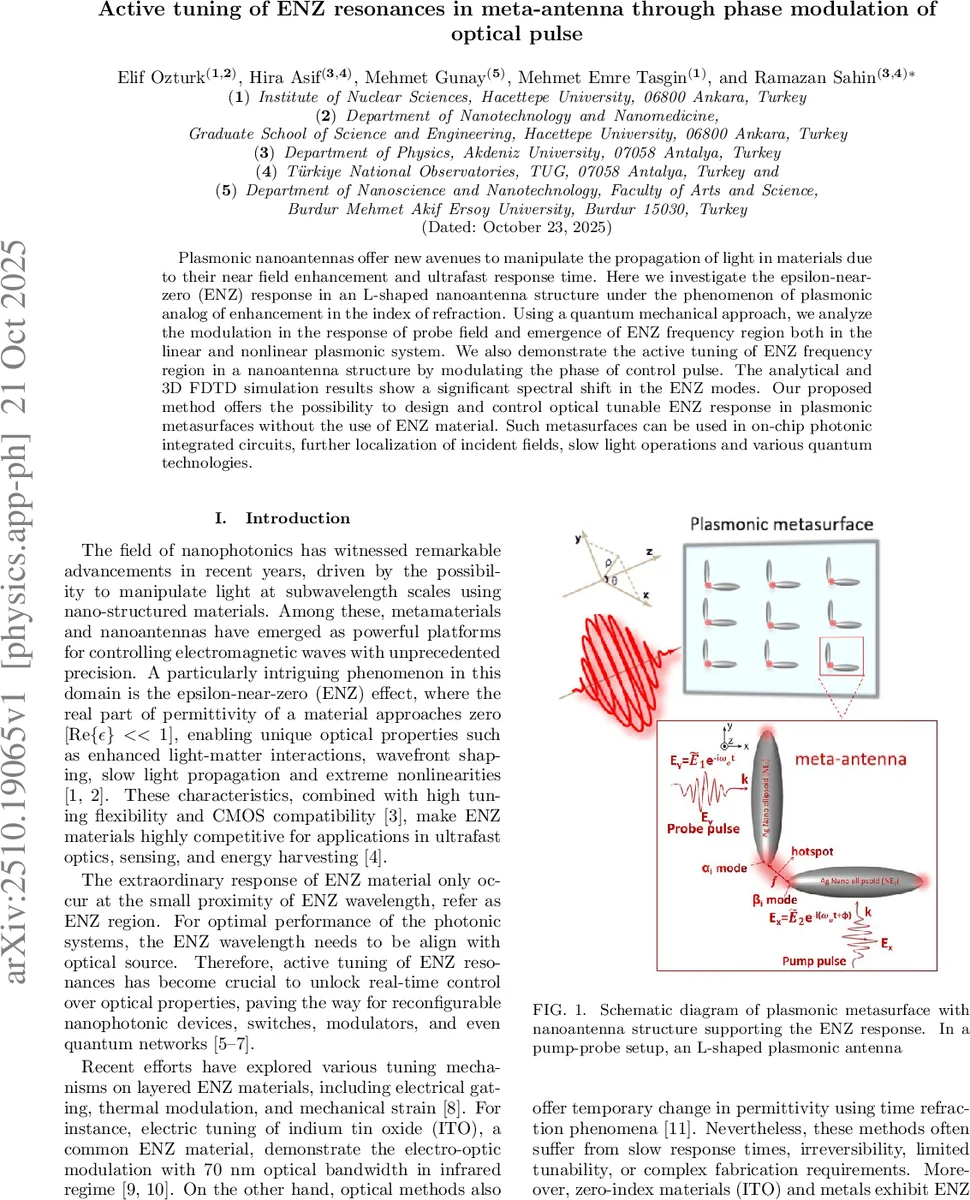
This paper introduces a novel method for actively tuning epsilon‑near‑zero (ENZ) resonances in a plasmonic metasurface without employing any conventional ENZ material. The authors design a periodic array of L‑shaped silver nano‑ellipsoids (NEs) that function as a meta‑antenna. In a pump‑probe configuration, a circularly polarized control pulse (pump) polarized along the x‑axis excites a plasmon mode (β₁) in the horizontal ellipsoid (NE 2), while a weaker probe pulse polarized along the y‑axis excites a linear plasmon mode (α₁) in the vertical ellipsoid (NE 1). Both pulses share the same central frequency ω₀ = 3.19 × 10¹⁵ rad s⁻¹, but their relative optical phase ϕ can be varied arbitrarily.
A quantum‑mechanical Hamiltonian is employed to describe the interaction between the two plasmonic modes. The resulting complex susceptibility χ(ω) depends explicitly on the phase difference ϕ through a term proportional to f e^{−iϕ}Ē₂/Ē₁, where f is the coupling strength (set to 0.06 ω₀) and Ē₂, Ē₁ are the complex field amplitudes of pump and probe. The detuning parameters δ_a and δ_b incorporate the resonant frequencies (ω_a = ω_b = ω₀) and decay rates (γ_a = γ_b = 0.05 ω₀). This analytical formulation predicts that the real part of χ can be driven to zero while the imaginary part becomes negative, defining an ENZ condition.
Two regimes are examined. In the linear case, the analytical and 3‑D finite‑difference time‑domain (FDTD) simulations reveal an ENZ point at ω ≈ 0.927 ω₀. In the nonlinear case, a second‑order plasmonic response is introduced with a nonlinear susceptibility χ^{(2)} = 10⁻¹⁰ ω₀ and a pump amplitude ten times larger than the probe (E₂ = 10 E₁). Here the ENZ frequency shifts to ω ≈ 1.98 ω₀. By varying the pump phase from ϕ = π/6 to ϕ = π/2, the authors observe a systematic blue‑shift of the resonance peaks: the linear α₁ mode moves from 1.15 ω₀ to 1.00 ω₀ (≈1.6 % modulation depth) and the nonlinear α₂ mode from 1.99 ω₀ to 1.96 ω₀ (≈1.5 %). These shifts are attributed to phase‑dependent redistribution of charge at the hot‑spot formed at the intersection of the two ellipsoids, which modifies the effective coupling strength f.
FDTD results for the electric polarization P(ω) and susceptibility χ(ω) confirm that both the real and imaginary parts of χ follow the same trend: the zero‑crossing of Re
Comments & Academic Discussion
Loading comments...
Leave a Comment