Rewiring Human Brain Networks via Lightweight Dynamic Connectivity Framework: An EEG-Based Stress Validation
In recent years, Electroencephalographic analysis has gained prominence in stress research when combined with AI and Machine Learning models for validation. In this study, a lightweight dynamic brain connectivity framework based on Time Varying Directed Transfer Function is proposed, where TV DTF features were validated through ML based stress classification. TV DTF estimates the directional information flow between brain regions across distinct EEG frequency bands, thereby capturing temporal and causal influences that are often overlooked by static functional connectivity measures. EEG recordings from the 32 channel SAM 40 dataset were employed, focusing on mental arithmetic task trials. The dynamic EEG-based TV-DTF features were validated through ML classifiers such as Support Vector Machine, Random Forest, Gradient Boosting, Adaptive Boosting, and Extreme Gradient Boosting. Experimental results show that alpha-TV-DTF provided the strongest discriminative power, with SVM achieving 89.73% accuracy in 3-class classification and with XGBoost achieving 93.69% accuracy in 2 class classification. Relative to absolute power and phase locking based functional connectivity features, alpha TV DTF and beta TV DTF achieved higher performance across the ML models, highlighting the advantages of dynamic over static measures. Feature importance analysis further highlighted dominant long-range frontal parietal and frontal occipital informational influences, emphasizing the regulatory role of frontal regions under stress. These findings validate the lightweight TV-DTF as a robust framework, revealing spatiotemporal brain dynamics and directional influences across different stress levels.
💡 Research Summary
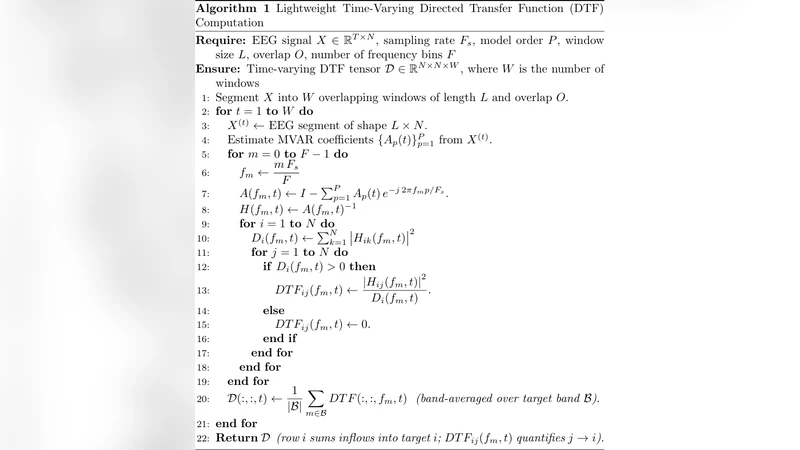
In recent years, electroencephalography (EEG) has become a popular tool for stress research, especially when combined with artificial intelligence and machine learning (ML) techniques for objective validation. The present study addresses a key limitation of conventional functional connectivity analyses: most static measures capture only average synchrony and ignore the temporal evolution and causal direction of information flow between brain regions. To overcome this, the authors propose a lightweight dynamic connectivity framework based on the Time‑Varying Directed Transfer Function (TV‑DTF). TV‑DTF extends the classic Directed Transfer Function by estimating multivariate autoregressive (MVAR) coefficients within short, overlapping sliding windows, thereby providing a frequency‑specific, time‑resolved picture of directed interactions. The framework is deliberately designed to be computationally efficient—model order and window length are optimized, and only the top 20 % of absolute TV‑DTF values are retained as features—making it suitable for real‑time applications.
The empirical evaluation uses the SAM‑40 dataset, which contains 32‑channel EEG recordings from participants performing a mental arithmetic task under three stress conditions: baseline (rest), moderate stress, and high stress. Standard preprocessing steps (0.5–45 Hz band‑pass filtering, ICA artifact removal, channel‑wise z‑scoring) are applied. TV‑DTF is computed for the canonical EEG bands (delta, theta, alpha, beta, gamma). Feature dimensionality is reduced with a Minimum‑Correlation Maximum‑Variance (Min‑Corr Max‑Var) strategy, yielding ≤30 features per band. These dynamic features are fed into five classifiers: linear and RBF‑kernel Support Vector Machines (SVM), Random Forest (RF), Gradient Boosting (GB), Adaptive Boosting (AdaBoost), and Extreme Gradient Boosting (XGBoost). A 10‑fold cross‑validation scheme assesses performance.
Results show that alpha‑band TV‑DTF provides the strongest discriminative power. In the three‑class problem (baseline vs. moderate vs. high stress), the SVM achieves 89.73 % accuracy; in the binary problem (baseline vs. high stress), XGBoost reaches 93.69 % accuracy. By contrast, static features derived from absolute power and Phase‑Locking Value (PLV) yield maximum accuracies of 81.4 % and 84.2 % respectively, confirming the superiority of the dynamic TV‑DTF approach. Feature‑importance analysis reveals that long‑range directed influences originating from frontal regions toward parietal and occipital cortices dominate the classification, aligning with the well‑established role of the prefrontal cortex in stress regulation and executive control.
The study contributes three main advances: (1) it introduces a computationally lightweight, time‑resolved directed connectivity metric that outperforms traditional static measures in stress classification; (2) it demonstrates that alpha and beta TV‑DTF bands are especially informative for distinguishing stress levels; and (3) it provides neurophysiological insight by highlighting frontal‑driven long‑range information flow as a hallmark of stress‑related brain dynamics.
Nevertheless, the work has limitations. The dataset is confined to a single cognitive task (mental arithmetic) and a relatively modest number of participants, which may restrict generalizability. Moreover, TV‑DTF performance is sensitive to the choice of MVAR model order and window parameters; systematic exploration of these hyper‑parameters is needed. Future research should expand the paradigm to include diverse stress‑inducing tasks, larger and more heterogeneous cohorts, and multimodal recordings (e.g., fNIRS, ECG) to test robustness. Integration with deep learning architectures for end‑to‑end temporal modeling, as well as comparative studies with other dynamic connectivity metrics (e.g., dynamic graph theory measures), would further solidify the framework’s applicability.
In summary, this paper validates a lightweight, time‑varying directed connectivity framework that captures spatiotemporal and causal brain dynamics, offering a powerful tool for EEG‑based stress assessment and advancing our understanding of how frontal networks orchestrate adaptive responses under varying stress loads.
Comments & Academic Discussion
Loading comments...
Leave a Comment