Multi-solitons to focusing mass-supercritical stochastic nonlinear Schrödinger equations
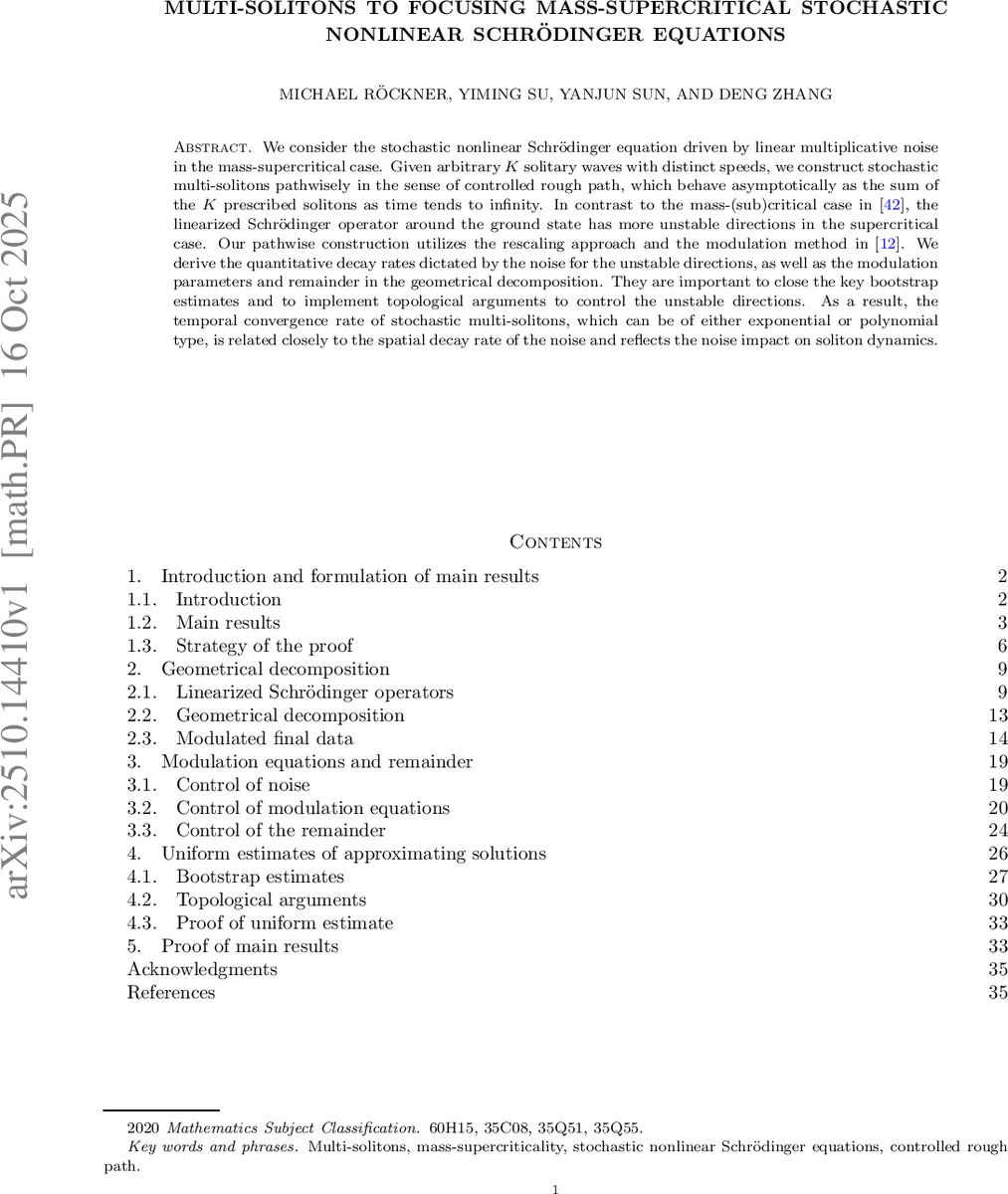
We consider the stochastic nonlinear Schrödinger equation driven by linear multiplicative noise in the mass-supercritical case. Given arbitrary $K$ solitary waves with distinct speeds, we construct stochastic multi-solitons pathwisely in the sense of controlled rough path, which behave asymptotically as the sum of the $K$ prescribed solitons as time tends to infinity. In contrast to the mass-(sub)critical case in \cite{RSZ23}, the linearized Schrödinger operator around the ground state has more unstable directions in the supercritical case. Our pathwise construction utilizes the rescaling approach and the modulation method in \cite{CMM11}. We derive the quantitative decay rates dictated by the noise for the unstable directions, as well as the modulation parameters and remainder in the geometrical decomposition. They are important to close the key bootstrap estimates and to implement topological arguments to control the unstable directions. As a result, the temporal convergence rate of stochastic multi-solitons, which can be of either exponential or polynomial type, is related closely to the spatial decay rate of the noise and reflects the noise impact on soliton dynamics.
💡 Research Summary
This paper establishes the existence and asymptotic behavior of multi-soliton solutions for the focusing mass-supercritical stochastic nonlinear Schrödinger equation (SNLS), driven by linear multiplicative noise. The work addresses a key open problem in stochastic dispersive PDEs: whether coherent multi-soliton structures can persist and be quantitatively described in the presence of noise, particularly in the more unstable supercritical regime.
The authors consider the SNLS with a power nonlinearity in the mass-supercritical range (1+4/d < p < 1+4/(d-2)_+). The noise term is of the form Σ X φ_k g_k dB_k, interpreted in the sense of controlled rough path theory to ensure pathwise analysis. The spatial profiles φ_k of the noise are assumed to decay at infinity, either exponentially (Case I) or polynomially (Case II, with sufficient rate ν∗).
The main result (Theorem 1.2) is a pathwise construction. Given K solitary wave profiles R_k—ground state solutions modulated by distinct velocities v_k, scales w_k, and phase parameters—the authors prove the existence of a random initial time T_0 and an H^1-valued solution X(t) such that, as t → ∞, the solution converges to the sum of these K solitons, up to a random phase factor W*(t) and a small remainder. The quantitative convergence rate is explicitly tied to the spatial decay of the noise: exponential spatial decay yields exponential-in-time convergence, while polynomial spatial decay yields polynomial-in-time convergence. This directly illustrates how noise qualitatively shapes long-term soliton dynamics.
The proof navigates significant challenges absent in the (sub)critical case. A major hurdle is the spectral structure of the linearized operator around a soliton: in the supercritical case, it possesses additional unstable directions (nonzero real eigenvalues) corresponding to modes a±. This allows for a richer set of solutions with the same asymptotic limit and complicates the control of the dynamics. The strategy combines the deterministic rescaling approach of Combet with a modulation method. Key steps include:
- Geometric Decomposition: The solution is decomposed into a sum of modulated solitons, time-dependent modulation parameters (for phase, scale, translation), and a remainder.
- Modulation Equations: ODEs for the modulation parameters are derived from imposing orthogonality conditions that force the remainder onto the stable and center modes of the linearized operator.
- Energy Estimates: Using a transformed equation (RNLS) that incorporates a random phase to simplify the noise term, sharp energy estimates for the remainder are established. The decay of the noise terms B*_k(t) = ∫_t^∞ g_k(s) dB_k(s) plays a crucial role here.
- Bootstrap and Topological Argument: A bootstrap argument is set up to control the remainder and modulation parameters within prescribed decay profiles. The control of the extra unstable directions (a±) is achieved not through orthogonality but via a final topological argument, which selects the correct initial modulation parameters to ensure the desired asymptotic trajectory.
The work demonstrates the “structural stability” of the multi-soliton construction under stochastic perturbations, meaning the procedure is robust against the first and zero-order terms introduced by the noise. It provides a concrete example supporting the soliton resolution conjecture in a stochastic context and deepens the understanding of how noise characteristics (spatial decay) imprint on the temporal decay rates of coherent structures.
Comments & Academic Discussion
Loading comments...
Leave a Comment