Decision Oriented Technique (DOTechnique): Finding Model Validity Through Decision-Maker Context
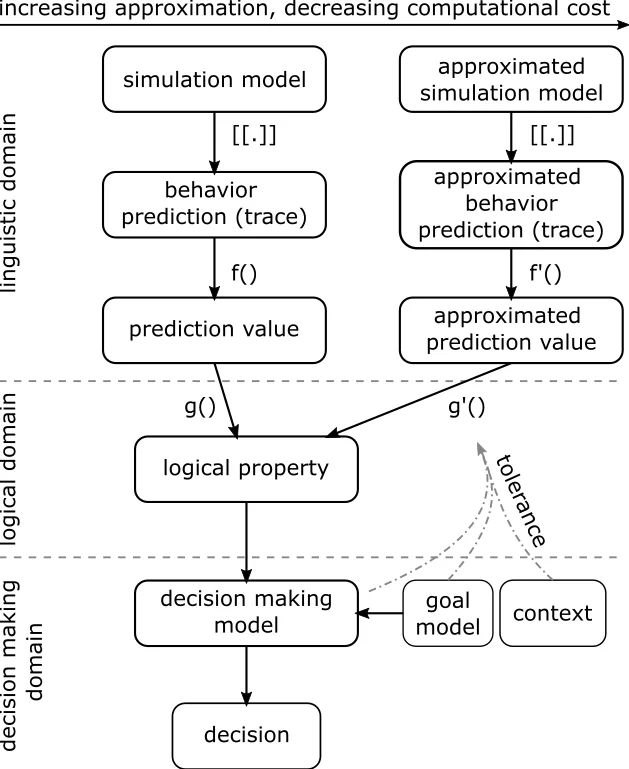
Model validity is as critical as the model itself, especially when guiding decision-making processes. Traditional approaches often rely on predefined validity frames, which may not always be available or sufficient. This paper introduces the Decision Oriented Technique (DOTechnique), a novel method for determining model validity based on decision consistency rather than output similarity. By evaluating whether surrogate models lead to equivalent decisions compared to high-fidelity models, DOTechnique enables efficient identification of validity regions, even in the absence of explicit validity boundaries. The approach integrates domain constraints and symbolic reasoning to narrow the search space, enhancing computational efficiency. A highway lane change system serves as a motivating example, demonstrating how DOTechnique can uncover the validity region of a simulation model. The results highlight the potential of the technique to support finding model validity through decision-maker context.
💡 Research Summary
The paper addresses a fundamental problem in model‑based engineering: determining the region in which a model can be safely applied when explicit validity frames are missing or incomplete. Traditional validation techniques compare model outputs against reference data or predefined constraints, which can be overly restrictive and often unavailable. To overcome this limitation, the authors introduce the Decision Oriented Technique (DOTechnique), a novel framework that defines model validity in terms of decision consistency rather than output similarity.
In DOTechnique, a high‑fidelity model (m_h) and a surrogate model (m_s) are each passed through the same decision‑making function (D). If the decisions produced by both models are sufficiently close—measured by a distance metric (d_Y) for continuous decision spaces or exact equality for categorical spaces—the corresponding input point belongs to the validity region (V_\varepsilon). This definition allows a surrogate model to be considered valid even when its numerical predictions differ from the high‑fidelity model, as long as the downstream decision remains unchanged. The authors formalize the boundary of this region, (B), and propose a simple binary‑search algorithm for one‑dimensional cases. Recognizing that most real problems are multi‑dimensional, they augment the search with domain constraints (C) and symbolic reasoning, thereby restricting the feasible search space (F) to physically plausible states and dramatically reducing computational effort.
The methodology is demonstrated on a highway lane‑change scenario modeled in Simulink. Two models are employed: (1) a detailed high‑fidelity model that simulates the longitudinal and lateral dynamics of the ego vehicle and surrounding traffic, and (2) a constant‑acceleration (C.A.) surrogate that uses the elementary kinematic equation (x(t)=\frac{1}{2} a t^2 + v t + x_0). The decision of interest is whether the ego vehicle initiates a lane change. The authors construct a multi‑stage binary‑search procedure (Algorithm 2) that iteratively refines the bounds on relative position (p), velocity (v), and acceleration (a) of each surrounding vehicle. For each candidate configuration, both models are executed and their lane‑change decisions compared using the distance metric (d_Y). If the decisions agree, the configuration is added to the surrogate’s validity region; otherwise, the search continues to narrow the boundary.
Domain knowledge is encoded as symbolic constraints: deterministic vehicle behavior, minimum speed limits, constant post‑maneuver velocity, minimum front and rear safety gaps, and specific positional rules for vehicles ahead of or behind the ego car. These constraints prune infeasible regions before any simulation is run, ensuring that only physically meaningful states are examined. The resulting validity region for the C.A. model is visualized in Figure 5 and shows that the surrogate is valid only under a subset of the high‑fidelity model’s operating envelope—specifically, when vehicles ahead are sufficiently distant, moving faster, and accelerating positively, or when vehicles behind are close, moving slower, and decelerating.
The paper’s contributions are threefold. First, it reframes model validity around decision consistency, eliminating dependence on pre‑defined validity frames. Second, it integrates symbolic reasoning with binary search to efficiently explore high‑dimensional input spaces. Third, it provides a concrete case study that validates the approach on a cyber‑physical system. Limitations include reliance on a single case study, lack of formal convergence guarantees for the multi‑dimensional boundary search, and the need to extend the method to multi‑objective decision contexts. Future work is suggested in the directions of broader domain validation, automated generation of symbolic constraints, and theoretical analysis of search algorithms. Overall, DOTechnique offers a promising, cost‑effective pathway for practitioners to assess model applicability when traditional validation resources are unavailable.
Comments & Academic Discussion
Loading comments...
Leave a Comment