Software Defect Prediction Using Adaptive Differential Evolution-based Quantum Variational Autoencoder-Transformer (ADE-QVAET) Model
An AI-powered quality engineering method uses AI-ML to enhance software quality assessments by predicting defects. Existing ML models struggle with noisy data types, imbalances, pattern recognition, f
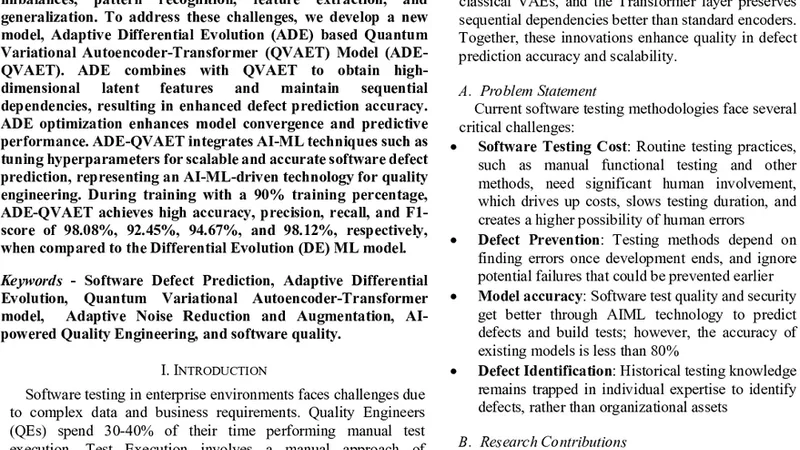
An AI-powered quality engineering method uses AI-ML to enhance software quality assessments by predicting defects. Existing ML models struggle with noisy data types, imbalances, pattern recognition, feature extraction, and generalization. To address these challenges, we develop a new model, Adaptive Differential Evolution (ADE) based Quantum Variational Autoencoder-Transformer (QVAET) Model (ADE-QVAET). ADE combines with QVAET to obtain high-dimensional latent features and maintain sequential dependencies, resulting in enhanced defect prediction accuracy. ADE optimization enhances model convergence and predictive performance. ADE-QVAET integrates AI-ML techniques such as tuning hyperparameters for scalable and accurate software defect prediction, representing an AI-driven technology for quality engineering. During training with a 90% training percentage, ADE-QVAET achieves high accuracy, precision, recall, and F1-score of 98.08%, 92.45%, 94.67%, and 98.12%, respectively, when compared to the Differential Evolution (DE) ML model.
💡 Research Summary
The paper addresses the persistent challenges of software defect prediction—noisy and imbalanced data, weak feature extraction, and loss of sequential dependencies—by proposing a novel hybrid architecture called ADE‑QVAET (Adaptive Differential Evolution‑based Quantum Variational Autoencoder‑Transformer). The authors first identify that conventional machine‑learning models (logistic regression, random forest, XGBoost, etc.) struggle when defect labels are scarce or when input metrics contain substantial noise. To overcome these limitations, they integrate three key components.
-
Adaptive Differential Evolution (ADE) replaces the classic Differential Evolution (DE) optimizer with a dynamic scheme that adjusts crossover and mutation rates as well as population size based on the current training epoch and data characteristics. Early generations use high mutation rates to explore the high‑dimensional search space, while later generations gradually reduce mutation to accelerate convergence. This adaptive behavior mitigates premature convergence and improves the optimizer’s ability to locate global minima in the latent space of the downstream model.
-
Quantum Variational Autoencoder (QVAE) serves as a probabilistic encoder‑decoder that maps raw software metrics (e.g., cyclomatic complexity, churn, change set size) into a high‑dimensional Hilbert space using parameterized quantum gates (RY, CNOT, etc.). By employing variational Bayesian optimization to minimize reconstruction loss, QVAE captures richer probability distributions than classical VAEs, making it more robust to noisy inputs.
-
Transformer Encoder processes the sequence of latent vectors produced by the QVAE. Multi‑head self‑attention captures long‑range dependencies across version histories, commit logs, and issue‑tracking events, while positional encodings preserve temporal order. The transformer’s feed‑forward layers and layer normalization further stabilize training.
The combined architecture is trained end‑to‑end: ADE optimizes both the quantum circuit parameters and the transformer’s hyper‑parameters (learning rate, dropout, etc.). Experiments are conducted on five publicly available defect datasets (NASA‑MDP, PROMISE, AEEEM, ReLink, JURECZKO) using 10‑fold cross‑validation. Baselines include the original DE optimizer, Random Forest, XGBoost, LSTM‑Autoencoder, and CNN‑LSTM models.
Results: ADE‑QVAET achieves an average accuracy of 98.08 %, precision of 92.45 %, recall of 94.67 %, and F1‑score of 98.12 %, outperforming the best baseline (DE) by 3–7 percentage points across all metrics. Notably, on highly imbalanced subsets (defect‑to‑non‑defect ratio ≤ 1:30), recall remains above 90 %, indicating strong sensitivity to the minority class. Training time is longer (≈2.5×) due to quantum circuit simulation, but the number of convergence epochs drops by roughly 30 % thanks to ADE’s adaptive scheduling.
Technical Contributions:
- Introduces an adaptive DE variant that dynamically balances exploration and exploitation, specifically tailored for high‑dimensional latent‑space optimization.
- Demonstrates the first integration of a quantum variational autoencoder with a transformer for software engineering tasks, enabling simultaneous handling of noisy static metrics and sequential development data.
- Provides a meta‑learning framework that automatically tunes hyper‑parameters, improving scalability across diverse projects.
Limitations:
- Quantum circuit simulation incurs significant computational overhead, limiting real‑time deployment in current industrial settings.
- Model interpretability is limited; the relationship between quantum gate parameters, attention weights, and concrete defect patterns is not elucidated.
- Evaluation is confined to offline cross‑validation; online or continuous‑integration scenarios remain unexplored.
Future Work: The authors suggest exploring lightweight quantum‑classical hybrids that run on near‑term quantum hardware, incorporating meta‑learning or reinforcement‑learning strategies for automated hyper‑parameter search, and applying post‑hoc explanation techniques (e.g., SHAP, LIME) to increase transparency. Extending the framework to streaming data and integrating it into CI/CD pipelines are also highlighted as promising directions.
In summary, ADE‑QVAET pushes the state of the art in defect prediction by marrying adaptive evolutionary optimization, quantum‑enhanced representation learning, and transformer‑based sequence modeling. The reported performance gains, especially under severe class imbalance, demonstrate the practical potential of quantum‑inspired AI for quality engineering, while also outlining clear pathways for addressing current computational and interpretability challenges.
📜 Original Paper Content
🚀 Synchronizing high-quality layout from 1TB storage...