MATStruct: High-Quality Medial Mesh Computation via Structure-aware Variational Optimization
💡 Research Summary
MATStruct introduces a novel, structure‑aware variational optimization framework for computing high‑quality medial meshes of three‑dimensional shapes. The authors start from a tetrahedral mesh that already contains detected convex sharp edges and corners. Using a Restricted Power Diagram (RPD) they partition the interior volume into convex cells; the dual of this diagram encodes the connectivity of the medial mesh.
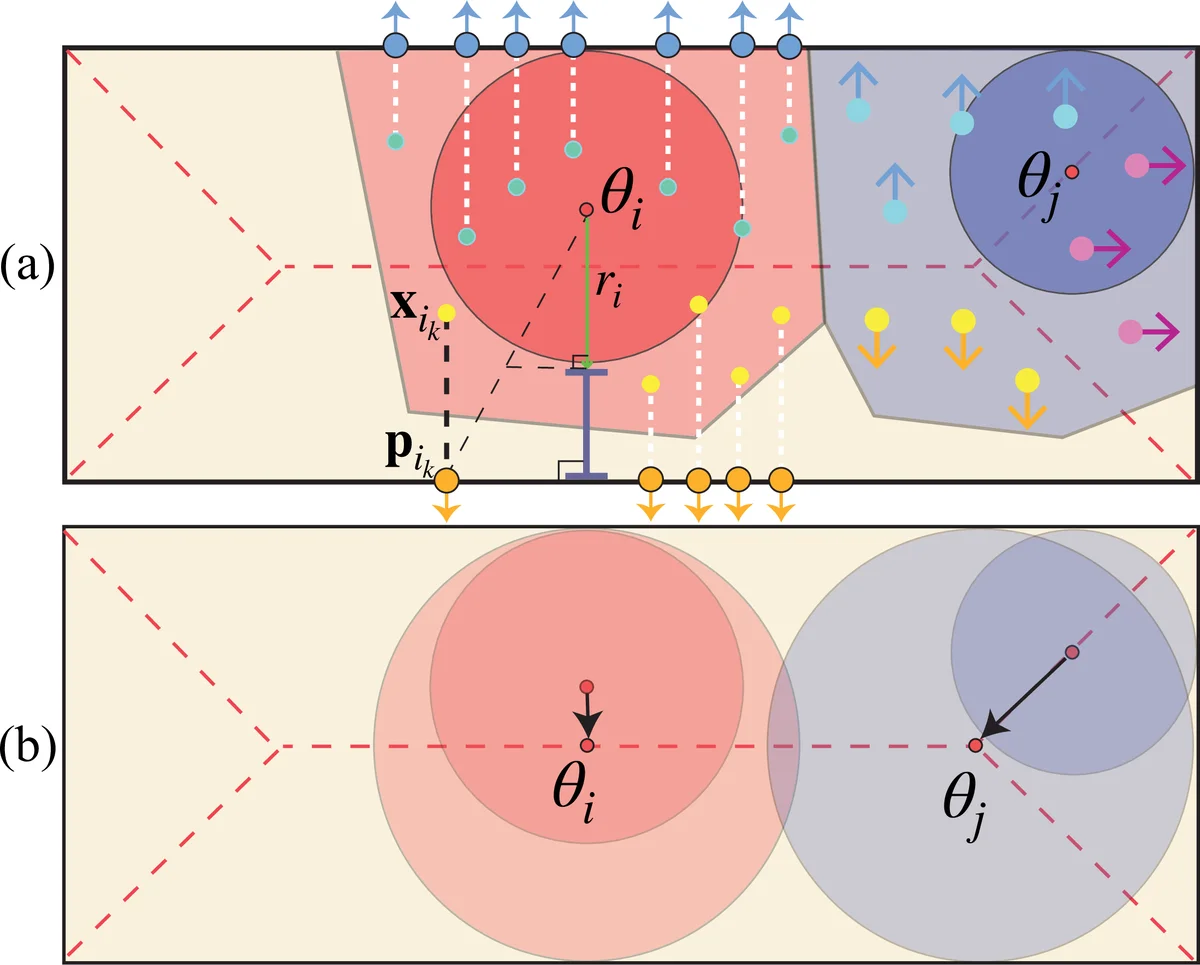
The core contribution is a particle‑based optimization that simultaneously enforces structural constraints and improves mesh quality. Structural awareness is achieved through a Spherical Quadratic Error Metric (SQEM) that projects each medial sphere onto the RPD cell boundaries, limiting its motion to directions that preserve the underlying medial structure (sheets, seams, and junctions). In parallel, a Gaussian kernel energy encourages an even spatial distribution of spheres, preventing the overcrowding around seams that plagued previous methods such as MATFP and MATTopo.
A key novelty is the volumetric RPD‑based classification of medial spheres. Instead of classifying spheres on the surface (which fails in dense regions), the authors examine the interior of each restricted power cell and assign spheres to T2 (sheet), T3 (seam), or T4 (junction) categories. This yields far more reliable identification of internal features, especially for CAD models with sharp edges and corners.
To quantitatively assess structural fidelity, the paper proposes the Medial Structure Error Ratio (MSER), which measures mismatches between extracted and ground‑truth medial structures across sheets, seams, and junctions. Experiments on a diverse benchmark (including hollow cylinders, CAD parts, and organic shapes) show that MATStruct reduces MSER by over 30 % relative to VoxelCore, MATFP, and MATTopo, while also delivering superior triangle quality (higher minimum angles, lower aspect ratios). Visual comparisons demonstrate clean, well‑connected medial sheets and clearly separated seams and junctions, something previous approaches could not achieve without excessive post‑processing.
The authors also discuss why alternative strategies such as Centroidal Voronoi Tessellation (CVT) or Optimal Delaunay Triangulation (ODT) are unsuitable: CVT requires an auxiliary volume decomposition and aims for uniform point distribution throughout the whole shape, conflicting with the goal of concentrating spheres along the medial structure; ODT assumes a fixed connectivity graph, which is unreliable during early optimization when sphere distribution is highly irregular.
In summary, MATStruct advances the state of the art by (1) integrating RPD‑based structural awareness directly into the optimization loop, (2) constraining sphere motion with SQEM to maintain topological correctness, (3) using a Gaussian energy to achieve uniform sphere spacing, and (4) introducing MSER for objective evaluation. The resulting medial meshes are both geometrically faithful and structurally clean, making them highly suitable for downstream tasks such as shape analysis, recognition, matching, and CAD‑centric applications. The code and dataset are publicly released, encouraging further research and practical adoption.
Comments & Academic Discussion
Loading comments...
Leave a Comment