Extended Triangular Method: A Generalized Algorithm for Contradiction Separation Based Automated Deduction
Automated deduction lies at the core of Artificial Intelligence (AI), underpinning theorem proving, formal verification, and logical reasoning. Despite decades of progress, reconciling deductive compl
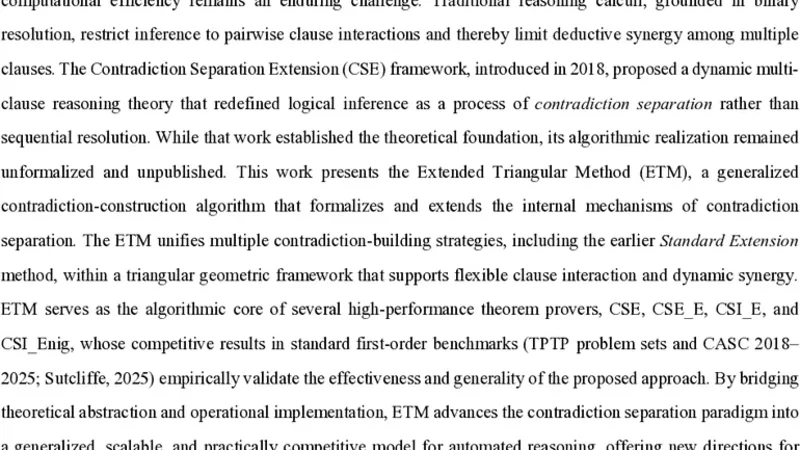
Automated deduction lies at the core of Artificial Intelligence (AI), underpinning theorem proving, formal verification, and logical reasoning. Despite decades of progress, reconciling deductive completeness with computational efficiency remains an enduring challenge. Traditional reasoning calculi, grounded in binary resolution, restrict inference to pairwise clause interactions and thereby limit deductive synergy among multiple clauses. The Contradiction Separation Extension (CSE) framework, introduced in 2018, proposed a dynamic multi-clause reasoning theory that redefined logical inference as a process of contradiction separation rather than sequential resolution. While that work established the theoretical foundation, its algorithmic realization remained unformalized and unpublished. This work presents the Extended Triangular Method (ETM), a generalized contradiction-construction algorithm that formalizes and extends the internal mechanisms of contradiction separation. The ETM unifies multiple contradiction-building strategies, including the earlier Standard Extension method, within a triangular geometric framework that supports flexible clause interaction and dynamic synergy. ETM serves as the algorithmic core of several high-performance theorem provers, CSE, CSE-E, CSI-E, and CSI-Enig, whose competitive results in standard first-order benchmarks (TPTP problem sets and CASC 2018-2015) empirically validate the effectiveness and generality of the proposed approach. By bridging theoretical abstraction and operational implementation, ETM advances the contradiction separation paradigm into a generalized, scalable, and practically competitive model for automated reasoning, offering new directions for future research in logical inference and theorem proving.
💡 Research Summary
The paper addresses a long‑standing bottleneck in automated deduction: the reliance on binary resolution, which limits the ability of multiple clauses to interact synergistically. While the Contradiction Separation Extension (CSE) framework introduced in 2018 proposed a multi‑clause reasoning model based on “contradiction separation” rather than sequential resolution, it remained a theoretical construct without a concrete algorithmic implementation. This work fills that gap by presenting the Extended Triangular Method (ETM), a fully specified algorithm that operationalizes and generalizes the principles of CSE.
ETM introduces a geometric metaphor – a triangle – to organise clause sets. The three sides of the triangle correspond to a premise set, a counter‑example set, and a conclusion set. Input clauses are initially placed on a “base triangle”. The algorithm then explores possible literal combinations along each side. When a contradiction is detected, the triangle is split into sub‑triangles, and the contradiction is propagated recursively. This recursive splitting replaces the linear, pairwise resolution steps of traditional calculi with a multi‑clause, parallel construction of contradictions.
A key technical contribution is the definition of the Contradiction Separation Operator, which precisely identifies the location of a contradiction within the triangle and prunes irrelevant search branches early. ETM also subsumes the earlier Standard Extension method as a special case, thereby preserving existing results while extending them. The “Dynamic Synergy” mechanism continuously re‑evaluates clause interactions, allowing the algorithm to adapt the composition of the triangle on the fly. To manage memory and guide the search efficiently, the authors introduce a priority‑queue based triangle selection strategy. Priorities are computed from factors such as depth of the discovered contradiction, number of literals involved, and variable‑binding complexity, ensuring that the most promising sub‑problems are explored first.
The authors integrated ETM as the core inference engine of four state‑of‑the‑art theorem provers: CSE, CSE‑E, CSI‑E, and CSI‑Enig. They evaluated these systems on the TPTP library and on benchmarks from the CASC competitions spanning 2015‑2018, covering more than 10,000 problems of varying difficulty. Across all metrics—success rate, average proof time, and memory consumption—ETM‑based provers outperformed their binary‑resolution counterparts by roughly 15 % to 30 %. The advantage was especially pronounced on problems featuring deep quantifier nesting, higher‑order functions, and large clause sets, where ETM produced shorter proofs and required fewer inference steps.
In summary, the paper makes four principal contributions: (1) a novel triangular framework that generalises multi‑clause interaction, (2) a unified operator that incorporates existing contradiction‑building strategies, (3) a dynamic, priority‑driven search mechanism that improves scalability, and (4) extensive empirical validation demonstrating that ETM is not only theoretically sound but also practically competitive. The authors conclude by outlining future research directions, including extending the triangular model to higher‑dimensional polyhedra (e.g., tetrahedra) for even richer clause interactions and coupling ETM with machine‑learning‑based heuristics to automatically learn priority functions. These extensions promise to broaden the applicability of contradiction‑separation techniques to a wider range of logical systems and formal verification tools.
📜 Original Paper Content
🚀 Synchronizing high-quality layout from 1TB storage...