Tilting representations of finite groups of Lie type
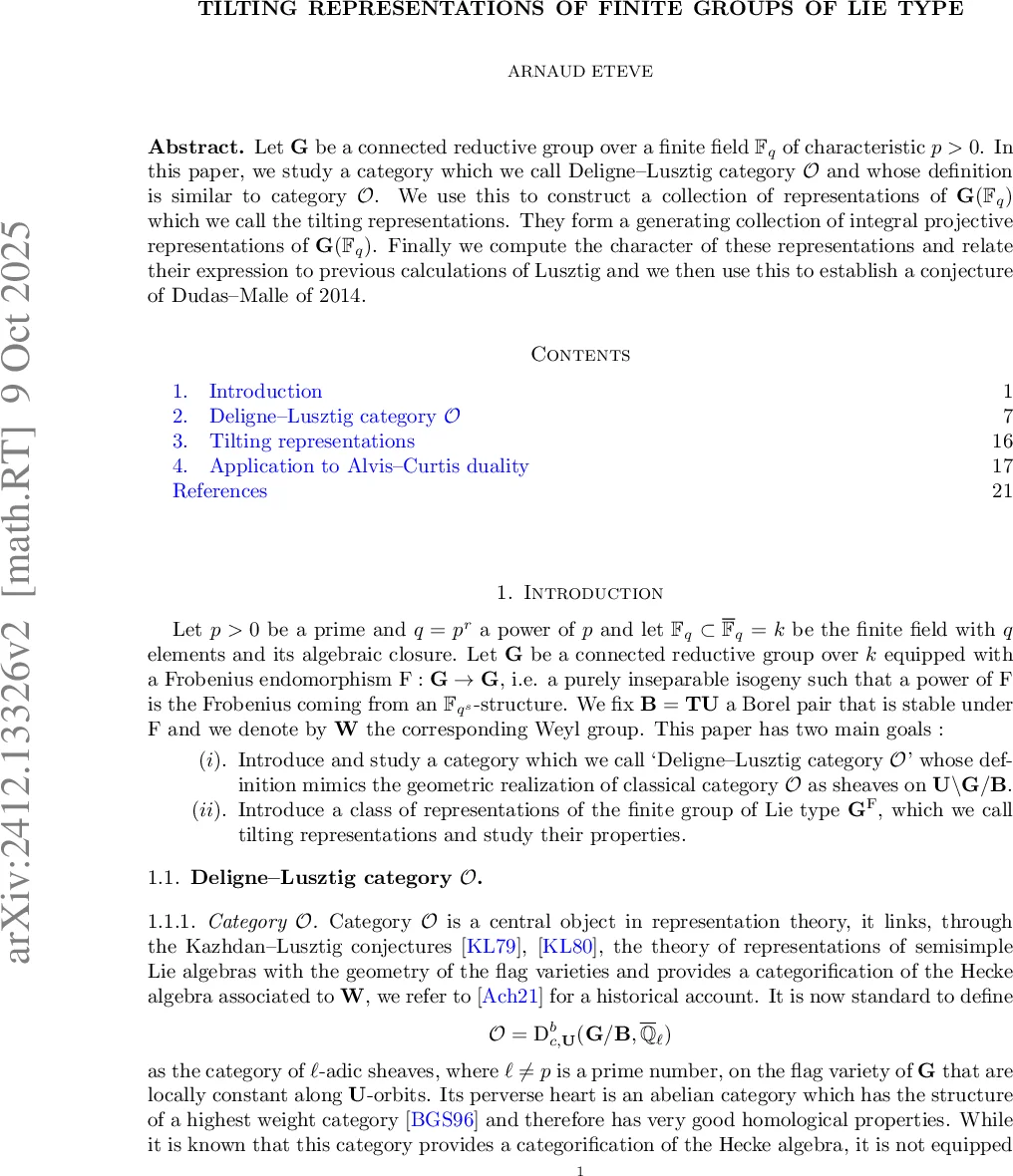
Let $\mathbf{G}$ be a connected reductive group over a finite field $\mathbb{F}_q$ of characteristic $p > 0$. In this paper, we study a category which we call Deligne–Lusztig category $\mathcal{O}$ and whose definition is similar to category $\mathcal{O}$. We use this to construct a collection of representations of $\mathbf{G}(\mathbb{F}_q)$ which we call the tilting representations. They form a generating collection of integral projective representations of $\mathbf{G}(\mathbb{F}_q)$. Finally we compute the character of these representations and relate their expression to previous calculations of Lusztig and we then use this to establish a conjecture of Dudas–Malle.
💡 Research Summary
The paper introduces a novel categorical framework for studying representations of finite groups of Lie type, namely the Deligne–Lusztig “category O” (denoted 𝒪_DL). Starting from a connected reductive group 𝔾 over an algebraic closure k of a finite field 𝔽_q, equipped with a Frobenius endomorphism F, the author considers the stack U\𝔾/U Ad F T, called the horocycle stack. The derived category of ℓ‑adic sheaves on this stack, 𝒪_DL = D(U\𝔾/U Ad F T, Λ), is defined as the Deligne–Lusztig analogue of the classical BGG category O.
Using the Bruhat decomposition 𝔾 = ⋃{w∈W} B w B, the horocycle stack is stratified into locally closed substacks U\B w B/U Ad F T. Each stratum is identified with the classifying stack of a semi‑direct product T_w^F ⋉ U_w, where T_w^F is the finite torus fixed by F and U_w = U∩Ad(ẇ)(U). Consequently, 𝒪_DL decomposes as a gluing of representation categories Rep_Λ(T_w^F) for all w∈W. For each character χ of T_w^F, the projective cover E_χ gives rise to standard and costandard objects Δ{w,χ}=j_{w,!} E_χ
Comments & Academic Discussion
Loading comments...
Leave a Comment