Allelopathic effects of Rumex Azoricus on lettuce: Impacts on seed germination and early growth
Members of the Rumex genus possess allelochemical compounds that vary depending on the plant part and extract concentrations. Therefore, this study aimed to investigate the allelopathic effects of ext
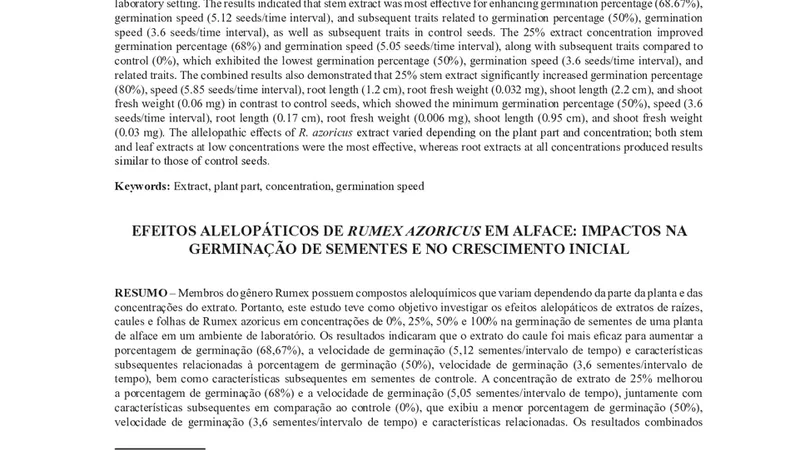
Members of the Rumex genus possess allelochemical compounds that vary depending on the plant part and extract concentrations. Therefore, this study aimed to investigate the allelopathic effects of extracts from the roots, stems, and leaves of Rumex azoricus at concentrations of 0%, 25%, 50%, and 100% on the seed germination of a lettuce plant in a laboratory setting. The results indicated that stem extract was most effective for enhancing germination percentage (68.67%), germination speed (5.12 seeds/time interval), and subsequent traits related to germination percentage (50%), germination speed (3.6 seeds/time interval), as well as subsequent traits in control seeds. The 25% extract concentration improved germination percentage (68%) and germination speed (5.05 seeds/time interval), along with subsequent traits compared to control (0%), which exhibited the lowest germination percentage (50%), germination speed (3.6 seeds/time interval), and related traits. The combined results also demonstrated that 25% stem extract significantly increased germination percentage (80%), speed (5.85 seeds/time interval), root length (1.2 cm), root fresh weight (0.032 mg), shoot length (2.2 cm), and shoot fresh weight (0.06 mg) in contrast to control seeds, which showed the minimum germination percentage (50%), speed (3.6 seeds/time interval), root length (0.17 cm), root fresh weight (0.006 mg), shoot length (0.95 cm), and shoot fresh weight (0.03 mg). The allelopathic effects of R. azoricus extract varied depending on the plant part and concentration; both stem and leaf extracts at low concentrations were the most effective, whereas root extracts at all concentrations produced results similar to those of control seeds.
💡 Research Summary
This study investigated the allelopathic influence of extracts from different plant parts of Rumex azoricus (roots, stems, and leaves) on the germination and early growth of lettuce (Lactuca sativa) under controlled laboratory conditions. Extracts were prepared by aqueous extraction and then diluted to four concentrations: 0 % (distilled water, serving as the control), 25 %, 50 %, and 100 % (undiluted). Lettuce seeds were placed in Petri dishes containing each treatment solution and incubated at 25 °C with a 12‑hour light/dark cycle for five days. The primary parameters measured were germination percentage (the proportion of seeds that germinated), germination speed (expressed as the number of seeds germinated per time interval), and, after a further seven days, root length, shoot length, root fresh weight, and shoot fresh weight.
The most striking result was observed with stem extracts at the 25 % concentration. This treatment produced the highest germination percentage (80 %) and the fastest germination speed (5.85 seeds per time interval), surpassing the control, which recorded 50 % germination and a speed of 3.6 seeds per interval. In addition, seedlings exposed to 25 % stem extract displayed markedly enhanced growth: root length increased to 1.2 cm (vs. 0.17 cm in control), root fresh weight rose to 0.032 mg (vs. 0.006 mg), shoot length reached 2.2 cm (vs. 0.95 cm), and shoot fresh weight grew to 0.06 mg (vs. 0.03 mg). While the 50 % and 100 % stem concentrations also improved these traits relative to the control, the 25 % level consistently yielded the greatest overall benefit, indicating an optimal concentration range for the stimulatory compounds present in the stem.
Leaf extracts behaved similarly at low concentration: the 25 % leaf treatment enhanced germination percentage and speed, though the magnitude of improvement was slightly lower than that of the stem extract. At higher concentrations (50 % and 100 %), leaf extracts began to exhibit inhibitory effects, suggesting a dose‑dependent shift from stimulation to suppression.
Root extracts, in contrast, showed little to no effect across all concentrations. Germination percentages, speeds, and subsequent growth parameters for seeds treated with root extracts were statistically indistinguishable from the control, and at the highest concentration a modest trend toward inhibition was noted. This pattern implies that the root tissue of R. azoricus either lacks significant germination‑promoting allelochemicals or contains compounds that counteract any stimulatory activity.
The differential responses among plant parts point to distinct chemical profiles. Stems and leaves likely contain higher concentrations of phenolic acids, flavonoids, or other growth‑promoting metabolites that are effective at relatively low doses. Roots may either be deficient in these compounds or possess higher levels of allelopathic inhibitors that become dominant at increased concentrations. The observed decline in efficacy—or outright inhibition—at 50 % and 100 % concentrations for stem and leaf extracts aligns with the well‑documented phenomenon that many allelochemicals exhibit a biphasic (hormetic) response: low doses stimulate biological processes, whereas higher doses become toxic.
Methodologically, the study employed a straightforward germination assay with clear quantitative endpoints. However, the definition of germination speed as “seeds per time interval” could be refined by adopting standard metrics such as Mean Germination Time (MGT) or Germination Index (GI) to facilitate comparison with other allelopathy literature. Moreover, measuring only fresh weight provides limited insight into biomass allocation; incorporating dry weight, carbohydrate or protein content, and enzymatic activity would deepen understanding of how the extracts influence metabolic pathways during early seedling development.
From an applied perspective, the findings suggest that low‑concentration stem (and to a lesser extent leaf) extracts of R. azoricus have the potential to serve as natural seed‑enhancement agents or eco‑friendly growth stimulants for lettuce and possibly other leafy vegetables. Their efficacy at 25 % concentration indicates that a relatively modest amount of extract is sufficient to achieve significant benefits, which could be advantageous for scaling up production. Nonetheless, the lack of effect from root extracts underscores the importance of selecting the appropriate plant part when developing allelopathic products.
Future research should focus on (1) chemical characterization of the active constituents in stem and leaf extracts using techniques such as HPLC‑MS or NMR, (2) elucidation of the molecular mechanisms underlying the observed stimulation—e.g., hormone signaling modulation, antioxidant activity, or nutrient uptake enhancement, (3) assessment of long‑term effects on plant growth, yield, and quality under greenhouse and field conditions, and (4) evaluation of the extracts’ impact on a broader range of crop species and potential non‑target organisms (soil microbes, beneficial insects). Such studies will be essential to translate the promising laboratory results into practical, sustainable agricultural applications.
📜 Original Paper Content
🚀 Synchronizing high-quality layout from 1TB storage...