An Introduction to Mars Terraforming, 2025 Workshop Summary
Terraforming Mars is an age old science fiction concept now worth revisiting through the lens of modern science and technology. This document serves as a summary of contemporary ideas about Mars terra
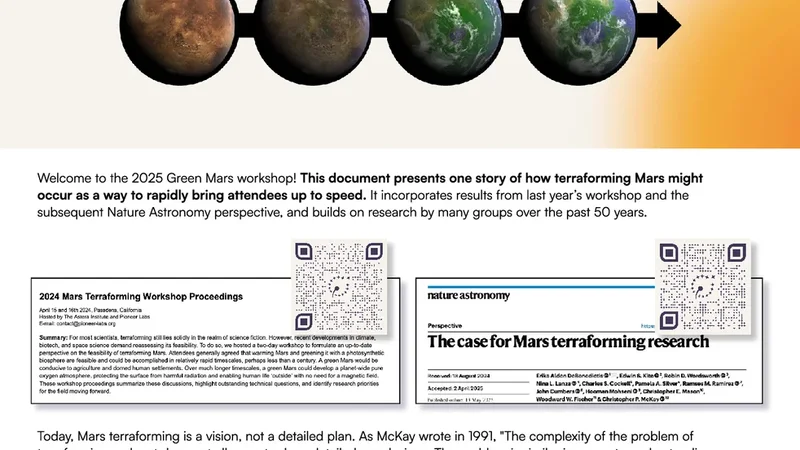
Terraforming Mars is an age old science fiction concept now worth revisiting through the lens of modern science and technology. This document serves as a summary of contemporary ideas about Mars terraforming, prepared for attendees of the 2025 Green Mars Workshop. It presents one illustrative story of how Mars might be transformed into a habitable world. The story is told in reverse, beginning with possible planetary endpoints and tracing backward to the steps required to reach them. Along the way, it highlights alternative approaches, critical unknowns and research priorities, and the near term applications and benefits of terraforming research for planetary science, climate engineering, and sustainable technologies on Earth.
💡 Research Summary
The 2025 Green Mars Workshop summary titled “An Introduction to Mars Terraforming” presents a comprehensive, forward‑looking synthesis of the most current scientific and engineering concepts for converting Mars into a world capable of supporting human life. The authors adopt a novel “reverse‑storytelling” framework: they begin with the envisioned end‑state—a planet with Earth‑like surface pressure, temperature, a stable hydrological cycle, and a breathable atmosphere—and then work backward to identify the sequence of interventions required to reach that goal. This approach clarifies the ultimate objectives, makes the intermediate milestones explicit, and helps policymakers and researchers prioritize actions.
The paper first outlines why terraforming has moved from pure science‑fiction to a serious research topic. Mars possesses many favorable attributes (day length, axial tilt, presence of water ice, and a CO₂‑rich atmosphere), yet its surface pressure (~6 mbar), mean temperature (≈ –60 °C), and high radiation environment make it inhospitable for long‑term human habitation. Overcoming these constraints demands a multi‑pronged strategy that simultaneously raises atmospheric pressure, warms the planet, creates a sustainable water cycle, and mitigates radiation.
The core technical roadmap is divided into four interlocking pillars:
-
Atmospheric Modification and Warming – The authors propose scaling up the greenhouse effect by releasing massive quantities of high‑impact gases such as methane, per‑fluorocarbons (PFCs), and ammonia. Methane could be generated in situ by engineered cyanobacterial bioreactors, while PFCs might be synthesized on Mars using electrochemical processes powered by abundant solar or nuclear energy. A “polar ice heating” sub‑strategy involves directing high‑power microwave or laser beams at the polar caps to sublimate water ice, thereby injecting water vapor (itself a potent greenhouse gas) into the atmosphere and jump‑starting a positive feedback loop.
-
Radiation Shielding and Artificial Magnetosphere – Because Mars lacks a global magnetic field, surface radiation levels remain lethal. Two complementary solutions are discussed: (a) an artificial magnetosphere created by a large orbital current loop that generates a dipole field comparable to Earth’s, and (b) in‑situ shielding by mixing high‑density, radiation‑absorbing materials (e.g., iron‑rich perovskites) into the regolith to form protective layers beneath habitats. The feasibility of each approach is evaluated in terms of power requirements, material availability, and long‑term stability.
-
Soil Amendment and Biological Engineering – Martian regolith is rich in perchlorates and sulfates but deficient in nitrogen, phosphorus, and potassium—key nutrients for plant growth. The authors suggest a staged biotechnological program that first introduces nitrogen‑fixing cyanobacteria and phosphate‑solubilizing microbes, then gradually seeds genetically engineered higher plants capable of tolerating perchlorate stress and low pressure. This “terraforming bio‑front” aims to raise soil fertility to at least 10 % of Earth’s baseline within a few centuries, providing a foundation for agriculture and further atmospheric oxygen production.
-
Hydrological Cycle Development – Water is the linchpin of any terraforming effort. The paper outlines three sources: (i) polar ice caps, (ii) subsurface aquifers, and (iii) atmospheric water vapor generated by the warming phase. A “polar warming plasma laser” concept is introduced to vaporize cap ice in a controlled manner, while a network of subsurface drilling rigs would extract, purify, and re‑inject water to sustain a closed‑loop system. The goal is to achieve a planetary water recycling efficiency exceeding 80 %, thereby supporting cloud formation, precipitation, and surface runoff.
Alternative pathways are examined. “Partial terraforming” focuses on creating high‑pressure, warm enclaves (e.g., domed cities or underground habitats) while leaving the rest of the planet in its native state. This reduces cost and risk, allowing early human presence and infrastructure testing. The authors also discuss high‑technology options such as artificial photosynthesis (electrochemical CO₂ reduction to fuels) and large‑scale CO₂ electro‑reduction to produce synthetic hydrocarbons, which could supplement greenhouse gas inputs and eventually generate a breathable O₂‑rich atmosphere.
The summary identifies four major unknowns that dominate risk assessments: (1) the long‑term stability of artificially introduced greenhouse gases in the thin Martian atmosphere, (2) whether an artificial magnetosphere can provide sufficient radiation protection without destabilizing the ionosphere, (3) the survivability and ecological impact of engineered microbes under extreme temperature, pressure, and perchlorate conditions, and (4) the scalability and reliability of a Mars‑wide energy infrastructure (nuclear fusion, fission, or massive solar farms) needed to power all other processes.
Research priorities are ordered to address these uncertainties:
- Energy Infrastructure – Build prototype fusion or high‑capacity solar arrays to supply the megawatt‑to‑gigawatt power levels required for atmospheric processing, ice heating, and magnetosphere generation.
- Atmospheric Experiments – Conduct small‑scale greenhouse gas release trials in situ to measure radiative forcing, atmospheric mixing, and loss rates.
- Biological Soil Trials – Deploy closed‑loop bioreactors with cyanobacteria and engineered plants to evaluate nutrient cycling, perchlorate detoxification, and oxygen production under Martian pressure and temperature.
- Radiation Shielding Demonstrations – Test orbital current loops and regolith‑based shielding modules to quantify dose reduction for surface habitats.
- Water Cycle Prototypes – Install polar ice sublimation rigs and subsurface water extraction systems to validate the hydrological feedback mechanisms.
Beyond the direct goal of making Mars habitable, the authors argue that terraforming research yields immediate spin‑offs for Earth. Technologies for large‑scale greenhouse gas management, high‑efficiency artificial photosynthesis, low‑cost radiation shielding materials, and resilient bio‑engineered microbes can be repurposed for climate mitigation, desert reclamation, and sustainable agriculture. In this sense, Mars terraforming serves as a grand testbed for planetary‑scale engineering, driving innovation that can accelerate Earth’s transition to a low‑carbon, resilient future.
In conclusion, the workshop summary provides a clear, goal‑oriented roadmap that integrates atmospheric physics, magnetospheric engineering, synthetic biology, and planetary hydrology. By laying out concrete technical steps, identifying critical knowledge gaps, and emphasizing Earth‑beneficial outcomes, the paper positions Mars terraforming not merely as an aspirational vision but as a strategic research program with tangible scientific, economic, and societal returns.
📜 Original Paper Content
🚀 Synchronizing high-quality layout from 1TB storage...