Anomaly-Aware YOLO: A Frugal yet Robust Approach to Infrared Small Target Detection
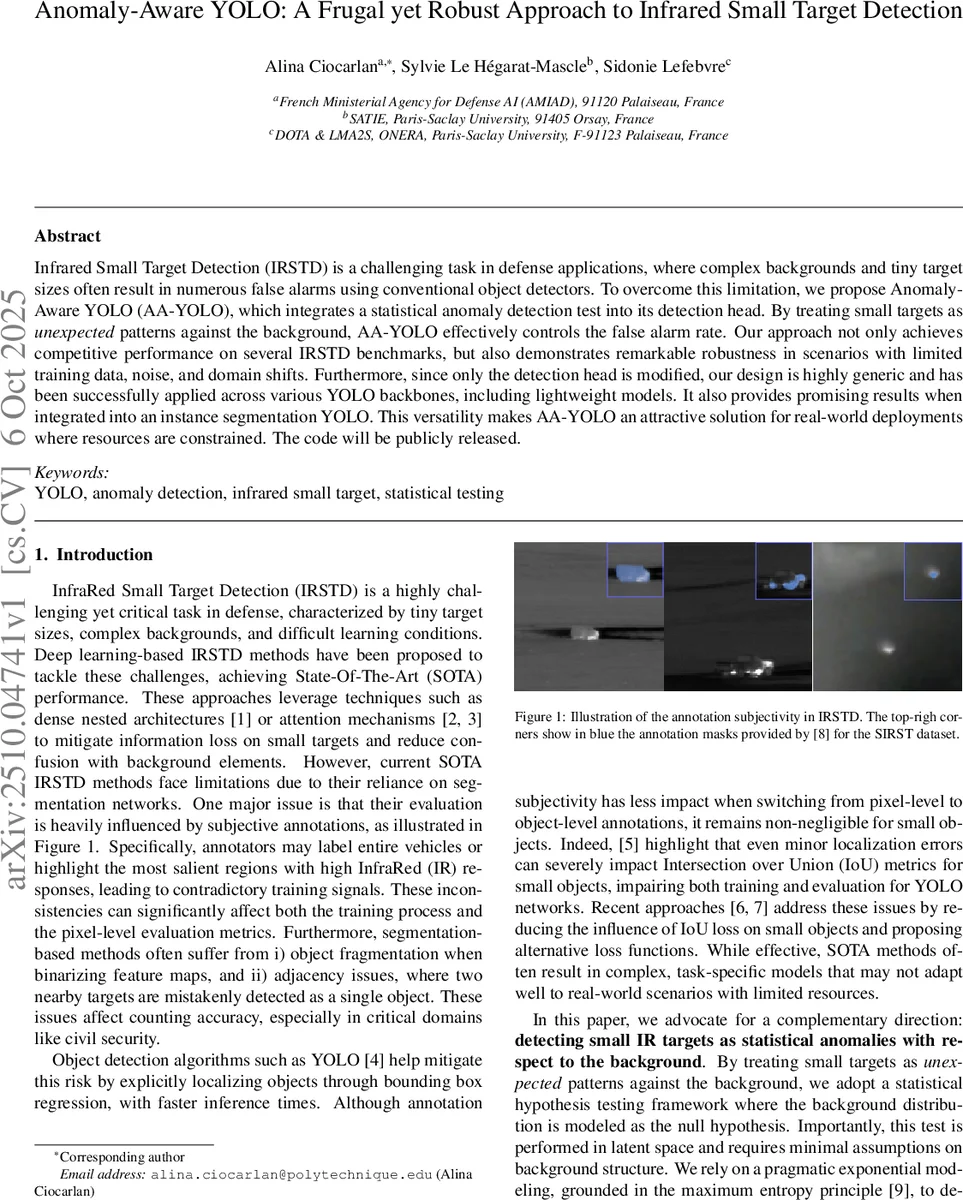
Infrared Small Target Detection (IRSTD) is a challenging task in defense applications, where complex backgrounds and tiny target sizes often result in numerous false alarms using conventional object detectors. To overcome this limitation, we propose Anomaly-Aware YOLO (AA-YOLO), which integrates a statistical anomaly detection test into its detection head. By treating small targets as unexpected patterns against the background, AA-YOLO effectively controls the false alarm rate. Our approach not only achieves competitive performance on several IRSTD benchmarks, but also demonstrates remarkable robustness in scenarios with limited training data, noise, and domain shifts. Furthermore, since only the detection head is modified, our design is highly generic and has been successfully applied across various YOLO backbones, including lightweight models. It also provides promising results when integrated into an instance segmentation YOLO. This versatility makes AA-YOLO an attractive solution for real-world deployments where resources are constrained. The code will be publicly released.
💡 Research Summary
Infrared small‑target detection (IRSTD) is a notoriously difficult problem for defense applications because targets are extremely tiny, have low contrast, and appear against highly cluttered backgrounds. Conventional deep‑learning approaches either rely on segmentation networks, which suffer from annotation subjectivity, fragmentation, and adjacency errors, or on object‑detectors such as YOLO, which struggle with class imbalance and IoU‑sensitivity for small objects. In this work the authors propose Anomaly‑Aware YOLO (AA‑YOLO), a method that injects a statistical anomaly‑detection test directly into the YOLO detection head, thereby treating every small infrared target as an unexpected pattern relative to a learned background model.
The key technical contribution is the Anomaly‑Aware Detection Head (AADH). After the backbone (e.g., YOLOv7 or YOLOv9) produces its usual feature map, each voxel in the final latent space is modeled as a C‑dimensional random variable. The background (null hypothesis H0) is assumed to follow an exponential distribution for each channel – a maximum‑entropy choice for non‑negative data with a known mean. Two aggregate statistics are considered: the minimum across channels (µ1) and the sum across channels (µ2). Empirical ablations show that µ2, which follows an Erlang (Gamma) distribution under the exponential hypothesis, yields a more sensitive p‑value. The p‑value is transformed into a significance score (−ln F) and passed through a scaled, zero‑centered sigmoid (parameter α) to produce an objectness score in
Comments & Academic Discussion
Loading comments...
Leave a Comment