Emergent curved space and gravitational lensing in quantum materials
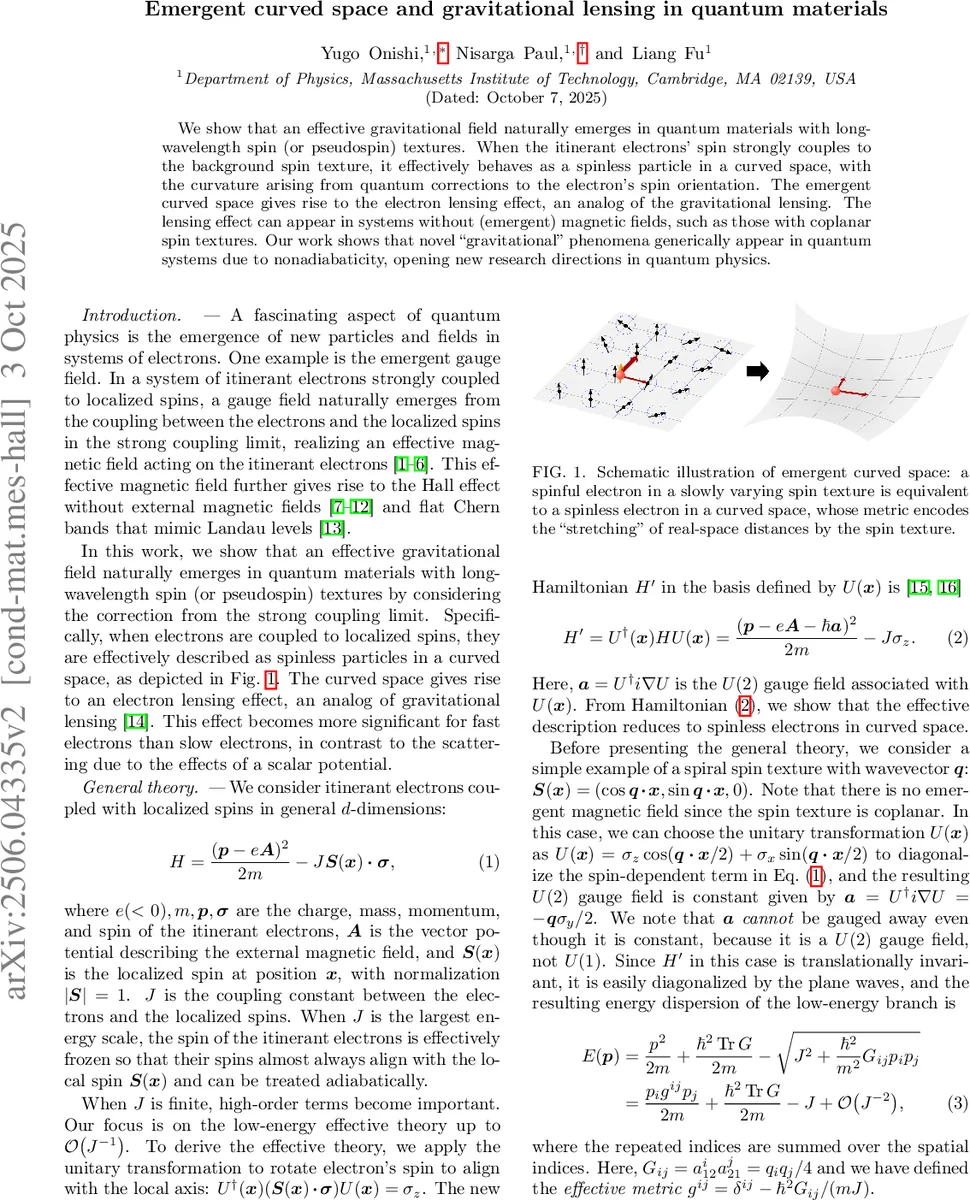
We show that an effective gravitational field naturally emerges in quantum materials with long-wavelength spin (or pseudospin) textures. When the itinerant electrons’ spin strongly couples to the background spin texture, it effectively behaves as a spinless particle in a curved space, with the curvature arising from quantum corrections to the electron’s spin orientation. The emergent curved space gives rise to the electron lensing effect, an analog of the gravitational lensing. The lensing effect can appear in systems without (emergent) magnetic fields, such as those with coplanar spin textures. Our work shows that novel ``gravitational’’ phenomena generically appear in quantum systems due to nonadiabaticity, opening new research directions in quantum physics.
💡 Research Summary
The authors present a theory in which an effective gravitational field emerges in quantum materials that host long‑wavelength spin (or pseudospin) textures. Starting from a generic Hamiltonian for itinerant electrons coupled to localized spins,
(H=(\mathbf{p}-e\mathbf{A})^{2}/2m - J,\mathbf{S}(\mathbf{x})!\cdot!\boldsymbol{\sigma}),
they perform a local SU(2) rotation (U(\mathbf{x})) that aligns the electron spin with the texture. The rotation generates an SU(2) gauge field ( \mathbf{a}=U^{\dagger}i\nabla U). In the strong‑coupling limit (J) dominates, but finite‑(J) corrections of order (J^{-1}) are retained. By applying a Schrieffer‑Wolff transformation to decouple the high‑energy (spin‑up) sector, they obtain a low‑energy effective Hamiltonian
\
Comments & Academic Discussion
Loading comments...
Leave a Comment