On-Demand and Tunable Andreev-Conversion of Single-Electron Charge Pulses
Electron quantum optics explores coherent single-electron charge pulse propagation in electronic nanoscale circuits akin to table-top photon setups. While past experiments focused on normal-state conductors, incorporating superconductors holds promise for exploiting the electron-hole degree of freedom in quantum sensing applications and quantum information processing. Here, we propose and analyze an on-demand and tunable mechanism for converting single-electron pulses into holes through Andreev processes on a superconductor. We develop a Floquet-Nambu scattering formalism to demonstrate the dynamic conversion of charge pulses and the controllable generation of coherent electron-hole superpositions through interferometric magnetic flux control based on the chiral edge states of a quantum Hall sample. Our discussion covers optimal conditions in realistic scenarios, affirming the feasibility of our proposal with current technology.
💡 Research Summary
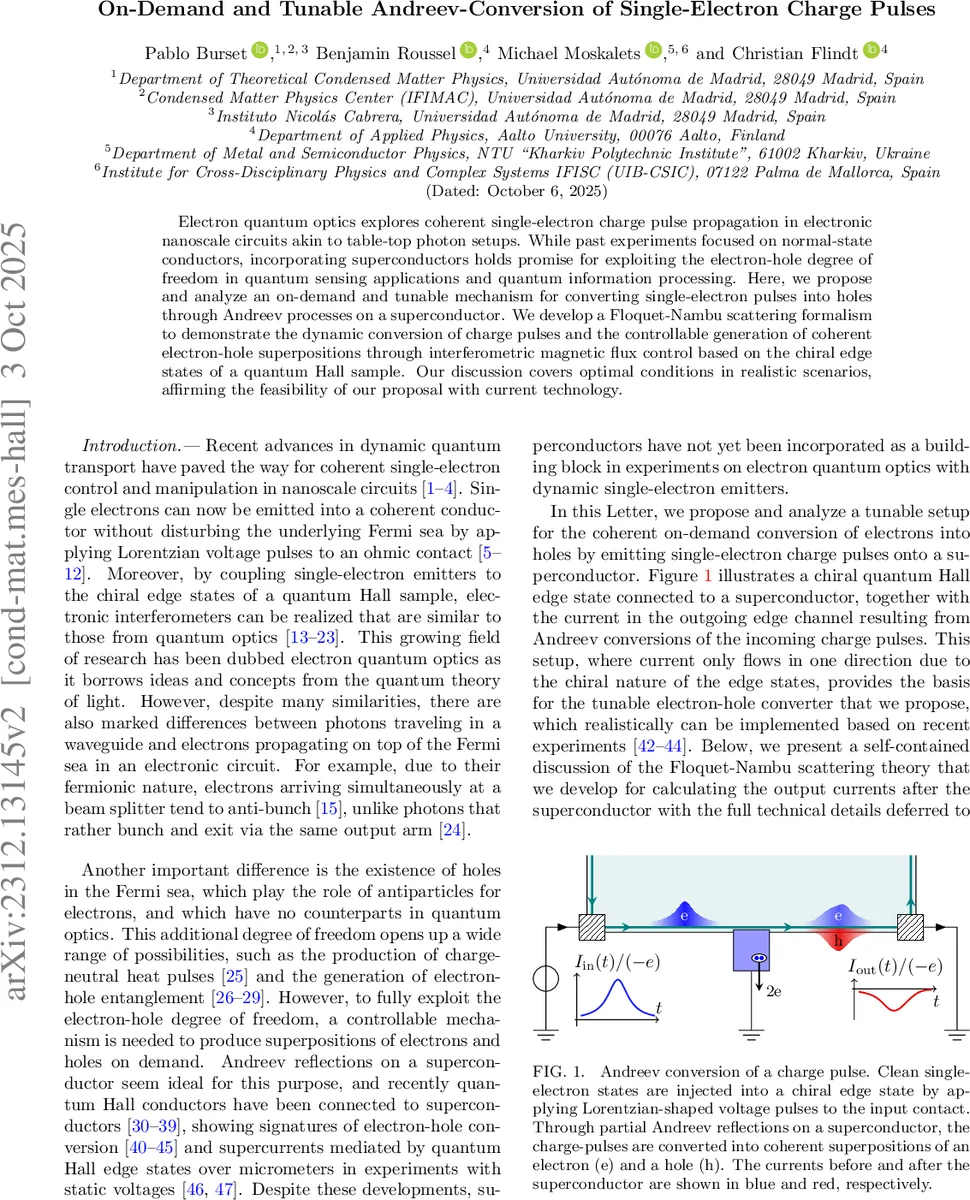
This paper proposes and theoretically analyzes a novel scheme for the on-demand and tunable conversion of single-electron charge pulses into holes (and coherent electron-hole superpositions) using Andreev reflection at a superconductor interface within an electron quantum optics architecture. The core idea integrates dynamic single-electron sources, chiral quantum Hall edge states as one-dimensional waveguides, and a superconducting junction.
The authors develop a comprehensive theoretical framework by combining Floquet scattering theory—essential for handling the periodic voltage pulses that generate clean single-electron excitations—with the Nambu spinor formalism used to describe electron-hole conversion in superconductors. This hybrid “Floquet-Nambu scattering formalism” quantitatively describes how an incoming single-electron wavepacket, emitted via Lorentzian voltage pulses, scatters at the superconductor. The scattering matrix elements give the probability amplitudes for the particle to be reflected as an electron or a hole, having exchanged energy quanta with the driving field.
A key result is that the conversion probability, and thus the composition of the outgoing quantum state as a superposition of an electron and a hole, can be continuously tuned. This tunability is achieved through interferometric control of a magnetic flux penetrating the circuit, analogous to adjusting a phase shifter in an optical interferometer. By varying this flux, the output can be tuned from a pure electron, through any arbitrary electron-hole superposition, to a pure hole state.
The paper provides a detailed discussion of the excess correlation function and the time-dependent current in the output channel, offering concrete predictions for experimental signatures. It further addresses practical considerations, analyzing the effects of finite temperature, pulse overlap, and multi-channel edge states on the fidelity and efficiency of the conversion process. The authors argue that the proposed setup is feasible with current experimental capabilities, citing recent advances in fabricating quantum Hall-superconductor hybrids and in generating time-resolved single-electron pulses.
The proposed device represents a fundamental building block for electron quantum optics with superconductors. It opens pathways for exploiting the electron-hole degree of freedom in solid-state quantum information processing, for example, in generating entangled electron-hole pairs or in creating novel quantum interference devices. The work also lays the groundwork for future explorations involving different superconducting pairing symmetries (like spin-triplet) and topological superconductors.
Comments & Academic Discussion
Loading comments...
Leave a Comment