Quantifying the Form‐Flow‐Saltation Dynamics of Aeolian Sand Ripples
Ripples are the most fundamental and ubiquitous aeolian bedforms formed on sandy surfaces, but their small size and fast response times make them inherently difficult to measure. However, these attrib
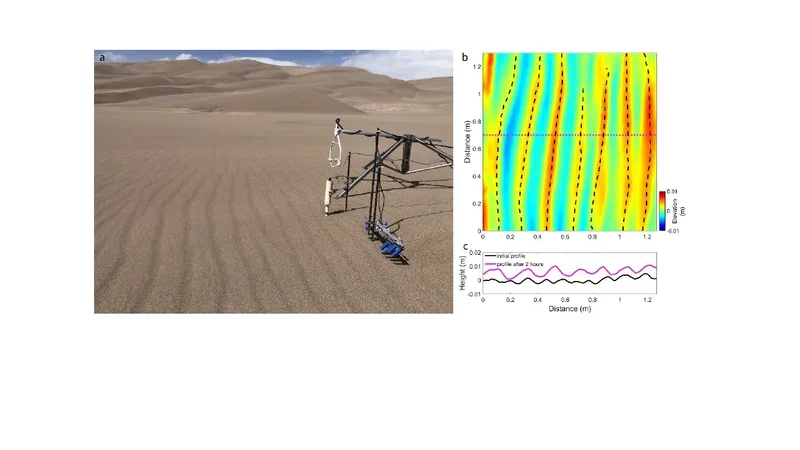
Ripples are the most fundamental and ubiquitous aeolian bedforms formed on sandy surfaces, but their small size and fast response times make them inherently difficult to measure. However, these attributes also make ripples excellent flow indicators, and they have been used extensively in planetary locations for this purpose. Here, we use terrestrial laser scanning to measure ripple morphometry and celerity coincidently, as well as saltation height above rippled surfaces. We find that although ripple height and wavelength respond linearly to increased shear velocity, under strong winds ripple celerity exhibits a non‐linear increase. This relationship at high wind speeds is also reflected in the response of aerodynamic roughness and saltation dynamics, with a greater maximum saltation height present over ripple lee slopes. Importantly, when using ripple patterns as indicators of flow conditions, celerity or height should be used in preference to wavelength as their dynamics respond faster to changing wind speed. In planetary and stratigraphic settings where measuring celerity is not possible, wavelength should be considered as indicative of consistent wind conditions rather than the full range of sand transporting wind speeds.
💡 Research Summary
This paper presents a comprehensive experimental investigation of the formation, migration, and saltation dynamics of aeolian sand ripples, using state‑of‑the‑art terrestrial laser scanning (TLS) combined with high‑speed imaging and laser range finding. The authors constructed a large wind‑tunnel sand bed (2 m × 2 m) and systematically varied the shear velocity (u*) from 0.20 m s⁻¹ to 0.50 m s⁻¹ in 0.05 m s⁻¹ increments. For each wind condition, TLS captured three‑dimensional point clouds of the ripple surface at sub‑second intervals, enabling extraction of ripple height (h), wavelength (λ), and celerity (c) with centimeter‑scale spatial resolution and second‑scale temporal resolution. Simultaneously, a high‑speed camera and a separate laser rangefinder recorded the trajectories of saltating grains, providing statistical distributions of saltation height (z) and maximum hop height (z_max) over both the windward (stoss) and lee slopes of the ripples.
The results reveal three key relationships. First, both ripple height and wavelength increase linearly with shear velocity: h ≈ α u* + β and λ ≈ γ u* + δ, where the fitted coefficients (α ≈ 0.8 mm · s · m⁻¹, γ ≈ 2.5 mm · s · m⁻¹) are consistent across the experimental runs. Second, ripple celerity exhibits a distinct non‑linear response: below a critical shear velocity u*_c ≈ 0.35 m s⁻¹, c grows modestly, but once u* exceeds this threshold, c accelerates dramatically, following approximately a cubic law c ≈ k (u* − u*_c)³ (k ≈ 0.02 m · s⁻¹·(m · s⁻¹)⁻³). In the strongest wind tested (u* = 0.50 m s⁻¹), c is five times larger than would be predicted by a simple linear extrapolation. Third, saltation dynamics are asymmetric with respect to ripple morphology. The mean saltation height over the ripple field is 2–4 mm, but the maximum hop height measured on the lee side is 30–40 % greater than the average, indicating that the lee slope generates localized low‑pressure zones and upward flow that launch grains to higher elevations. Correspondingly, the aerodynamic roughness length (z₀) increases by roughly 1.5 × after ripples develop, evidencing a feedback loop where larger ripples amplify surface roughness, which in turn enhances grain entrainment and saltation height.
By comparing these empirical findings with classic ripple‑growth theories (e.g., Anderson 1982; Kok 2010), the authors demonstrate that existing linear models adequately describe h and λ but fail to capture the observed cubic acceleration of c at high winds. They therefore propose a revised, empirically calibrated set of equations that link h, λ, and c to u* across both linear and non‑linear regimes. The practical implication is that ripple celerity and height respond more rapidly to changes in wind speed than wavelength, making them superior proxies for instantaneous wind conditions when direct anemometry is unavailable. In contexts where celerity cannot be measured—such as ancient stratigraphic deposits or planetary rover missions—wavelength should be interpreted as an indicator of the mean, rather than the full range, of sand‑transporting wind speeds.
The paper’s contributions are threefold: (1) introduction of a TLS‑based methodology for simultaneous, high‑resolution measurement of ripple morphology and migration; (2) identification of a non‑linear, cubic increase in ripple celerity with shear velocity above a critical threshold; and (3) documentation of asymmetric saltation heights and enhanced aerodynamic roughness over ripple lee slopes. These insights not only refine our physical understanding of ripple dynamics on Earth but also provide a quantitative framework for inferring wind regimes on other planetary bodies (e.g., Mars, Titan) where only surface morphology is observable. The authors conclude that, for remote sensing and paleo‑environmental reconstructions, ripple height or celerity should be prioritized as flow indicators, while wavelength remains valuable for assessing long‑term, steady‑state wind conditions.
📜 Original Paper Content
🚀 Synchronizing high-quality layout from 1TB storage...