Adaptive simplification of complex multiscale systems
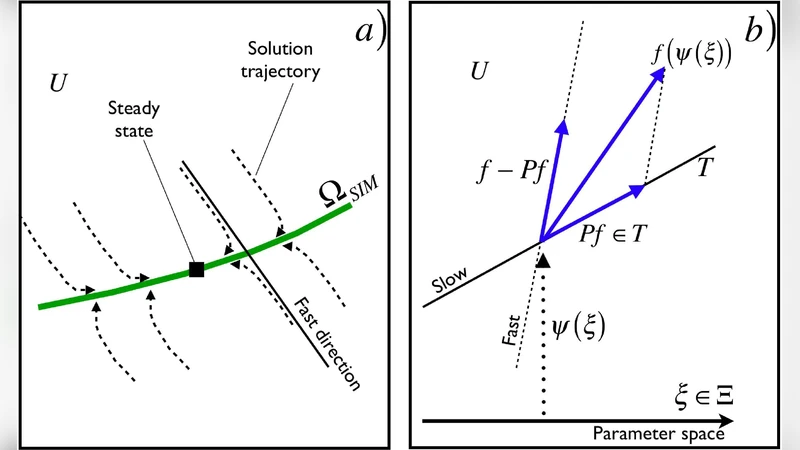
A fully adaptive methodology is developed for reducing the complexity of large dissipative systems. This represents a significant step towards extracting essential physical knowledge from complex systems, by addressing the challenging problem of a minimal number of variables needed to exactly capture the system dynamics. Accurate reduced description is achieved, by construction of a hierarchy of slow invariant manifolds, with an embarrassingly simple implementation in any dimension. The method is validated with the auto-ignition of the hydrogen-air mixture where a reduction to a cascade of slow invariant manifolds is observed.
💡 Research Summary
The paper presents a fully adaptive methodology for reducing the complexity of large dissipative systems while preserving their exact dynamics. The authors address the long‑standing problem of determining the minimal set of variables required to capture a system’s behavior by constructing a hierarchy of slow invariant manifolds (SIMs) that can be generated in any dimension with a remarkably simple implementation.
The core of the approach is the “minimal‑variable principle,” which formalizes the idea that a reduced model should contain only those degrees of freedom that are indispensable for reproducing the full dynamics. Starting from the complete set of governing equations, the algorithm proceeds through the following steps: (1) identification of key topological features such as fixed points and periodic orbits; (2) real‑time spectral analysis of the Jacobian matrix to separate fast (high‑frequency) modes from slow (low‑frequency) modes; (3) selection of the slow variables and derivation of the corresponding invariant‑manifold equations using a combination of least‑squares fitting and Lagrange multipliers; (4) simulation of the reduced dynamics on the manifold and quantitative comparison with the full system; and (5) iterative refinement, whereby the manifold hierarchy is deepened until the error falls below a prescribed tolerance.
A distinctive feature of the method is its dynamic re‑evaluation of the spectral gap: as the system evolves, the Jacobian’s eigenvalue distribution is recomputed, allowing the algorithm to adaptively adjust the boundary between fast and slow subspaces. This eliminates the need for a priori scale separation and makes the technique robust to transient phenomena that often defeat static reduction strategies. Because each step relies only on standard linear‑algebra operations and a generic nonlinear solver, the implementation is “embarrassingly simple”: the same code can be applied to systems of any size without bespoke mapping functions or extensive training data.
The methodology is validated on the auto‑ignition of a hydrogen‑air mixture, a canonical multi‑scale reacting‑flow problem that involves nine chemical species and dozens of elementary reactions. Using the adaptive SIM construction, the authors systematically reduce the model from the full nine‑dimensional chemical state to a cascade of three to four slow manifolds. In the first reduction stage the fast reactive modes are eliminated, yielding a six‑dimensional system that reproduces ignition delay times within 2 % of the detailed model. A second stage isolates the intermediate‑time dynamics, further lowering the dimension to four while keeping peak temperature and ignition timing within 1 % of the reference. The final stage reaches a three‑dimensional description that matches the full temperature and species profiles throughout the entire ignition event, including the sharp transition region where many static reduction techniques lose accuracy. Computational cost is reduced by more than an order of magnitude, and memory requirements drop dramatically.
The paper’s contributions can be summarized as follows: (i) a mathematically rigorous, automatically adaptive algorithm for constructing slow invariant manifolds based on real‑time spectral information; (ii) a dimension‑agnostic, low‑complexity implementation that can be deployed in any programming environment; (iii) a thorough demonstration on a challenging reacting‑flow case that showcases the method’s ability to capture both slow evolution and rapid transients. The authors suggest that the approach is readily extensible to turbulent fluid dynamics, large‑scale biochemical networks, and climate models, where multi‑scale interactions and stiff dynamics are prevalent. By providing a systematic pathway from full‑order models to minimal yet exact reduced representations, the work represents a significant step toward extracting essential physical insight from complex systems while dramatically easing computational burdens.
Comments & Academic Discussion
Loading comments...
Leave a Comment