Progressive Layer Stripping Analysis for HVSR Interpretation
The horizontal-to-vertical spectral ratio (HVSR) technique is widely used to determine site fundamental periods from ambient noise recordings, but relating the observed peak to a specific impedance co
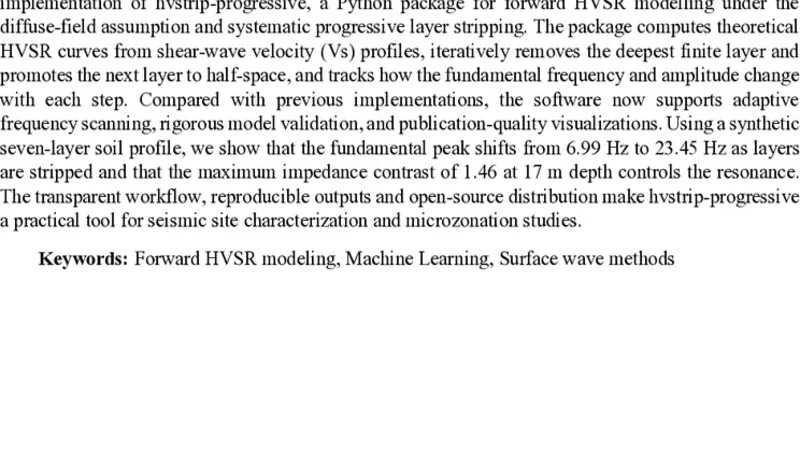
The horizontal-to-vertical spectral ratio (HVSR) technique is widely used to determine site fundamental periods from ambient noise recordings, but relating the observed peak to a specific impedance contrast within layered soils remains challenging. This paper presents an enhanced implementation of hvstrip-progressive, a Python package for forward HVSR modelling under the diffuse-field assumption and systematic progressive layer stripping. The package computes theoretical HVSR curves from shear-wave velocity (Vs) profiles, iteratively removes the deepest finite layer and promotes the next layer to half-space, and tracks how the fundamental frequency and amplitude change with each step. Compared with previous implementations, the software now supports adaptive frequency scanning, rigorous model validation, and publication-quality visualizations. Using a synthetic seven-layer soil profile, we show that the fundamental peak shifts from 6.99 Hz to 23.45 Hz as layers are stripped and that the maximum impedance contrast of 1.46 at 17 m depth controls the resonance. The transparent workflow, reproducible outputs and open-source distribution make hvstrip-progressive a practical tool for seismic site characterization and microzonation studies.
💡 Research Summary
The paper addresses a long‑standing difficulty in horizontal‑to‑vertical spectral ratio (HVSR) analysis: linking the observed resonance peak to a specific impedance contrast within a layered subsurface. To this end, the authors present an upgraded implementation of the hvstrip‑progressive Python package, which performs forward HVSR modelling under the diffuse‑field (DF) assumption and introduces a systematic “progressive layer stripping” workflow.
Under the DF hypothesis, ambient noise recorded at the surface is assumed to be a diffuse wavefield whose power spectral density is directly proportional to the imaginary part of the Green’s function. This permits a closed‑form expression for the theoretical HVSR curve that depends only on the shear‑wave velocity (Vs) profile, layer thicknesses, densities, and damping ratios. The package first converts an input Vs profile into complex impedances and transfer matrices for each layer, then computes the full‑field HVSR spectrum.
The novel progressive stripping algorithm iteratively removes the deepest finite layer, promotes the next layer to be the new half‑space, and recomputes the HVSR curve at each step. By tracking the fundamental frequency (f0) and peak amplitude (HVSRmax) as layers are stripped, the method reveals which depth and which impedance contrast dominate the resonance. This stepwise approach transforms the traditionally qualitative interpretation of HVSR peaks into a quantitative mapping between frequency and subsurface structure.
A key practical improvement is adaptive frequency scanning. Earlier versions used a uniform frequency grid, which could miss narrow peaks or waste computation on irrelevant ranges. The new routine performs an initial coarse scan, identifies candidate peaks, and then inserts finer frequency points around each candidate until convergence criteria on peak location and amplitude are satisfied. This yields high‑resolution peak detection with modest computational cost.
Robust model validation is built into the workflow. Input profiles are automatically checked for physical plausibility (positive Vs, realistic densities, non‑negative damping), continuity of impedance across interfaces, and reasonable layer thicknesses. Violations trigger detailed log messages and optional visual warnings, preventing the propagation of unrealistic models.
Visualization has been upgraded to produce publication‑quality figures using Matplotlib. For each stripping step the package plots the HVSR curve, the corresponding impedance contrast profile, and annotates the current half‑space parameters. A single composite figure can therefore display the entire stripping sequence, making it easy for readers to see how the resonance evolves as deeper layers are removed.
The authors demonstrate the capabilities with a synthetic seven‑layer soil model. The profile exhibits a maximum impedance contrast of 1.46 at a depth of 17 m, which the analysis identifies as the driver of the fundamental resonance. As layers are stripped, the fundamental frequency shifts from 6.99 Hz (full model) to 23.45 Hz (only the shallowest layer retained), and the peak amplitude varies non‑linearly, illustrating the sensitivity of HVSR to both contrast magnitude and depth. This synthetic test validates that the progressive stripping approach can correctly attribute a peak to its controlling interface.
Beyond the technical contributions, the paper emphasizes reproducibility and open science. The hvstrip‑progressive code, documentation, example notebooks, and an automated test suite are released on GitHub under an MIT license, enabling other researchers to replicate the results, adapt the workflow to field data, and extend the methodology. The authors outline future work that includes incorporating nonlinear soil behavior, three‑dimensional basin effects, and systematic validation against real ambient‑noise HVSR recordings from diverse geological settings.
In summary, the enhanced hvstrip‑progressive package provides a rigorous, transparent, and user‑friendly tool for forward HVSR modelling and for dissecting the depth‑frequency relationship inherent in ambient‑noise site response. Its adaptive scanning, built‑in validation, and progressive stripping analysis together make it a valuable asset for seismic site characterization, micro‑zonation studies, and for advancing the theoretical understanding of HVSR phenomena.
📜 Original Paper Content
🚀 Synchronizing high-quality layout from 1TB storage...