Funding, authorship patterns and citation impact of articles funded by Ukrainian agencies before and during Russia's full-scale war (2020-2023)
This study explores funding, authorship patterns, and citation impact of articles funded by the Ministry of Education and Science of Ukraine (MESU), the National Academy of Sciences of Ukraine (NASU),
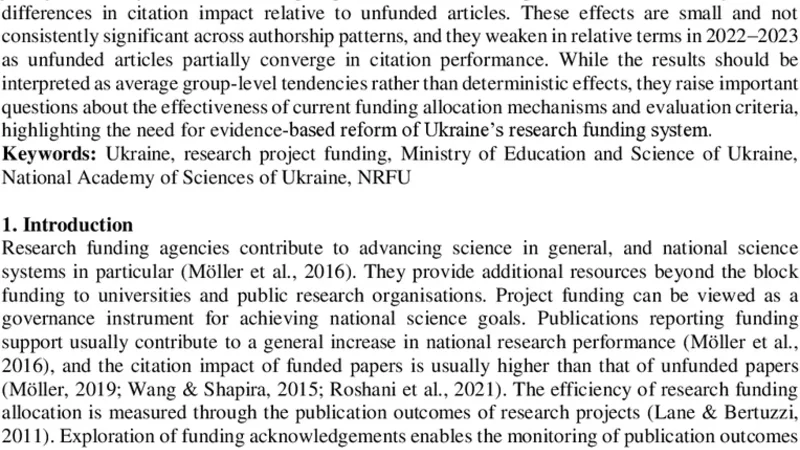
This study explores funding, authorship patterns, and citation impact of articles funded by the Ministry of Education and Science of Ukraine (MESU), the National Academy of Sciences of Ukraine (NASU), and the National Research Foundation of Ukraine (NRFU). The analysis focuses on articles published in Scopus-indexed journals between 2020 and 2023. The findings show that the share of articles funded by these agencies increased from 8.6% in 2020-2021 to 11.9% in 2022-2023. Foreign co-funding as well as international co-authorship and co-affiliations are consistently associated with higher citation impact. In particular, foreign co-affiliations are associated with higher field-normalised citation impact (FNCI) for MESU-funded articles in 2022-2023, exceeding that of articles jointly funded by MESU and foreign agencies. NASU funding is associated with only modest differences in citation impact relative to unfunded articles. These effects are small and not consistently significant across authorship patterns and become less pronounced in 2022-2023, as the citation impact of unfunded articles partially converges with that of funded articles. While the results should be interpreted as average group-level tendencies rather than deterministic effects, they raise important questions about the effectiveness of current funding allocation mechanisms and evaluation criteria, highlighting the need for evidence-based reform of Ukraine’s research funding system.
💡 Research Summary
This paper investigates how funding from three Ukrainian agencies—the Ministry of Education and Science of Ukraine (MESU), the National Academy of Sciences of Ukraine (NASU), and the National Research Foundation of Ukraine (NRFU)—shapes publication output, patterns of international collaboration, and citation impact in the period spanning 2020 to 2023. Using Scopus‑indexed articles as the data set, the authors first identify the funding source for each paper, then classify authors by country and institutional affiliation to detect international co‑authorship and co‑affiliation. Citation performance is measured with the field‑normalized citation impact (FNCI), which controls for disciplinary and yearly citation differences.
The analysis is divided into two chronological windows: 2020‑2021 (pre‑war and early‑war phase) and 2022‑2023 (full‑scale invasion period). The share of articles acknowledging any of the three agencies rose from 8.6 % in the first window to 11.9 % in the second, indicating that research funding activity intensified despite the conflict. Across all agencies, papers that received foreign co‑funding or involved international co‑authors/co‑affiliations consistently achieved higher FNCI scores than purely domestic‑funded works. The effect is strongest for MESU‑funded papers: in 2022‑2023, articles with foreign co‑affiliations outperform even those jointly funded by MESU and a foreign agency, suggesting that the mere presence of an international institutional link is a powerful driver of citation impact. By contrast, NASU‑funded papers show only modest, often statistically insignificant, differences in FNCI relative to unfunded articles, implying that the current NASU allocation mechanisms do not translate into measurable citation advantage. NRFU results are limited by sample size but follow a similar pattern to MESU.
A notable temporal trend is the convergence of citation impact between funded and unfunded articles in the later window. Unfunded papers experience a rise in FNCI, narrowing the gap that existed in 2020‑2021. This may reflect increased visibility of Ukrainian research through international collaborations, or a broader shift in citation behavior during the war. The authors acknowledge several limitations: reliance on Scopus excludes non‑indexed journals and conference proceedings; FNCI captures only short‑term citation dynamics; and the study does not account for funding magnitude, project duration, or discipline‑specific funding strategies.
Policy implications are drawn from these findings. First, the positive association between international co‑affiliation and citation impact underscores the value of policies that facilitate cross‑border partnerships, especially for MESU, which could institutionalize mechanisms to encourage foreign co‑affiliation. Second, the modest effect of NASU funding suggests a need to revisit its evaluation criteria and perhaps incorporate citation‑based metrics into funding decisions. Third, the observed resilience of Ukrainian research output during a full‑scale war highlights the importance of flexible, rapid‑response funding streams and robust international networks to sustain scientific activity under crisis conditions. Finally, the authors advocate for a multi‑dimensional assessment framework that goes beyond simple publication counts, integrating field‑normalized citation metrics to better capture research quality and impact.
In sum, the study provides empirical evidence that, in Ukraine, funding agency, international collaboration, and co‑affiliation jointly shape citation outcomes, with the effect varying across agencies and over time. It calls for evidence‑based reforms of the Ukrainian research funding system to better align financial support with measurable scientific impact, especially in the challenging context of ongoing conflict.
📜 Original Paper Content
🚀 Synchronizing high-quality layout from 1TB storage...