Interplay of interlayer distance and in-plane lattice relaxations in encapsulated twisted bilayers
Encapsulation protects functional layers, ensuring structural stability and improving the quality of assembled van der Waals heterostructures. Here, we develop a model that describes lattice relaxation in twisted bilayers accounting for encapsulation effects, incorporated via a single parameter characterizing rigidity of encapsulation material interfaces. By analysing the twist-angle dependence of weak-to-strong lattice relaxation transition in twisted transition metal dichalcogenide bilayers, we show that increasing interface rigidity raises the crossover twist angle between the two relaxation regimes. Furthermore, tuning this rigidity parameter allows to achieve a good agreement with existing experimental results.
💡 Research Summary
The paper presents a comprehensive theoretical framework for understanding how encapsulation influences lattice relaxation in twisted bilayers of transition‑metal dichalcogenides (TMDs). While previous studies have focused on suspended (non‑encapsulated) systems, recent experiments have shown that encapsulating TMD bilayers in hexagonal boron nitride (hBN) shifts the crossover between weak and strong relaxation regimes to larger twist angles. To capture this effect, the authors introduce a single phenomenological parameter k that quantifies the rigidity of the interface between the TMD bilayer and the surrounding encapsulation slabs.
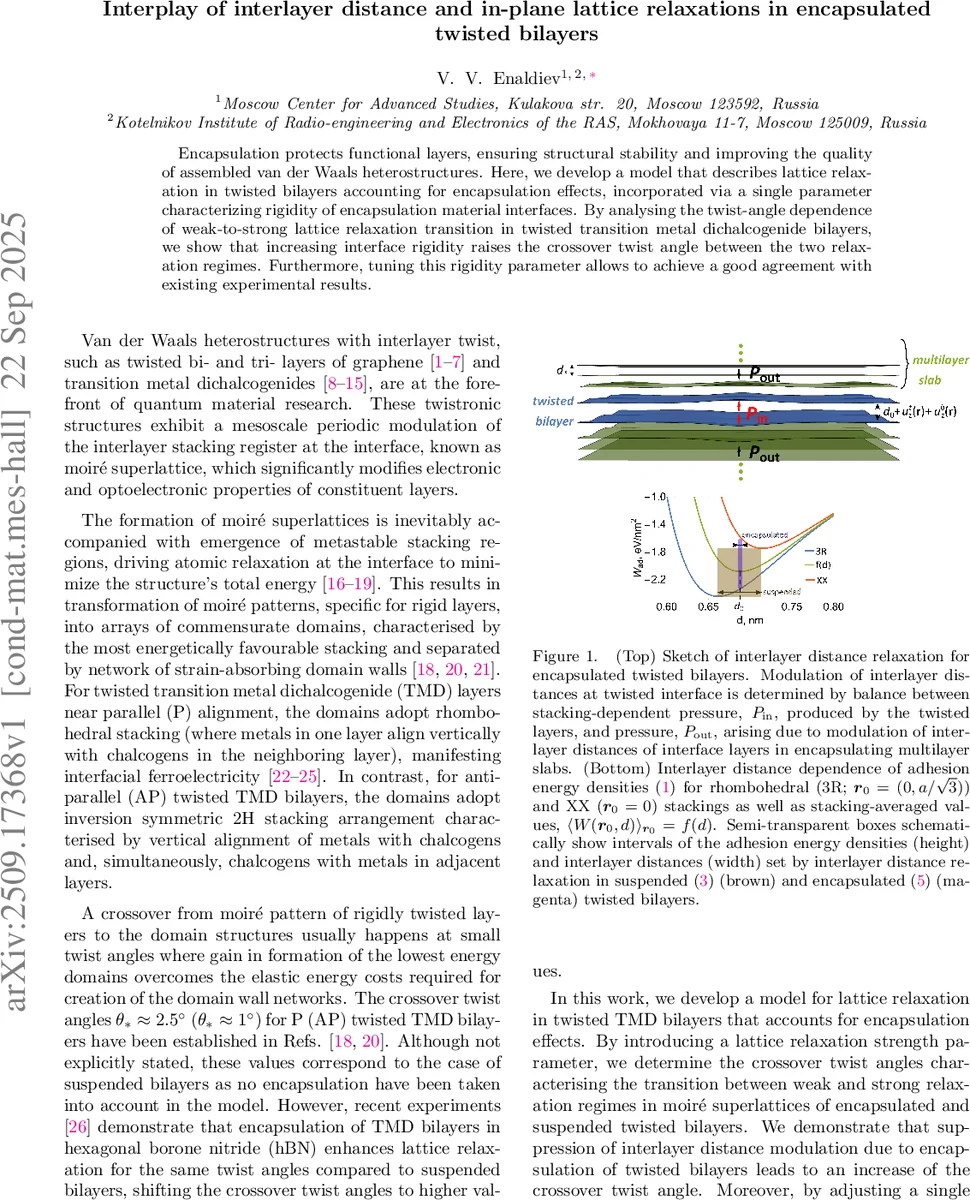
The starting point is the stacking‑dependent adhesion energy W_ad(r₀,d) (Equation 1), which depends on the in‑plane offset r₀ and the interlayer distance d. In the suspended case, the interlayer distance locally minimizes W_ad, leading to a simple cosine‑sine modulation (Equation 3). To incorporate encapsulation, the authors model each encapsulating slab as an elastic medium with a harmonic out‑of‑plane binding potential W_u/d(d)=½k(d−d*)² (Equation 4). The pressure exerted by the TMD bilayer (P_in) must balance the pressure from the slab (P_out), yielding a modified distance modulation (Equation 5). This expression reduces to the suspended result when k=0 and to a completely rigid case when k≫4ε, where ε is the curvature of f(d) around its minimum. Thus, increasing k suppresses the amplitude of interlayer‑distance variations across the moiré supercell.
In‑plane relaxation is then treated by introducing displacement fields u_t(r) and u_b(r) for the top and bottom layers. The total energy (Equation 6) combines the elastic energy (characterized by Lamé parameters λ and μ) and the locally evaluated adhesion energy W_ad(r₀(r), d_enc(r₀(r))). The authors expand the displacement fields in Fourier series consistent with the moiré periodicity and numerically minimize the energy functional for a range of twist angles θ and interface rigidities k.
A key observable is the relaxation‑strength parameter R_ν(θ)=S_XX_ν(θ)/S_sc(θ), where S_XX_ν is the area of regions with XX stacking (the high‑energy stacking) and S_sc is the area of a moiré supercell. For large angles (θ ≳ 5°) the system remains in a weak‑relaxation regime; R_ν saturates at a value R_max independent of k. For small angles (θ < 2°) strong relaxation creates well‑defined triangular domains separated by domain walls, and R_ν scales as θ², reflecting the fixed minimal area of the XX regions. The transition between these regimes is continuous in θ, but the authors define a crossover angle θ* as the point where R_ν reaches 0.66 R_max (the upper bound of the transition interval).
Numerical results show that θ* shifts systematically with k. In the suspended limit (k=0) the crossover occurs at θ*≈3.8°, consistent with earlier theoretical estimates for free‑standing TMD bilayers. When the interface is perfectly rigid (k≫4ε), θ* moves to ≈4.5°, an increase of about 0.75°. This shift matches the experimentally observed ∆θ*≈1° between hBN‑encapsulated and suspended P‑WSe₂ bilayers reported in Ref.
Comments & Academic Discussion
Loading comments...
Leave a Comment