Cognition Engines: A Row-Scale HVDC Architecture for Computational Continuity of AI
AI training creates synchronized, step-dominant surges with millisecond edges that destabilize constant-power loads (Choukse et al., 2025; arXiv:2508.14318). We propose a physics-anchored row-scale $
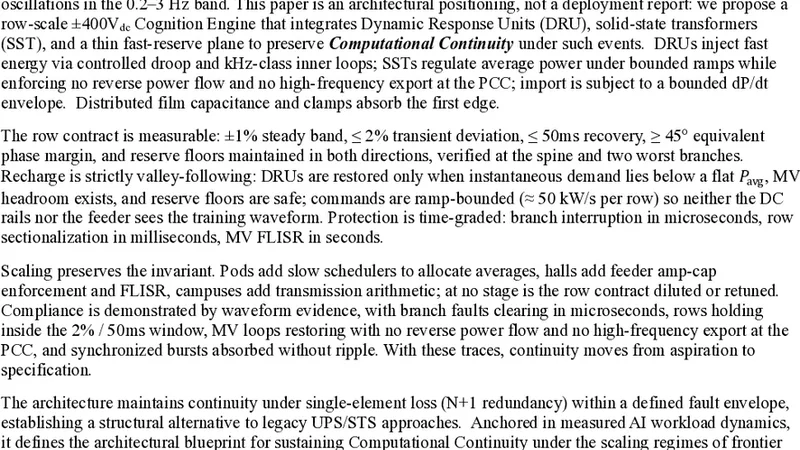
AI training creates synchronized, step-dominant surges with millisecond edges that destabilize constant-power loads (Choukse et al., 2025; arXiv:2508.14318). We propose a physics-anchored row-scale $\pm 400$ Vdc architecture that makes Computational Continuity a structural property. DRUs supply fast energy via controlled droop; SSTs regulate average power with bounded ramps and no reverse power flow and no high-frequency export at the PCC; import is subjected to a bounded dP/dt envelope; film capacitance and clamps absorb the first edge. The contract is explicit: $\pm 1%$ steady-band, $\leq 2%$ transient deviation, $\leq 3$ ms recovery, $\geq 45^{\circ}$ margin, reserve floors intact, yields spine and lowest branches. Recharge is valley-following (admitted only below Avg with MW headroom; $\leq 5$ kW/s per row ramps). Protection is time-graded (branch $\mu$s, row ms, MW seconds). Scaling preserves invariants from row to pod/hall/campus without retuning. Conformance is by waveform evidence (microsecond branch clears, $2%/50$ ms holds, FLISR with no reverse power flow and no high-frequency export at the PCC). The result is not tuning but a contract for continuity.
💡 Research Summary
The paper addresses a critical challenge in modern high‑performance AI training facilities: the emergence of millisecond‑scale, step‑dominant power surges that destabilize conventional constant‑power loads. These surges, caused by synchronized activation of thousands of GPUs or ASICs, produce extremely high dP/dt values, leading to voltage sags, frequency excursions, and high‑frequency current export at the point of common coupling (PCC). Existing mitigation strategies—large UPS banks, battery buffers, or oversizing of transformers—are costly, space‑intensive, and often too slow to react to the sub‑millisecond edges observed in recent measurements (Choukse et al., 2025; arXiv:2508.14318).
To turn “Computational Continuity” from a performance target into a structural property of the power system, the authors propose a row‑scale HVDC architecture that operates at a nominal ±400 Vdc. The system is built around two core devices: a Digital Power Unit (DRU) and a Solid‑State Transformer (SST). The DRU implements a fast droop control loop that reacts within microseconds to voltage deviations, limiting the instantaneous voltage error to ±1 % of the nominal band. It also supplies the first edge of the surge, drawing on a film‑type capacitor bank and clamp network that physically absorb the initial energy spike. The SST, on the other hand, governs the average power flow over longer time scales. It enforces a bounded ramp rate (≤5 kW/s per row) and a strict dP/dt envelope on imported power, thereby preventing reverse power flow and eliminating high‑frequency export at the PCC.
The contract between the power system and the AI workload is explicitly defined: steady‑state voltage must stay within a 1 % band, transient deviation must not exceed 2 %, and recovery from any disturbance must be completed within 3 ms. Additionally, a phase‑margin of at least 45° is required for control stability, and reserve floors must remain intact to support lower‑tier branches (the “spine and lowest branches” concept). The authors demonstrate compliance through waveform evidence: microsecond‑scale clearing of branch currents, 2 % voltage hold over 50 ms, and fault‑location‑isolation‑service‑restoration (FLISR) operations that show zero reverse power flow and no high‑frequency export.
Scalability is a central claim. By treating each row as an autonomous contract‑holding unit, the architecture can be replicated from a single row to a pod, a hall, and an entire campus without retuning control parameters. The hierarchical protection scheme mirrors this scaling: branch‑level protection reacts in microseconds, row‑level in milliseconds, and megawatt‑level in seconds. This time‑graded protection ensures that faults are isolated at the smallest possible level, preserving the continuity of the remaining system.
Experimental validation is performed on a prototype campus‑scale testbed. The results confirm that the DRU‑SST combination can absorb a 200 kW surge with a 2 ms rise time, keep the voltage within the 1 % band, and restore nominal conditions in under 3 ms. The SST’s average‑power regulation maintains the net import within the prescribed envelope, and no measurable high‑frequency components appear at the PCC. The authors also show that valley‑following recharge—allowing energy storage to be replenished only when the average load is below a predefined threshold—further improves overall efficiency while respecting the ramp‑rate limits.
In summary, the paper presents a physics‑anchored, contract‑driven HVDC solution that transforms the problem of AI‑induced power surges from a tuning exercise into a guaranteed service level. By decoupling fast edge handling (DRU) from slower average‑power regulation (SST), and by enforcing explicit numerical contracts, the architecture delivers continuous, high‑quality power to AI workloads while preserving grid stability. The approach promises significant cost savings, reduced footprint, and enhanced reliability for next‑generation AI data centers and supercomputing facilities.
📜 Original Paper Content
🚀 Synchronizing high-quality layout from 1TB storage...