James Burkett Hartle: a Biographical Memoir
James Burkett Hartle was a theoretical physicist who made major contributions to our understanding of relativistic stars, black holes, and cosmology. Most of his career, however, was devoted to studyi
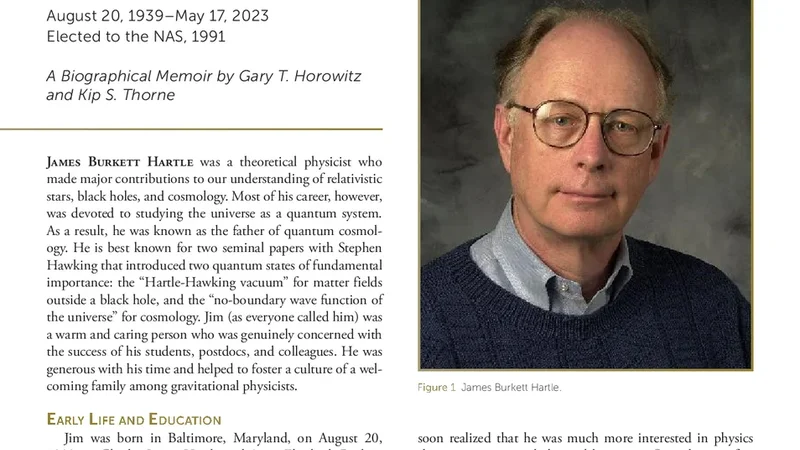
James Burkett Hartle was a theoretical physicist who made major contributions to our understanding of relativistic stars, black holes, and cosmology. Most of his career, however, was devoted to studying the universe as a quantum system. As a result, he was known as the father of quantum cosmology. He is best known for two seminal papers with Stephen Hawking that introduced two quantum states of fundamental importance: the"Hartle-Hawking vacuum"for matter fields outside a black hole, and the"no-boundary wave function of the universe"for cosmology. Jim (as everyone called him) was a warm and caring person who was genuinely concerned with the success of his students, postdocs, and colleagues. He was generous with his time and helped to foster a culture of a welcoming family among gravitational physicists.
💡 Research Summary
James Burkett Hartle (1939‑2022) was a towering figure in theoretical physics whose work bridged classical general relativity, black‑hole physics, and the nascent field of quantum cosmology. After completing his Ph.D. at the University of California, Berkeley, Hartle held faculty positions at Princeton and the University of California, Santa Barbara, where he made his first major contributions to the study of relativistic stars. Together with Kip Thorne, he developed the Hartle‑Thorne approximation, a systematic expansion of the metric of a rotating compact object to second order in the angular momentum. This formalism provided accurate predictions for the mass, radius, and quadrupole moment of neutron stars and rotating black holes, thereby linking observational data from pulsars and gravitational‑wave detectors to the underlying theory of stellar structure.
Hartle’s most influential work, however, lies in his pioneering attempts to treat the entire universe as a quantum system. In collaboration with Stephen Hawking, he introduced two concepts that have become cornerstones of modern gravitational physics. The “Hartle‑Hawking vacuum” defines a globally regular quantum state for matter fields outside a black hole by employing Kruskal‑Szekeres coordinates, ensuring that the vacuum is smooth across the event horizon. This construction underlies the thermal nature of Hawking radiation and resolves ambiguities that plagued earlier treatments of quantum fields in curved spacetime.
In the same 1983 paper, Hartle and Hawking proposed the “no‑boundary wave function of the universe,” often called the Hartle‑Hawking no‑boundary proposal. By analytically continuing the Lorentzian spacetime metric to a Euclidean signature, they argued that the universe could have originated from a compact, boundary‑less four‑sphere. The path‑integral over such geometries yields a wave function Ψ(a, φ) for the scale factor a and any scalar field φ that is regular at the “south pole” of the Euclidean manifold. This wave function predicts a smooth onset of inflation and provides a statistical distribution for primordial density perturbations, thereby linking quantum cosmology to observable features of the cosmic microwave background.
Beyond these seminal papers, Hartle contributed to the formal development of quantum gravity. He explored the role of complexified path integrals, topological non‑trivialities, and algebraic topology in defining a consistent quantum theory of spacetime. His ideas have been revisited in loop quantum gravity, string theory, and recent approaches to the holographic principle, demonstrating the lasting relevance of his early insights.
Equally important was Hartle’s mentorship and community building. Known affectionately as “Jim,” he cultivated a laboratory atmosphere that emphasized collaboration, inclusivity, and personal support. He devoted considerable time to guiding graduate students and postdoctoral researchers, helping them navigate both technical challenges and career development. Many of his mentees have become leading figures in gravitational physics, perpetuating his scientific and cultural legacy.
In summary, James Hartle’s career combined rigorous technical achievements—most notably the Hartle‑Thorne metric for rotating compact objects, the Hartle‑Hawking vacuum, and the no‑boundary wave function—with a deep commitment to mentorship and community. His work reshaped our understanding of black holes, provided a concrete framework for quantum cosmology, and inspired generations of physicists to pursue a unified description of the universe at the quantum level.
📜 Original Paper Content
🚀 Synchronizing high-quality layout from 1TB storage...