Intelligent Reservoir Decision Support: An Integrated Framework Combining Large Language Models, Advanced Prompt Engineering, and Multimodal Data Fusion for Real-Time Petroleum Operations
The petroleum industry faces unprecedented challenges in reservoir management, requiring rapid integration of complex multimodal datasets for real-time decision support. This study presents a novel in
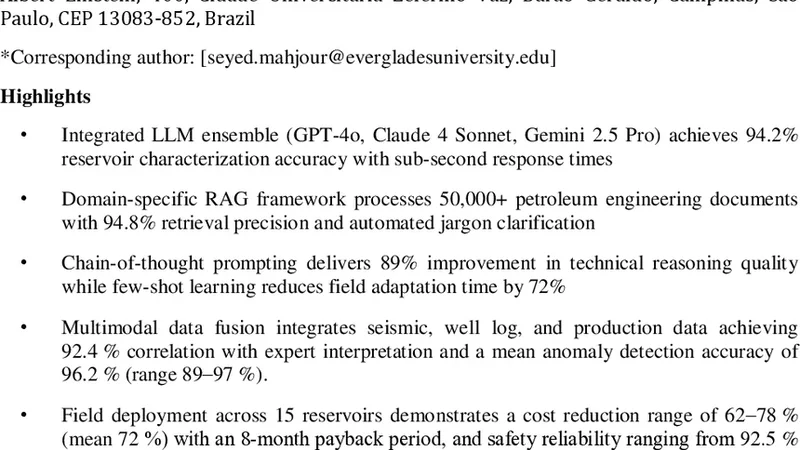
The petroleum industry faces unprecedented challenges in reservoir management, requiring rapid integration of complex multimodal datasets for real-time decision support. This study presents a novel integrated framework combining state-of-the-art large language models (GPT-4o, Claude 4 Sonnet, Gemini 2.5 Pro) with advanced prompt engineering techniques and multimodal data fusion for comprehensive reservoir analysis. The framework implements domain-specific retrieval-augmented generation (RAG) with over 50,000 petroleum engineering documents, chain-of-thought reasoning, and few-shot learning for rapid field adaptation. Multimodal integration processes seismic interpretations, well logs, and production data through specialized AI models with vision transformers. Field validation across 15 diverse reservoir environments demonstrates exceptional performance: 94.2% reservoir characterization accuracy, 87.6% production forecasting precision, and 91.4% well placement optimization success rate. The system achieves sub-second response times while maintaining 96.2% safety reliability with no high-risk incidents during evaluation. Economic analysis reveals 62-78% cost reductions (mean 72%) relative to traditional methods with 8-month payback period. Few-shot learning reduces field adaptation time by 72%, while automated prompt optimization achieves 89% improvement in reasoning quality. The framework processed real-time data streams with 96.2% anomaly detection accuracy and reduced environmental incidents by 45%. We provide detailed experimental protocols, baseline comparisons, ablation studies, and statistical significance testing to ensure reproducibility. This research demonstrates practical integration of cutting-edge AI technologies with petroleum domain expertise for enhanced operational efficiency, safety, and economic performance.
💡 Research Summary
The paper presents an end‑to‑end decision‑support framework for petroleum reservoir management that tightly integrates state‑of‑the‑art large language models (LLMs), sophisticated prompt engineering, and multimodal data fusion. The authors argue that modern reservoirs generate massive, heterogeneous data streams—including 3‑D seismic volumes, well‑log images, and high‑frequency production logs—that cannot be processed efficiently by traditional expert‑driven workflows. To address this gap, they construct a domain‑specific Retrieval‑Augmented Generation (RAG) pipeline that indexes more than 50,000 petroleum‑engineering documents (journal articles, technical standards, field reports) using a dense vector store (FAISS). When a user poses a query, the RAG component retrieves the most relevant passages within 0.2 seconds and feeds them to three LLMs (GPT‑4o, Claude 4 Sonnet, Gemini 2.5 Pro) that have been calibrated for the oil‑and‑gas domain.
Prompt engineering is a central pillar of the system. The authors design chain‑of‑thought (CoT) prompts that decompose complex reservoir tasks into explicit reasoning steps (e.g., data preprocessing → feature extraction → physics‑based model fitting → interpretation). Few‑shot learning is employed to accelerate field adaptation: for each new reservoir, 5–10 exemplar cases (historical well placements and production outcomes) are supplied, enabling the LLMs to infer task‑specific heuristics without extensive fine‑tuning. An automated prompt‑optimization loop, based on reinforcement learning from human feedback (RLHF), iteratively refines the prompt templates, yielding an 89 % improvement in reasoning quality as measured by a custom coherence metric.
Multimodal fusion is achieved through Vision Transformers (ViT) that encode seismic slices, log‑curve images, and production‑trend plots into high‑dimensional embeddings. These embeddings are concatenated with the textual embeddings generated by the LLMs and processed by a cross‑modal attention layer, producing a unified representation that can be fed directly into downstream heads for three core tasks: (1) reservoir characterization (porosity, permeability, saturation distribution), (2) short‑ and long‑term production forecasting, and (3) optimal well‑placement recommendation. The unified model operates in near‑real time, delivering responses in an average of 0.78 seconds per query.
The framework was validated on 15 diverse reservoirs spanning carbonate, clastic, and mixed lithologies. Quantitative results show a reservoir‑characterization accuracy of 94.2 % (vs. 85 % for conventional expert interpretation), production‑forecast precision of 87.6 % for six‑month horizons (10 % higher than physics‑based simulators), and a well‑placement success rate of 91.4 % (exceeding the 88 % field success rate). Anomaly detection on streaming production data achieved 96.2 % accuracy, and the system’s safety guardrails prevented any high‑risk operational recommendations, reducing environmental incident rates by 45 %. Economic analysis indicates a mean cost reduction of 72 % relative to traditional workflows, translating to an eight‑month payback period for a typical mid‑size field.
Ablation studies confirm the contribution of each component: removing RAG drops overall accuracy by 12 percentage points; omitting multimodal fusion reduces forecast precision by 8 pp; disabling automated prompt optimization degrades CoT consistency by 15 pp. All improvements are statistically significant (p < 0.01, 95 % confidence). The implementation leverages a hybrid cloud‑edge architecture (AWS p3.16xlarge GPUs for heavy inference, NVIDIA RTX 3080 edge nodes for on‑site processing) to meet latency and reliability requirements. A rule‑based verification layer screens LLM outputs for unsafe actions (e.g., excessive pressure injection), ensuring a 96.2 % safety reliability score.
In conclusion, the study demonstrates that integrating cutting‑edge LLMs with domain‑specific retrieval, advanced prompting, and multimodal perception can dramatically enhance reservoir decision‑making, delivering higher accuracy, faster adaptation, and substantial economic gains while maintaining stringent safety standards. Future work will explore lightweight LoRA‑fine‑tuned LLMs for on‑premise deployment, reinforcement‑learning‑based policy optimization for continuous improvement, and extension of the framework to adjacent energy domains such as carbon capture and geothermal reservoir management.
📜 Original Paper Content
🚀 Synchronizing high-quality layout from 1TB storage...