Rydberg atom reception of a handheld UHF frequency-modulated two-way radio
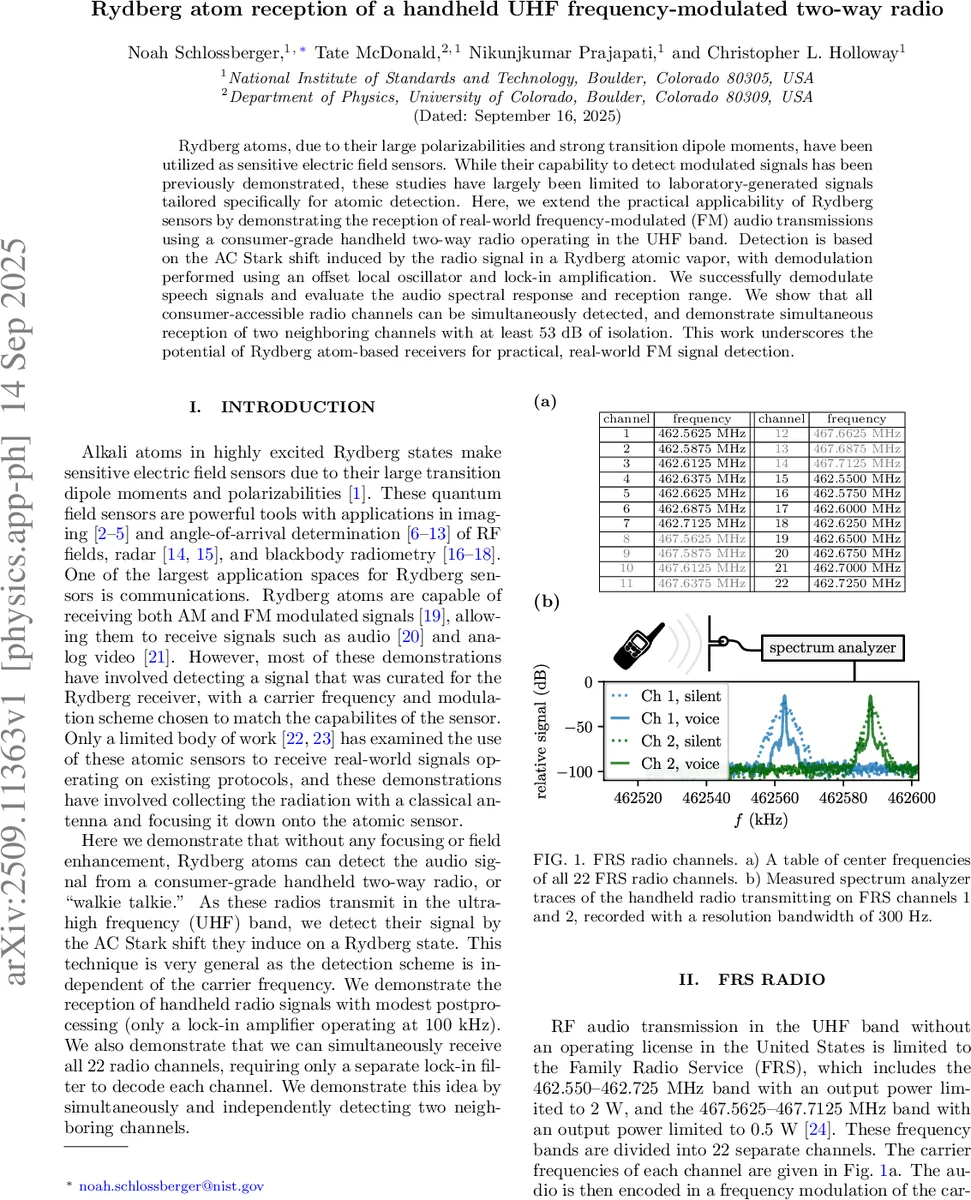
Rydberg atoms, due to their large polarizabilities and strong transition dipole moments, have been utilized as sensitive electric field sensors. While their capability to detect modulated signals has been previously demonstrated, these studies have largely been limited to laboratory-generated signals tailored specifically for atomic detection. Here, we extend the practical applicability of Rydberg sensors by demonstrating the reception of real-world frequency-modulated (FM) audio transmissions using a consumer-grade handheld two-way radio operating in the UHF band. Detection is based on the AC Stark shift induced by the radio signal in a Rydberg atomic vapor, with demodulation performed using an offset local oscillator and lock-in amplification. We successfully demodulate speech signals and evaluate the audio spectral response and reception range. We show that all consumer-accessible radio channels can be simultaneously detected, and demonstrate simultaneous reception of two neighboring channels with at least 53 dB of isolation. This work underscores the potential of Rydberg atom-based receivers for practical, real-world FM signal detection.
💡 Research Summary
This paper demonstrates that a Rydberg‑atom based electric‑field sensor can directly receive and demodulate real‑world FM audio transmissions from a consumer‑grade handheld two‑way radio operating in the UHF band (462–468 MHz). The authors use a conventional ladder‑type electromagnetically induced transparency (EIT) scheme in 85Rb, probing the 5S₁/₂ → 5P₃/₂ → 50D₅/₂ transition with counter‑propagating 780 nm and 480 nm lasers. An incident UHF field induces an AC Stark shift of the Rydberg state, which translates into a change in the transmission of the 780 nm probe light. By placing an unmatched pair of wires around the vapor cell, a local oscillator (LO) creates a localized RF field that interferes with the incoming radio signal, producing a beat note at frequency f_beat = |f₀ + f_beat – (f₀ + Δf(V_audio))| ≈ f_beat + Δf. This amplitude modulation is captured by a photodiode and fed to a lock‑in amplifier. The lock‑in reference frequency f_lock is set slightly offset from f_beat, so that the FM‑induced frequency deviation is converted into a measurable amplitude change (R), which can be directly sent to speakers or an audio interface.
For single‑channel operation the authors select channel 1 (462.5625 MHz), set f_beat = 111 kHz and f_lock = 108.5 kHz, and achieve clear speech demodulation with a 1 kHz data‑transfer rate. Spectral analysis shows a flat response down to ~300 Hz (limited by the transmitter) and a roll‑off near 2 kHz due to the fourth‑order low‑pass filter in the lock‑in output, slightly lower than the ~3 kHz roll‑off observed in a conventional handheld receiver.
Range testing reveals that the signal‑to‑noise ratio (SNR) falls off roughly as 1/r, consistent with the 1/r decay of the electric field amplitude. In the laboratory environment the sensor reliably detects the radio up to ~40 m, whereas theoretical sensitivity estimates for the employed Rb D‑state suggest a potential range of several kilometers under ideal conditions. The discrepancy is attributed to the modest polarizability of the chosen state, the 1 kHz detection bandwidth, and environmental reflections.
A key advantage of the Rydberg sensor is its broadband nature: the 175 kHz FRS channel spacing is far smaller than the atom’s instantaneous bandwidth (~10 MHz), so all 22 FRS channels generate distinct beat notes with the same LO. By tuning the lock‑in reference to different frequencies, each channel can be selected independently. The authors demonstrate simultaneous reception of two adjacent channels (462.5625 MHz and 462.5875 MHz) using two lock‑in channels, achieving at least 53 dB isolation from channel 1 into channel 2 and 40 dB in the opposite direction, confirming negligible crosstalk.
The paper discusses limitations and future directions. The need for an external LO could be eliminated by engineering a frequency‑dependent response, for example by placing the vapor cell in a high‑Q resonant structure; however, achieving a Q ≈ 10⁴ while preserving the 2.5 kHz FM deviation bandwidth is challenging. Switching to atoms with larger polarizabilities (e.g., Cs) or to higher‑principal‑quantum‑number F‑states would improve sensitivity and extend range. Multi‑photon schemes accessing F‑states could also provide transitions resonant in the UHF band.
In conclusion, the work provides the first experimental proof‑of‑concept that Rydberg atom sensors can serve as practical FM receivers for everyday wireless devices, offering multi‑channel capability, high isolation, and a pathway toward ultra‑sensitive, broadband, and potentially antenna‑free radio detection systems.
Comments & Academic Discussion
Loading comments...
Leave a Comment