An extension of $F$-spaces and its applications
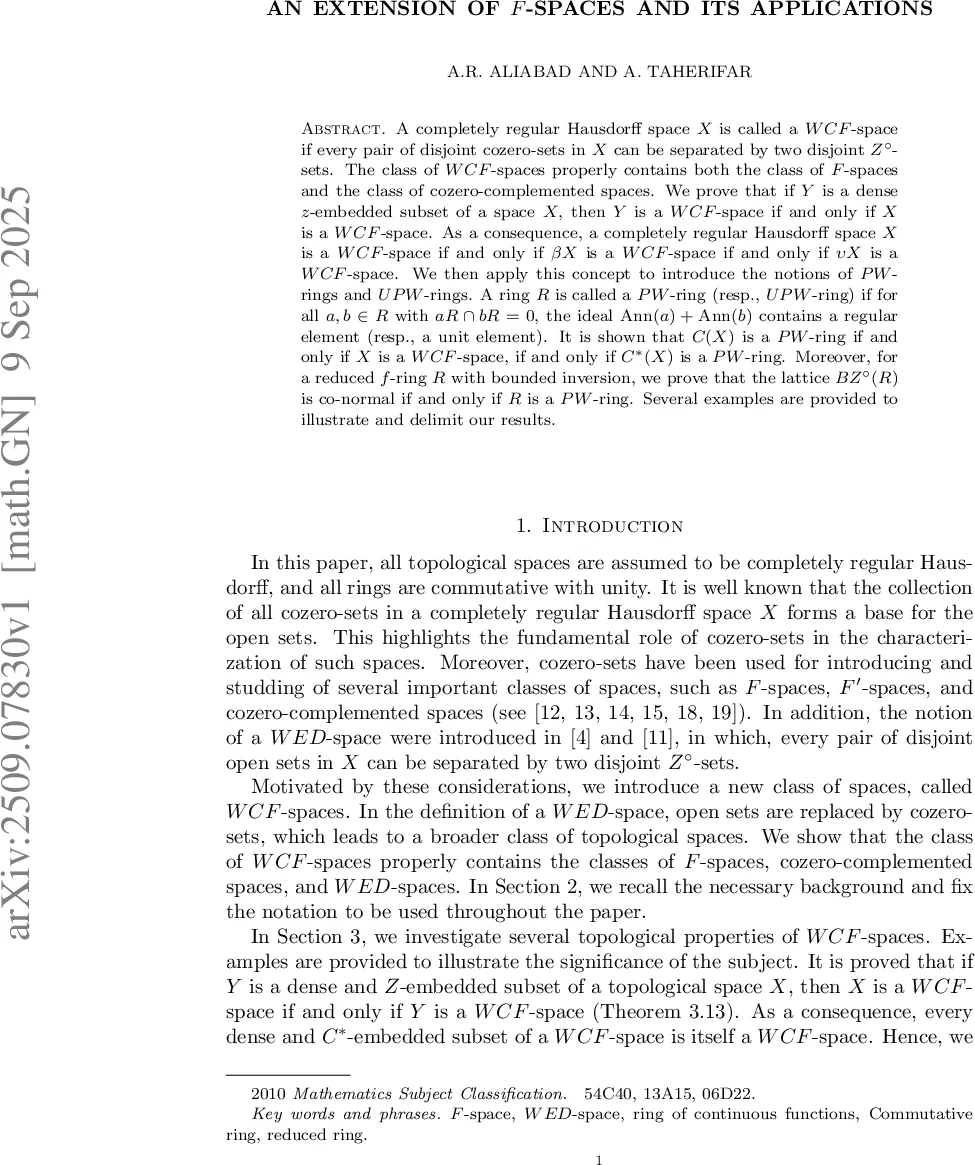
A completely regular Hausdorff space $X$ is called a $WCF$-space if every pair of disjoint cozero-sets in $X$ can be separated by two disjoint $Z^{\circ}$-sets. The class of $WCF$-spaces properly contains both the class of $F$-spaces and the class of cozero-complemented spaces. We prove that if $Y$ is a dense $z$-embedded subset of a space $X$, then $Y$ is a $WCF$-space if and only if $X$ is a $WCF$-space. As a consequence, a completely regular Hausdorff space $X$ is a $WCF$-space if and only if $βX$ is a $WCF$-space if and only if $\upsilon X$ is a $WCF$-space. We then apply this concept to introduce the notions of $PW$-rings and $UPW$-rings. A ring $R$ is called a $PW$-ring (resp., $UPW$-ring) if for all $a, b \in R$ with $aR \cap bR = 0$, the ideal $\Ann(a)+\Ann(b)$ contains a regular element (resp., a unit element). It is shown that $C(X)$ is a $PW$-ring if and only if $X$ is a $WCF$-space, if and only if $C^{*}(X)$ is a $PW$-ring. Moreover, for a reduced $f$-ring $R$ with bounded inversion, we prove that the lattice $BZ^{\circ}(R)$ is co-normal if and only if $R$ is a $PW$-ring. Several examples are provided to illustrate and delimit our results.
💡 Research Summary
The paper introduces a new topological class called WCF‑spaces and investigates its algebraic counterpart, the PW‑rings (and UPW‑rings).
A completely regular Hausdorff space (X) is defined to be a WCF‑space if for any two disjoint cozero‑sets (A,B\subseteq X) there exist zero‑sets (Z_{1},Z_{2}) with (A\subseteq Z_{1}), (B\subseteq Z_{2}) such that the interiors of (Z_{1}) and (Z_{2}) are disjoint. This condition replaces the open‑set requirement of the previously studied WED‑spaces with cozero‑sets, thereby producing a strictly larger class. The authors prove that every F‑space and every cozero‑complemented space is a WCF‑space, and that WED‑spaces are also WCF‑spaces. Several examples demonstrate that the inclusions are proper: a free union of an F‑space and a cozero‑complemented space yields a WCF‑space that is neither an F‑space nor cozero‑complemented; a P‑space with a single non‑isolated point is a WCF‑space but not a WED‑space; and a one‑point compactification of an uncountable discrete space fails to be a WCF‑space.
A central topological result (Theorem 3.13) shows that dense (z)-embedded subspaces preserve the WCF property: if (Y) contains a dense (z)-embedded subset (X), then (X) is a WCF‑space iff (Y) is. Consequently, the Stone–Čech compactification (\beta X) and the realcompactification (\upsilon X) are WCF‑spaces exactly when (X) is (Corollary 3.14). This transferability is crucial for the algebraic applications that follow.
On the algebraic side, the authors define a PW‑ring as a commutative ring with identity such that for any elements (a,b) with (aR\cap bR=0), the sum of their annihilators (\operatorname{Ann}(a)+\operatorname{Ann}(b)) contains a regular element (i.e., a non‑zero‑divisor). A UPW‑ring requires the sum to contain a unit. These notions generalize earlier concepts of W‑rings (regular element) and U‑rings (unit). Basic closure properties are established: a direct product of rings is a PW‑ring iff each factor is (Proposition 4.4), and for reduced rings, the condition that (\operatorname{Ann}(I)+\operatorname{Ann}^{2}(I)) contains a regular element for every ideal (I) is equivalent to being a W‑ring (Theorem 4.8).
The pivotal connection between topology and algebra is the equivalence:
- (C(X)) (the ring of all real‑valued continuous functions on (X)) is a PW‑ring iff (X) is a WCF‑space iff (C^{*}(X)) (the subring of bounded continuous functions) is a PW‑ring.
Thus, the separation property of cozero‑sets in (X) translates directly into the existence of regular elements in the sum of annihilators of disjoint principal ideals of (C(X)). Moreover, the authors prove that for reduced (f)-rings with bounded inversion (a class that includes all (C(X))), the lattice (BZ^{\circ}(R)={P_{f}:f\in R}) is co‑normal precisely when (R) is a PW‑ring (Proposition 4.14). Co‑normality means that for any two elements whose meet is zero, there exist complementary elements whose joins are the top element and each is disjoint from one of the original elements. This result links lattice‑theoretic properties to the PW‑condition, providing a new perspective on the structure of ideals in function rings.
The paper supplies a rich collection of examples and counterexamples to delineate the boundaries of the introduced concepts. Notably, spaces with a single non‑isolated point whose neighborhoods are determined by cardinality illustrate subtle distinctions: some are WCF‑spaces, some are not, depending on whether disjoint cozero‑sets can be made clopen. The authors also discuss how the WCF property behaves under taking open subsets and cozero‑subsets (Proposition 3.15).
In summary, the authors achieve three major contributions:
- Introduce and thoroughly analyze WCF‑spaces, establishing their place among known classes and proving stability under dense (z)-embeddings and compactifications.
- Define PW‑rings and UPW‑rings, showing how these algebraic notions capture the separation of cozero‑sets in the associated topological space.
- Connect lattice co‑normality with the PW‑property for reduced (f)-rings with bounded inversion, thereby unifying topological separation, ring‑theoretic regularity, and lattice theory.
The work opens several avenues for future research, such as extending WCF‑spaces beyond completely regular Hausdorff settings, exploring non‑commutative analogues of PW‑rings, and investigating further lattice‑theoretic characterizations of function rings.
Comments & Academic Discussion
Loading comments...
Leave a Comment