Characterizing a high-dimensional unitary transformation without measuring the qudit it transforms
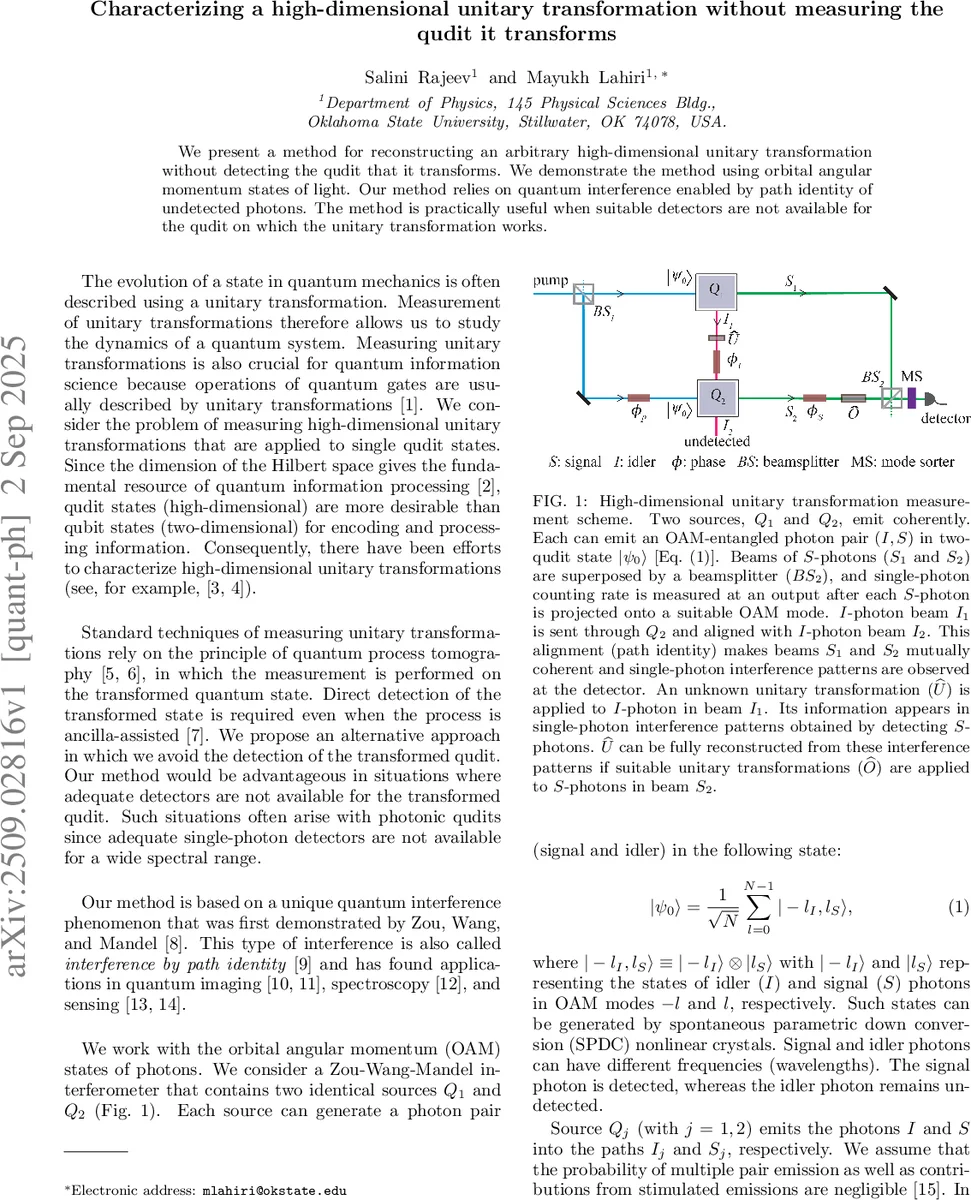
We present a method for reconstructing an arbitrary high-dimensional unitary transformation without detecting the qudit that it transforms. We demonstrate the method using orbital angular momentum states of light. Our method relies on quantum interference enabled by path identity of undetected photons. The method is practically useful when suitable detectors are not available for the qudit on which the unitary transformation works.
💡 Research Summary
The paper introduces a novel protocol for characterizing an arbitrary high‑dimensional unitary transformation without ever detecting the qudit (the photon) on which the transformation acts. The authors demonstrate the method experimentally using orbital angular momentum (OAM) modes of light, but the scheme is general and can be applied to any photonic degree of freedom. The core idea exploits the Zou‑Wang‑Mandel (ZWM) interferometer and the phenomenon of “path identity”: two identical spontaneous parametric down‑conversion (SPDC) sources (Q₁ and Q₂) each emit an idler–signal photon pair. The idler from Q₁ traverses the unknown unitary U and is then aligned perfectly with the idler from Q₂, making the two idler paths indistinguishable. Because the idlers are never measured, the two signal photons (S₁ and S₂) become mutually coherent and interfere at a balanced beam splitter. By applying a controllable known unitary O to the signal photon from Q₂ before interference, the single‑photon counting rate for a chosen OAM mode l, denoted Pₗ, takes the form
Pₗ ∝ 1 + N⁻¹ Σₖ |O_{lk}| |U_{kl}| sin(φ_in + arg U_{kl} – arg O_{lk}),
where φ_in is a tunable phase that can be varied experimentally. Consequently, each interference fringe encodes both the magnitude |U_{kl}| and the phase arg U_{kl} of a specific matrix element of the unknown unitary. By selecting O appropriately, one can isolate any desired element.
The authors define a “basic form” O_b(q,r), a two‑dimensional rotation acting only on OAM modes q and r while leaving all other modes untouched. By setting the rotation angle θ to 0 or π/2, the interference patterns give directly the four elements U_{qq}, U_{rr}, U_{qr}, and U_{rq} (both amplitudes and phases) via the visibility and phase shift of the sinusoidal fringes. Repeating this for every unordered pair (q,r) yields the full N×N matrix, requiring N(N‑1)/2 experimental configurations.
To reduce the experimental overhead, the authors show that several basic forms can be multiplied to form a “compound form” O_c. For a four‑dimensional system, two basic rotations O_b(0,1) and O_b(2,3) combined into O_c(0,1;2,3) allow the extraction of eight matrix elements from only eight interference patterns, halving the number of required settings. In general, up to ⌊N/2⌋ basic rotations can be combined, leading to at most N‑1 (for even N) or N (for odd N) compound forms to reconstruct the whole unitary.
The protocol is validated by reconstructing a four‑dimensional Hadamard gate. Sixteen interference patterns obtained from three compound forms reproduce the exact matrix: all amplitudes are ½ (visibility ½) and the relative phases match the theoretical values.
Key advantages of the method are: (i) no detection of the transformed qudit is needed, which is crucial when suitable single‑photon detectors are unavailable (e.g., in infrared or ultraviolet regimes); (ii) only single‑photon interference is required, eliminating the need for coincidence counting or post‑selection; (iii) the scheme is compatible with existing high‑dimensional OAM platforms and can be extended to other degrees of freedom. The main experimental challenges are maintaining precise path identity and phase stability, and ensuring low multi‑pair emission probabilities to keep the interference visibility high.
In summary, the work provides a practical, scalable technique for full tomography of high‑dimensional unitary operations without measuring the transformed photon, opening new possibilities for benchmarking high‑dimensional quantum gates, quantum communication channels, and quantum simulators where detector technology is a limiting factor.
Comments & Academic Discussion
Loading comments...
Leave a Comment