Conformal bootstrap: from Polyakov to our times
💡 Research Summary
The manuscript “Conformal bootstrap: from Polyakov to our times” provides a sweeping historical and technical survey of the conformal bootstrap program, tracing its roots from the early days of strong‑interaction and critical‑phenomena research in the 1960s‑70s to the sophisticated numerical implementations of the 2010s. The author begins by recounting the little‑known interactions at the 1970 Kyiv International Conference on High Energy Physics, where Western physicist Hans Kastrup met Soviet scientists Sasha Migdal and Sasha Polyakov. Their discussions highlighted the emerging idea that scale invariance and anomalous dimensions could describe critical phenomena, a notion that Polyakov formalized in a 1970 JETP Letters paper. In that work Polyakov derived the functional forms of three‑ and four‑point correlators from conformal invariance, checked them against the two‑dimensional Ising model, and introduced a skeleton‑expansion framework that was later dubbed the “old bootstrap”.
The “old bootstrap” relied on assuming conformal two‑point propagators and conformal n‑point vertices, but without a small expansion parameter it suffered from an overabundance of undetermined constants. The arrival of Wilson’s renormalization group (RG) and the ε‑expansion in the early 1970s quickly eclipsed this approach, although Wilson himself acknowledged that, had RG not been developed, the Migdal‑Polyakov bootstrap might have become the dominant paradigm.
Polyakov’s 1974 “Non‑Hamiltonian approach to conformal quantum field theory” marked a decisive shift. He abandoned the skeleton expansion, introduced a complete set of local primary operators, and emphasized that the operator product expansion (OPE) in a conformal field theory has a finite radius of convergence. Crucially, he proposed a dynamical equation for the OPE coefficient functions (the “C‑functions”) by demanding crossing symmetry of the four‑point function after inserting the OPE in different channels. Although he did not use the term “bootstrap”, his program—expressed in terms of “algebraic amplitudes” (conformal blocks) and “unitary amplitudes” (Mellin‑type objects that cancel logarithmic violations of the OPE)—became the conceptual ancestor of the modern bootstrap.
Parallel developments occurred in Rome (Gatto, Ferrara, Grillo, Parisi) and Sofia (Mack, Sofiá), who explored non‑perturbative CFTs and contributed to the early literature on conformal symmetry. The breakthrough of 1984, when Belavin, Polyakov, and Zamolodchikov introduced infinite‑dimensional Virasoro symmetry and the modern notion of conformal blocks, cemented the analytical bootstrap in two dimensions and opened the way to higher‑dimensional generalizations.
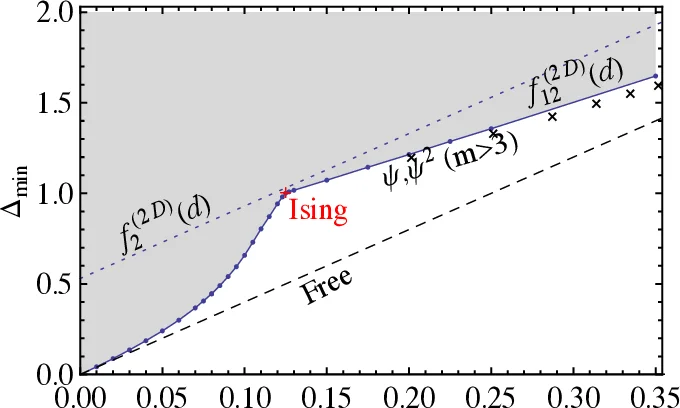
The second half of the paper focuses on the revival of the bootstrap as a numerical tool. Starting with the “conformal technicolor” bounds of 2006, researchers recast the bootstrap constraints as linear or semidefinite programming problems, turning the abstract crossing equations into concrete optimization tasks. The most celebrated achievement of this era is the precise determination of the three‑dimensional Ising model critical exponents (η, ν, etc.) between 2011 and 2014, surpassing the accuracy of traditional RG methods and demonstrating that the bootstrap can serve as a predictive, non‑perturbative computational framework.
Finally, the author outlines open challenges that will dominate future work: (i) Uniqueness problems – whether a given set of scaling dimensions and OPE coefficients uniquely defines a CFT; (ii) Existence problems – establishing rigorous proofs that solutions to the bootstrap equations correspond to bona‑fide quantum field theories; (iii) Bootstrapping 3D conformal gauge theories – extending the program to non‑abelian gauge dynamics; and (iv) the large‑Δ problem, where operators with very high scaling dimensions strain the convergence of the numerical algorithms.
In conclusion, the manuscript argues that conformal invariance is a fundamental symmetry of nature, deserving of continued experimental tests and theoretical refinement. By weaving together personal recollections, historical anecdotes, and technical developments, the paper offers both a narrative of how the bootstrap evolved from a speculative idea to a powerful modern methodology and a roadmap for the unresolved questions that will shape the field in the coming decades.
Comments & Academic Discussion
Loading comments...
Leave a Comment