The power of moral words: Loaded language generates framing effects in the extreme dictator game
Understanding whether preferences are sensitive to the frame has been a major topic of debate in the last decades. For example, several works have explored whether the dictator game in the give frame gives rise to a different rate of pro-sociality than the same game in the take frame, leading to mixed results. Here we contribute to this debate with two experiments. In Study 1 ($N=567$) we implement an extreme dictator game in which the dictator either gets $0.50 and the recipient gets nothing, or the opposite (i.e., the recipient gets $0.50 and the dictator gets nothing). We experimentally manipulate the words describing the available actions using six terms, from very negative (e.g., stealing) to very positive (e.g., donating) connotations. We find that the rate of pro-sociality is affected by the words used to describe the available actions. In Study 2 ($N=221$) we ask brand new participants to rate each of the words used in Study 1 from extremely wrong'' to extremely right’’ . We find that these moral judgments explain the framing effect in Study 1. In sum, our studies provide evidence that framing effects in an extreme Dictator game can be generated using morally loaded language.
💡 Research Summary
The paper investigates whether morally charged language can generate framing effects in a non‑strategic social decision problem, specifically an extreme version of the Dictator Game (DG). In the classic DG a dictator decides how to split a sum of money with an anonymous recipient, and many studies have examined whether framing the game as a “give” or “take” situation influences generosity. Results have been mixed, leading to uncertainty about the existence of framing effects when the economic outcomes are identical.
To isolate the influence of language, the authors designed an “extreme DG” in which the dictator has only two possible actions: either keep the entire $0.50 for herself/himself or give the entire $0.50 to the other participant. The monetary consequences are identical across conditions; only the wording describing the two actions varies. Six word pairs were selected based on sentiment analysis using SentiWordNet, ranging from strongly negative (“steal”) to strongly positive (“donate”). The pairs are: steal / don’t steal, take / don’t take, demand / don’t demand, give / don’t give, boost / don’t boost, and donate / don’t donate. Each pair was presented in two orders to control for order effects, yielding twelve experimental conditions.
Study 1 recruited 727 U.S. participants from Amazon Mechanical Turk (AMT). After removing duplicate entries and participants who failed two comprehension checks, the final sample comprised 567 subjects (52.7 % female, mean age 37.6 years). Participants were randomly assigned to one of the twelve wording conditions and then made the binary choice. The authors created a binary variable “Pro‑Sociality” equal to 1 if the participant gave the $0.50 to the other person, 0 otherwise. Overall, 14.1 % of decisions were pro‑social, but the rate varied dramatically across frames: the “steal” frame produced the highest pro‑social rate (29.5 %), while the “boost” frame produced the lowest (5.0 %). Pairwise logistic regressions showed that the “steal” wording led to significantly higher generosity than any other wording, and the “boost” wording led to significantly lower generosity than most alternatives. Thus, merely swapping a single word in the instructions altered behavior by a factor of six.
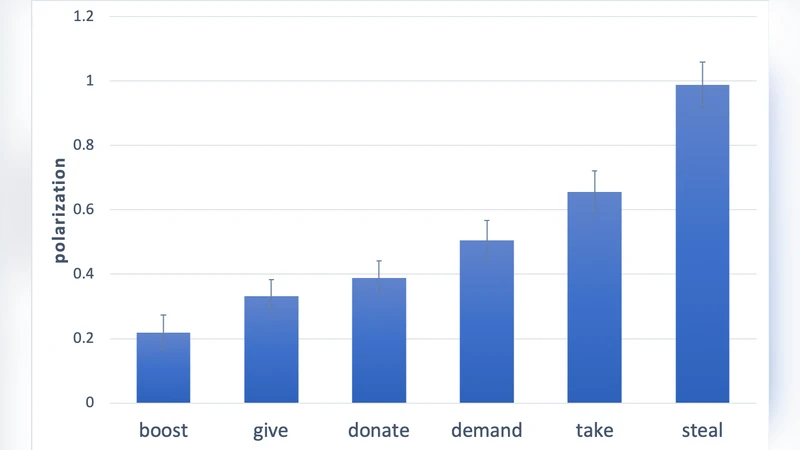
Study 2 aimed to explain why the wording mattered. A new sample of 250 U.S. AMT workers (221 after cleaning) was presented with the full instructions for each of the six frames, one after another, in random order. For each frame participants rated, on a 5‑point Likert scale (1 = “extremely wrong”, 5 = “extremely right”), the moral acceptability of both the pro‑self action (e.g., “steal”) and the pro‑social action (e.g., “don’t steal”). The authors defined the “polarization” of a frame as the difference between the moral rating of the pro‑social option and that of the pro‑self option. They then regressed the pro‑social choice rates from Study 1 on these polarization scores. The analysis revealed a strong positive relationship: frames with larger moral polarization (i.e., where the pro‑social option was judged much more right than the pro‑self option) yielded higher rates of generosity. This finding demonstrates that participants’ moral judgments of the words mediate the framing effect observed in the extreme DG.
Interpretation and Contributions
- Evidence of Moral Framing – The study provides clear, causal evidence that language with moral valence can shift behavior in a setting where the economic payoffs are identical. This supports the notion that “framing” in non‑strategic games can operate through moral preferences rather than through beliefs about others’ actions.
- Challenge to Standard Social‑Preference Models – Traditional models (Fehr‑Schmidt, Bolton‑Ockenfels, Charness‑Rabin) assume utility depends only on monetary outcomes and possibly inequity aversion. The observed effect cannot be explained by these models, suggesting the need to incorporate moral utility components.
- Methodological Innovation – By using sentiment‑based word selection and separating the measurement of moral judgments from the decision task (different participant pools), the authors isolate the psychological mechanism and provide a replicable protocol for future framing research.
Limitations
- The sample consists solely of U.S. MTurk workers; cultural differences may alter the moral connotations of the selected words.
- The extreme DG offers only two discrete choices, which may not capture the richness of real‑world allocation decisions that involve partial sharing.
- The study measures immediate choices; it remains unknown whether the framing effect persists over time or influences actual charitable behavior outside the laboratory.
Future Directions
Research could test the robustness of moral framing across cultures and languages, explore its impact in continuous‑choice DGs, and examine long‑term behavioral consequences. Additionally, integrating moral utility parameters into formal economic models would help predict when and how language will sway decisions.
In sum, the paper convincingly shows that morally loaded terminology alone can generate sizable framing effects in an extreme dictator game, and that participants’ moral evaluations of those terms quantitatively explain the behavioral variation. This work bridges experimental economics, moral psychology, and linguistics, highlighting the power of words in shaping human cooperation.
Comments & Academic Discussion
Loading comments...
Leave a Comment