An underdog story: Re-emergence of a polar instability at high pressure in KNbO3
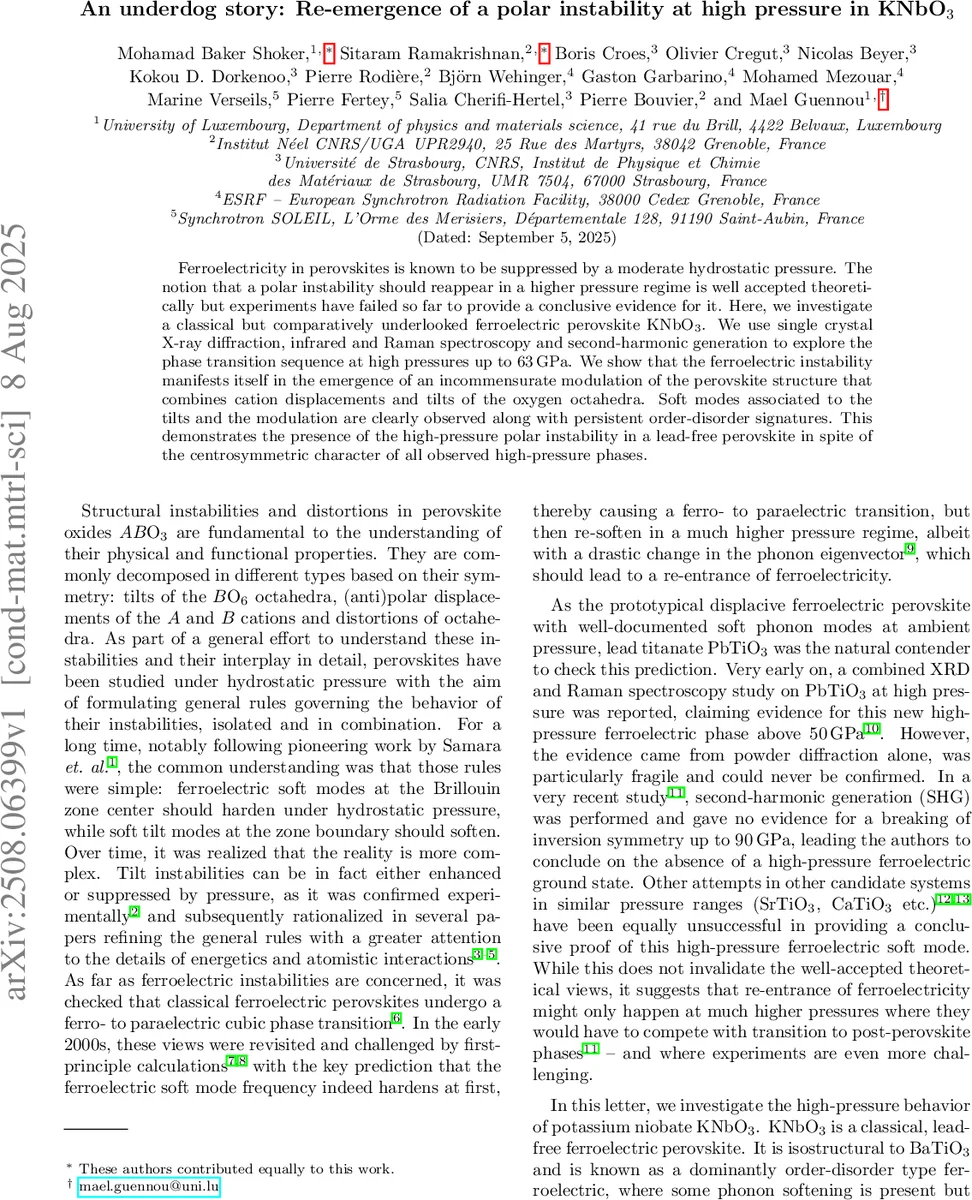
Ferroelectricity in perovskites is known to be suppressed by a moderate hydrostatic pressure. The notion that a polar instability should reappear in a higher pressure regime is well accepted theoretically but experiments have failed so far to provide a conclusive evidence for it. Here, we investigate a classical but comparatively underlooked ferroelectric perovskite KNbO3. We use single crystal X-ray diffraction, infrared and Raman spectroscopy and second-harmonic generation to explore the phase transition sequence at high pressures up to 63 GPa. We show that the ferroelectric instability manifests itself in the emergence of an incommensurate modulation of the perovskite structure that combines cation displacements and tilts of the oxygen octahedra. Soft modes associated to the tilts and the modulation are clearly observed along with persistent order-disorder signatures. This demonstrates the presence of the high-pressure polar instability in a lead-free perovskite in spite of the centrosymmetric character of all observed high-pressure phases.
💡 Research Summary
This paper presents a comprehensive experimental investigation of the high‑pressure behavior of the lead‑free ferroelectric perovskite potassium niobate (KNbO₃) up to 63 GPa, addressing a long‑standing theoretical prediction that ferroelectric (polar) instabilities can re‑emerge at very high pressures after being suppressed at moderate pressures. The authors combine single‑crystal X‑ray diffraction (XRD), Raman and infrared (IR) spectroscopy, and second‑harmonic generation (SHG) microscopy to map out structural, vibrational, and symmetry changes across several pressure‑induced phase transitions.
At low pressures (≤ 14 GPa) the material follows the well‑known sequence: orthorhombic Amm2 → tetragonal P4mm → cubic Pm 3̅m, with Raman spectra showing broad disorder‑related bands characteristic of the order‑disorder nature of KNbO₃. As pressure increases, the cubic phase first transforms to a tetragonal I4/mcm structure at ~37 GPa, identified by the appearance of superlattice reflections at the R‑point (½ ½ ½) and confirmed by refinements in the I‑centered lattice. This transition corresponds to the condensation of an anti‑phase octahedral tilt (a⁰a⁰c⁻ in Glazer notation) and matches density‑functional theory (DFT) calculations that predict a pressure‑enhanced tilt instability.
The most striking result occurs near 44 GPa, where additional satellite reflections appear at an incommensurate wave vector q ≈ 0.84 b*. The satellite positions shift continuously with pressure, reaching q ≈ 0.77 b* at higher pressures. Superspace analysis shows that a (3+1)‑dimensional superspace group I2/c(0σ1σ2)0s provides the best description, ruling out a (3+2)‑dimensional model. The refined structure reveals a complex modulation that couples displacements of the A‑site K⁺ and B‑site Nb⁵⁺ cations with additional octahedral tilts. Nb atoms shift longitudinally along the modulation direction, while K atoms undergo transverse displacements along the c‑axis. The most strongly modulated oxygen atoms (O2) generate a large variation of the Nb–O–Nb bond angle (144°–169°), indicating a superposition of the original anti‑phase tilt with an in‑phase tilt component. This combined displacement‑tilt modulation is unprecedented for a simple perovskite under pressure.
Raman spectroscopy captures the vibrational fingerprints of these transitions. Between 37 and 43 GPa, the emergence of soft tilt modes and the activation of Eg + B2g hard modes confirm the cubic‑to‑I4/mcm transition. At 44 GPa, a plethora of sharp peaks appear, among them two modes identified as amplitudon and phason, characteristic of incommensurate structures. These modes display a soft‑mode‑like hardening with pressure, supporting the view that the modulation activates phonons at specific k‑points rather than a continuous phonon density of states. Infrared reflectivity shows a strong mode near 400 cm⁻¹, assigned to the R‑4 antipolar Nb motion, whose intensity is unusually high, likely reflecting the proximity to the incommensurate state.
Second‑harmonic generation measurements provide a direct probe of macroscopic inversion symmetry. While a clear SHG signal is observed in the low‑pressure ferroelectric phases, the intensity drops to the noise level at ~14 GPa and remains undetectable up to the highest pressure studied. Importantly, the SHG experiments were performed on the same crystal used for the XRD measurements that confirmed the incommensurate phase, demonstrating that despite the local loss of inversion symmetry within the modulated structure, the overall crystal remains centrosymmetric at the macroscopic scale.
Overall, the study delivers the first unambiguous experimental evidence that a polar instability can indeed re‑appear at very high pressure in a lead‑free perovskite, albeit in a form that coexists with a pressure‑enhanced tilt instability and manifests as an incommensurate modulation rather than a simple ferroelectric phase. The findings reconcile earlier contradictory reports on PbTiO₃ and other perovskites, showing that the re‑entrance of ferroelectricity may be hidden behind complex structural modulations that preserve global inversion symmetry. This work opens new avenues for exploiting pressure‑tuned polar instabilities in functional oxides, suggesting that tailored incommensurate modulations could be used to engineer local non‑centrosymmetric environments while maintaining overall structural stability, with potential implications for high‑pressure nonlinear optics, pressure‑controlled ferroelectric memories, and the design of exotic quantum phases in perovskite materials.
Comments & Academic Discussion
Loading comments...
Leave a Comment