GW231123: Binary Black Hole Merger or Cosmic String?
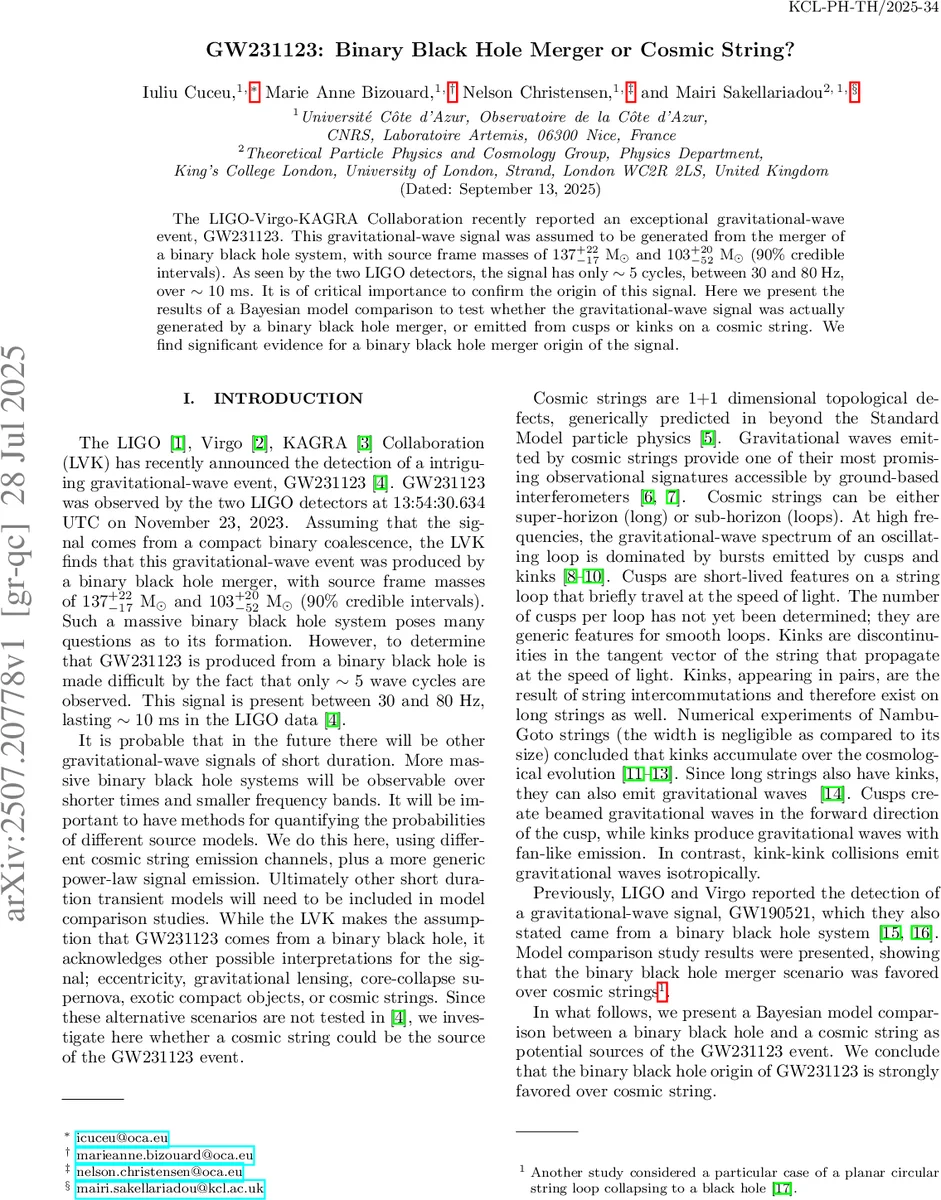
The LIGO-Virgo-KAGRA Collaboration recently reported an exceptional gravitational-wave event, GW231123. This gravitational-wave signal was assumed to be generated from the merger of a binary black hole system, with source frame masses of $137^{+22}{-17}~\textup{M}\odot$ and $103^{+20}{-52}~ \textup{M}\odot$ (90% credible intervals). As seen by the two LIGO detectors, the signal has only $\sim 5$ cycles, between 30 and 80 Hz, over $\sim 10$ ms. It is of critical importance to confirm the origin of this signal. Here we present the results of a Bayesian model comparison to test whether the gravitational-wave signal was actually generated by a binary black hole merger, or emitted from cusps or kinks on a cosmic string. We find significant evidence for a binary black hole merger origin of the signal.
💡 Research Summary
The paper presents a Bayesian model‑comparison study of the gravitational‑wave event GW231123, which was originally reported by the LIGO‑Virgo‑KAGRA collaboration as a high‑mass binary black‑hole (BBH) merger with source‑frame component masses around 130 M⊙ and 110 M⊙. The signal is unusually short—only about five cycles between 30 Hz and 80 Hz lasting roughly 10 ms—making it a challenging case for source identification. The authors ask whether the data could instead be explained by bursts from cosmic strings, specifically cusp, kink, or kink‑kink collision events, and they also test a generic power‑law model that captures a broader class of short‑duration transients.
Data preparation follows the standard LIGO Open Science Center pipeline, with the 60 Hz power‑line and its harmonics subtracted. For the BBH hypothesis the authors adopt the NRSur7Dq4 numerical‑relativity surrogate waveform, which was shown in the original LVK analysis to give the best match for this event. Priors on masses, distance, sky location, and other extrinsic parameters are taken to be the same as in the LVK publication, effectively assuming a non‑informative prior on the model class itself.
For the cosmic‑string hypotheses the authors construct frequency‑domain waveforms of the form
(h_i(f)=A_i,\Theta(f-f_{\rm low})\Theta(f_{\rm high}-f),f^{-q_i})
with i = cusp, kink, kink‑kink. The spectral indices are fixed to the theoretical values q_c = 4/3, q_k = 5/3, q_kk = 2, while the high‑frequency cutoff f_high is a free parameter (uniform priors: 25–448 Hz for cusps, 25–2000 Hz for kinks and kink‑kink). Amplitudes A_i follow a log‑uniform prior between 10⁻²³ and 10⁻¹⁸. To explore whether a more flexible model could improve the fit, a generic power‑law model with a free spectral index q (uniform prior 0.01–4) is also included.
Evidence (Z) for each model is computed using the nested‑sampling package dynesty within the bilby inference framework. The Bayes factor BF is defined as the ratio Z(data|model)/Z(data|noise‑only). The results are striking: the BBH model yields log₁₀ BF ≈ 82 with a network‑matched SNR ≈ 21, far exceeding any of the cosmic‑string alternatives. The cusp model gives log₁₀ BF ≈ 38 (SNR ≈ 15), the kink model log₁₀ BF ≈ 31 (SNR ≈ 13), and the kink‑kink model log₁₀ BF ≈ 24 (SNR ≈ 12). The generic power‑law model, benefitting from an extra degree of freedom, achieves log₁₀ BF ≈ 45 (SNR ≈ 16) but still falls well short of the BBH evidence.
Posterior distributions for the cosmic‑string parameters reveal that all three burst models prefer a high‑frequency cutoff around 67 Hz, which coincides with the merger frequency expected for a ∼200 M⊙ BBH. However, in the time domain the cosmic‑string waveforms contain only about three cycles, insufficient to reproduce the observed five‑cycle structure. This mismatch manifests as a bimodal posterior on the arrival time, indicating that the burst can only fit a portion of the data. By contrast, the BBH posterior shows a single, well‑constrained arrival time and component masses m₁ = 125.98⁺¹³·⁵₋₁₄·⁶ M⊙, m₂ = 107.77⁺¹⁴·¹₋₁₇·₃ M⊙, and a luminosity distance d_L ≈ 1.9 Gpc, fully consistent with the LVK analysis.
The authors conclude that, while cosmic‑string burst models can generate a detectable signal above the noise threshold, they are decisively disfavored when directly compared to the BBH waveform. The Bayes factors and SNRs clearly favor the binary black‑hole interpretation. The study underscores the importance of systematic, multi‑model Bayesian inference for short‑duration gravitational‑wave transients, especially as future detectors may observe even briefer signals where model discrimination becomes more challenging. The paper also points to future work that will expand the model set to include other exotic sources and improve priors for cosmic‑string burst parameters.
Comments & Academic Discussion
Loading comments...
Leave a Comment