Theoretical study of the electronic correlation and superconducting pairing in La$_{2.85}$Pr$_{0.15}$Ni$_2$O$_7$ film grown on SrLaAlO$_4$
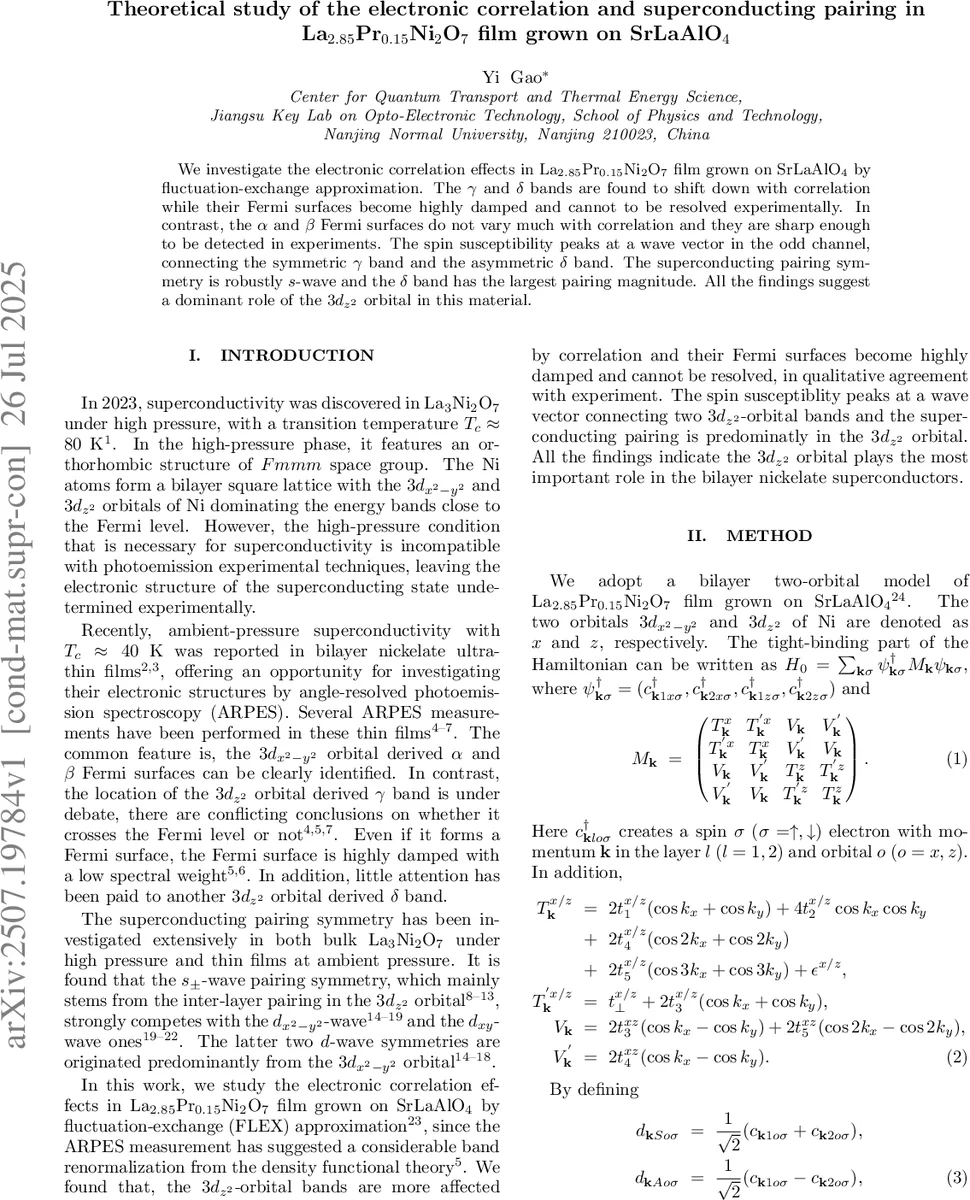
We investigate the electronic correlation effects in La${2.85}$Pr${0.15}$Ni$_2$O$_7$ film grown on SrLaAlO$4$ by fluctuation-exchange approximation. The $γ$ and $δ$ bands are found to shift down with correlation while their Fermi surfaces become highly damped and cannot to be resolved experimentally. In contrast, the $α$ and $β$ Fermi surfaces do not vary much with correlation and they are sharp enough to be detected in experiments. The spin susceptibility peaks at a wave vector in the odd channel, connecting the symmetric $γ$ band and the asymmetric $δ$ band. The superconducting pairing symmetry is robustly $s$-wave and the $δ$ band has the largest pairing magnitude. All the findings suggest a dominant role of the $3d{z^{2}}$ orbital in this material.
💡 Research Summary
The authors present a comprehensive theoretical investigation of the electronic correlation effects and superconducting pairing mechanism in La₂.₈₅Pr₀.₁₅Ni₂O₇ thin films epitaxially grown on SrLaAlO₄. Using a bilayer two‑orbital (Ni 3d x²‑y² and 3d z²) tight‑binding model, they incorporate multiorbital Hubbard interactions and solve the problem within the fluctuation‑exchange (FLEX) approximation. The calculation is fully self‑consistent: the bare susceptibility χ⁰(q) is obtained from the non‑interacting Green’s function, spin and charge susceptibilities χ_s(q) and χ_c(q) are built via matrix RPA‑like equations, and the normal self‑energy Σ(k,iω_n) is evaluated from the interaction kernels. Analytic continuation to real frequencies is performed with a 1024‑point Padé approximant, allowing the authors to compute the spectral function A(k,ω) and the quasiparticle lifetimes.
In the non‑interacting limit (U=0) four bands appear: two symmetric (α, γ) and two antisymmetric (β, δ) combinations of the layer degrees of freedom. The α and β bands are derived mainly from the 3d x²‑y² orbital, while γ and δ originate from the 3d z² orbital. The γ band crosses the Fermi level near the M point, whereas the δ band sits just above the Fermi level at Γ and does not form a Fermi surface.
When the on‑site intra‑orbital interaction U is increased from 1.5 eV to 3.9 eV (with Hund’s coupling J_H = J′ = 0.56 eV and U′ = U – 2J_H), the authors observe a pronounced orbital‑selective renormalization. The real parts of the quasiparticle energies for γ (at M) and δ (at Γ) shift downwards; the δ band eventually moves ∼20 meV below the Fermi level at the largest U. Simultaneously, the imaginary parts of these energies grow dramatically, indicating strong damping and short lifetimes. Consequently, the spectral weight of γ and δ becomes highly broadened and essentially invisible in the calculated A(k,0), in agreement with ARPES reports that only the α and β Fermi surfaces are clearly resolved. By contrast, the α and β bands experience only minor shifts and retain sharp quasiparticle peaks, preserving their experimentally observed Fermi surfaces.
The spin susceptibility χ_s(q) is evaluated as a 16 × 16 matrix (layer × orbital indices). Across all interaction strengths, its leading eigenvalue peaks at Q ≈ (±0.625π, ±0.625π). Detailed inspection of the matrix elements shows that the dominant contribution comes from the odd‑channel component involving the 3d z² orbital, specifically the inter‑layer symmetric (γ) and antisymmetric (δ) z‑orbital components. This identifies the γ–δ scattering as the primary source of spin fluctuations, highlighting the central role of the 3d z² orbital in the magnetic response.
To address superconductivity, the linearized Eliashberg equation is solved using the pairing interaction V_a(q) = ½
Comments & Academic Discussion
Loading comments...
Leave a Comment