An effective physics-informed neural operator framework for predicting wavefields
Solving the wave equation is fundamental for geophysical applications. However, numerical solutions of the Helmholtz equation face significant computational and memory challenges. Therefore, we introduce a physics-informed convolutional neural operator (PICNO) to solve the Helmholtz equation efficiently. The PICNO takes both the background wavefield corresponding to a homogeneous medium and the velocity model as input function space, generating the scattered wavefield as the output function space. Our workflow integrates PDE constraints directly into the training process, enabling the neural operator to not only fit the available data but also capture the underlying physics governing wave phenomena. PICNO allows for high-resolution reasonably accurate predictions even with limited training samples, and it demonstrates significant improvements over a purely data-driven convolutional neural operator (CNO), particularly in predicting high-frequency wavefields. These features and improvements are important for waveform inversion down the road.
💡 Research Summary
The manuscript introduces a Physics‑Informed Convolutional Neural Operator (PICNO) designed to solve the Helmholtz equation efficiently in the frequency domain. Traditional numerical solvers for the Helmholtz equation, such as finite‑difference, spectral, and pseudo‑spectral methods, become prohibitively expensive as model size and frequency increase, limiting their applicability to large‑scale 3‑D seismic imaging and full‑waveform inversion. Recent advances in scientific machine learning (SciML) have shown that embedding physical laws into learning frameworks can improve data efficiency and generalization. Building on this idea, the authors propose PICNO, which incorporates the governing partial differential equation directly into the loss function while leveraging a convolutional neural operator (CNO) architecture.
The key innovation lies in the formulation of the learning target. Instead of predicting the full complex‑valued wavefield (U), the network learns the scattered field (\delta U = U - U_0), where (U_0) is the analytically computed background wavefield for a homogeneous reference velocity (v_0). This background field encodes source location and frequency, eliminating the need for explicit source embedding and providing a physically meaningful prior. The input to the network consists of three channels: the real and imaginary parts of (U_0) and the spatial velocity model (v(x,z)). The output channels are the real and imaginary parts of (\delta U).
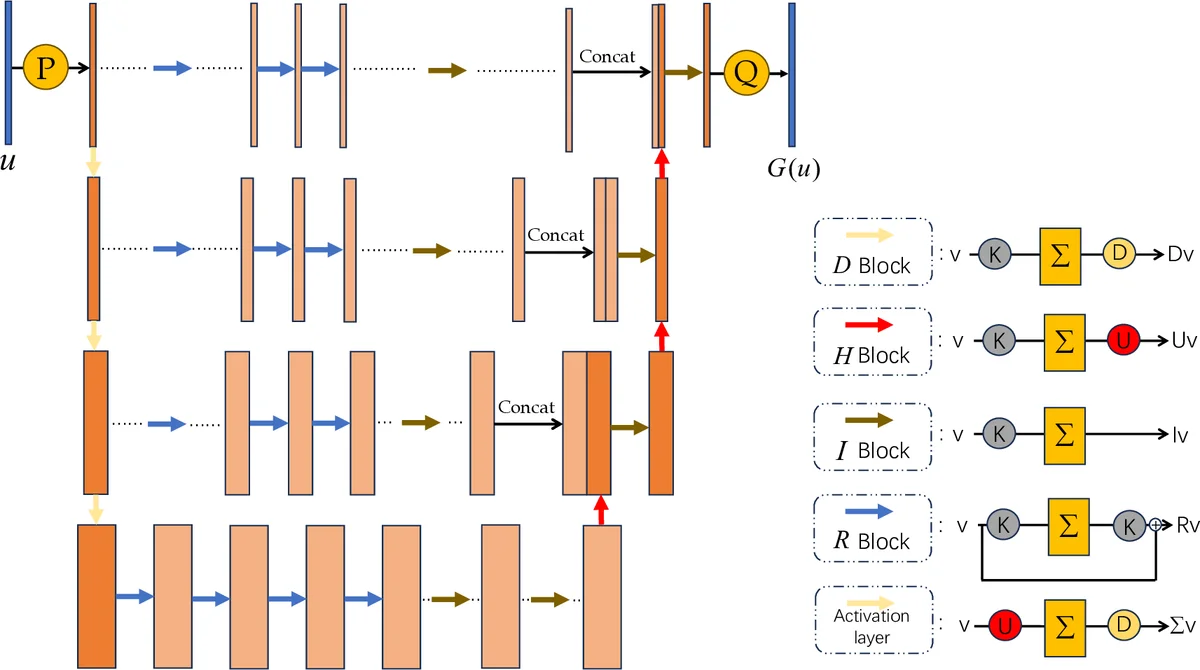
The underlying CNO follows a continuous‑discrete equivalence principle, mapping functions between infinite‑dimensional spaces via a lifting operator, a sequence of convolution‑based layers, and a projection operator. Each layer comprises a spatial convolution kernel (K), a Leaky ReLU activation (\Sigma), and a resolution‑changing operator (V) (upsampling or downsampling). The architecture adopts a U‑Net‑style design with four building blocks—downsampling, invariant, upsampling, and residual blocks—connected through skip connections to preserve multi‑scale information. Unlike Fourier Neural Operators that perform convolutions in the spectral domain, CNO operates directly in physical space, which simplifies handling non‑periodic boundaries and arbitrary geometries.
Training employs a composite loss: a data term (mean‑square error between predicted and true scattered fields) and a physics term that penalizes the residual of the discretized Helmholtz operator applied to the reconstructed total field (U_0 + \delta U_{\text{pred}}). The physics loss is computed efficiently using Fourier‑based derivatives or finite differences, avoiding the memory overhead of automatic differentiation. A weighting factor (\lambda) balances data fidelity and physical consistency.
Experiments are conducted on synthetic 2‑D velocity models with varying complexity, source positions, and frequencies ranging from low (5 Hz) to high (30 Hz). Training datasets are deliberately small (a few hundred examples) to test data efficiency. PICNO is benchmarked against a purely data‑driven CNO, a Physics‑Informed Neural Operator (PINO) from prior work, and conventional finite‑difference solutions. Results show that PICNO reduces relative error by up to 53 % compared with the data‑driven CNO, especially in high‑frequency regimes where traditional methods struggle. Moreover, PICNO generalizes well to out‑of‑distribution velocity models and frequencies not seen during training, thanks to the embedded PDE constraints. Visual inspection confirms that phase and amplitude of the predicted scattered fields match the ground truth, indicating superior physical consistency.
The authors discuss limitations, noting that the current study is confined to 2‑D problems and that extending to 3‑D will require careful memory management and possibly hierarchical operator designs. They also acknowledge that more complex boundary conditions (e.g., absorbing or non‑linear) and anisotropic media would demand extensions to the loss formulation and network architecture.
In conclusion, PICNO offers a compelling solution for fast, accurate, and physically consistent wavefield prediction in the frequency domain. By combining a convolutional neural operator with physics‑informed training, it achieves high fidelity with limited data, making it a promising surrogate model for large‑scale seismic forward modeling and inversion workflows.
Comments & Academic Discussion
Loading comments...
Leave a Comment