Source Wavefront Generation for a Non-Interferometric Reconfigurable Null Test using a Photonic Lantern
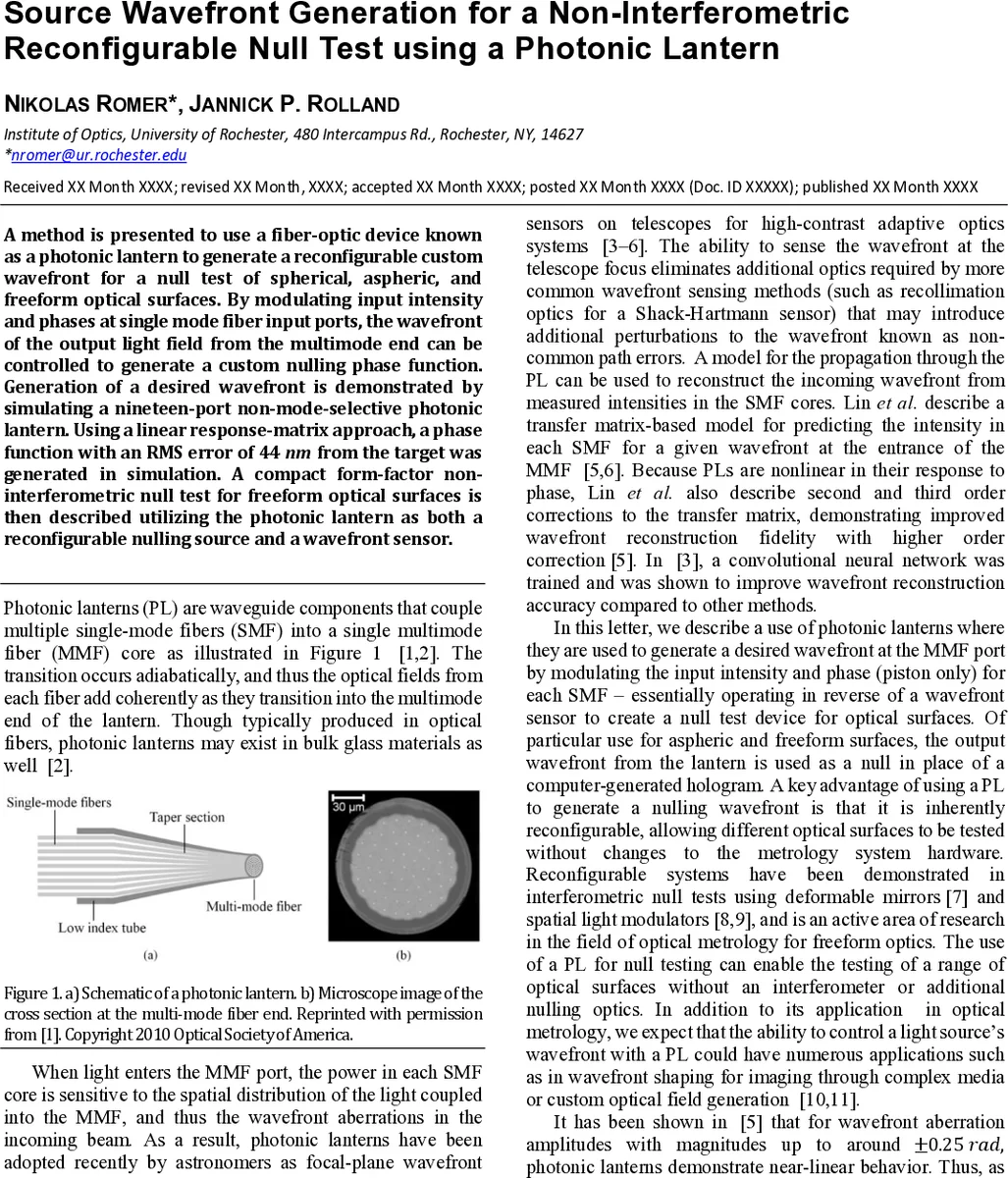
A method is presented to use a fiber-optic device known as a photonic lantern to generate a reconfigurable custom wavefront for a null test of spherical, aspheric, and freeform optical surfaces. By modulating input intensity and phases at single mode fiber input ports, the wavefront of the output light field from the multimode end can be controlled to generate a custom nulling phase function. Generation of a desired wavefront is demonstrated by simulating a nineteen-port non-mode-selective photonic lantern. Using a linear response-matrix approach, a phase function with an RMS error of 44 nm from the target was generated in simulation. A compact form-factor noninterferometric null test for freeform optical surfaces is then described utilizing the photonic lantern as both a reconfigurable nulling source and a wavefront sensor.
💡 Research Summary
This paper introduces a novel approach to optical surface metrology that leverages a photonic lantern (PL) both as a reconfigurable wavefront generator and as a wavefront sensor, thereby enabling a compact, non‑interferometric null test for spherical, aspheric, and free‑form optics. A photonic lantern consists of multiple single‑mode fiber (SMF) inputs that adiabatically merge into a single multimode fiber (MMF) core. By independently controlling the intensity and phase of the light launched into each SMF, the authors demonstrate that the complex field emerging from the MMF can be shaped to match an arbitrary target phase distribution.
To validate the concept, a 19‑port non‑mode‑selective lantern is modeled in R‑Soft. The propagation through the tapered region, the MMF, and subsequent free‑space propagation are each represented by linear operators, whose product forms a system matrix R. The desired output field—unit amplitude across a circular pupil with a trefoil + focus Zernike phase pattern—is specified, and the pseudo‑inverse of R is used to compute the required complex excitation vector for the SMFs. Simulations show that the reconstructed output wavefront deviates from the target by an RMS error of 44 nm (0.044 λ at 632 nm), confirming that a linear response‑matrix approach can achieve sub‑λ/20 accuracy.
The authors discuss the principal sources of error: (i) the inherent non‑linearity of the PL, especially crosstalk among SMF cores during the taper; (ii) deviation from linearity for larger peak‑to‑valley phase excursions; and (iii) numerical noise in the finite‑difference propagation. They note that higher‑order corrections (second‑ and third‑order terms) and machine‑learning‑based inversion, as demonstrated in recent wavefront‑sensing work, could substantially improve fidelity for more demanding phase profiles.
A practical null‑test configuration is proposed. A monochromatic laser is split and coupled into the SMF ports; each port is equipped with intensity and phase modulators (e.g., thermo‑optic or electro‑optic phase shifters). The combined output from the MMF illuminates the test surface at normal incidence. After reflection, the beam retraces the same path and re‑enters the PL, which now acts as a focal‑plane wavefront sensor. By comparing the returned SMF intensities/phases with the originally programmed “reference” wavefront, the surface figure error can be directly extracted. This scheme eliminates the need for a separate computer‑generated hologram, beam splitters, and the double‑pass interferometer traditionally required for null testing, offering a more compact and reconfigurable solution.
Limitations are acknowledged. The linear model breaks down for large‑amplitude aberrations, and the system is sensitive to temperature and mechanical perturbations that affect mode mixing in the MMF. To mitigate these issues, the authors suggest moving to solid‑state PLs fabricated by femtosecond laser inscription or future 3‑D printing techniques, which would provide greater environmental stability. They also point out that the spatial resolution of the generated null is limited by the number of SMF cores; while current demonstrations use up to 37 cores, fabrication capabilities exist for hundreds of cores, which would enable measurement of higher‑spatial‑frequency errors.
In summary, the work demonstrates that a photonic lantern can be used not only to sense but also to synthesize arbitrary wavefronts, achieving a simulated RMS phase error of 44 nm. By integrating this capability into a null‑test architecture, the authors provide a reconfigurable, interferometer‑free metrology platform that is especially attractive for testing free‑form optics. Future research will focus on nonlinear inversion techniques, optimized lantern designs (e.g., hybrid lanterns with a dedicated reference core), and experimental validation of the full system.
Comments & Academic Discussion
Loading comments...
Leave a Comment