CQI-Based Interference Prediction for Link Adaptation in Industrial Sub-networks
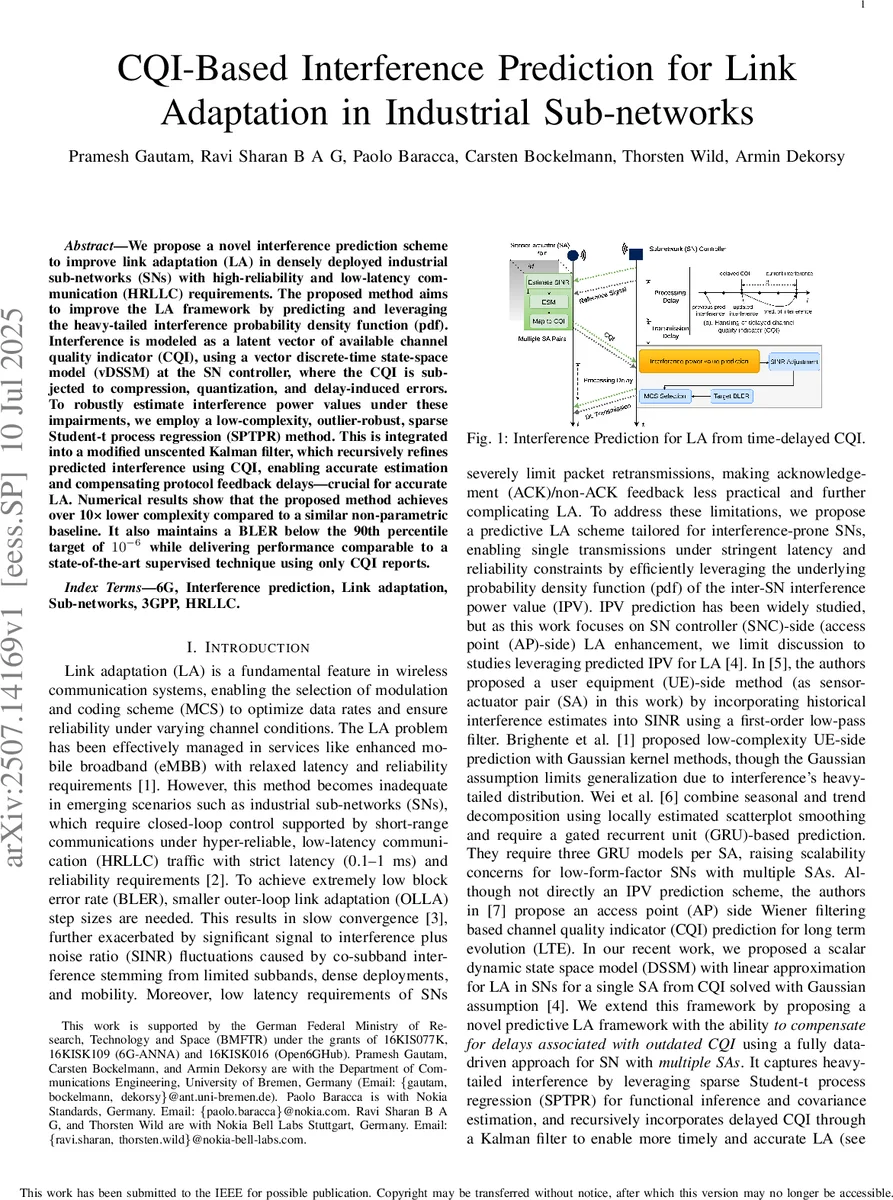
We propose a novel interference prediction scheme to improve link adaptation (LA) in densely deployed industrial sub-networks (SNs) with high-reliability and low-latency communication (HRLLC) requirements. The proposed method aims to improve the LA framework by predicting and leveraging the heavy-tailed interference probability density function (pdf). Interference is modeled as a latent vector of available channel quality indicator (CQI), using a vector discrete-time state-space model (vDSSM) at the SN controller, where the CQI is subjected to compression, quantization, and delay-induced errors. To robustly estimate interference power values under these impairments, we employ a low-complexity, outlier-robust, sparse Student-t process regression (SPTPR) method. This is integrated into a modified unscented Kalman filter, which recursively refines predicted interference using CQI, enabling accurate estimation and compensating protocol feedback delays, crucial for accurate LA. Numerical results show that the proposed method achieves over 10x lower complexity compared to a similar non-parametric baseline. It also maintains a BLER below the 90th percentile target of 1e-6 while delivering performance comparable to a state-of-the-art supervised technique using only CQI reports.
💡 Research Summary
**
The paper addresses the challenge of achieving reliable, low‑latency (HRLLC) communications in densely deployed industrial sub‑networks (SNs) where conventional link adaptation (LA) techniques, originally designed for eMBB services, struggle due to rapid interference fluctuations and protocol feedback delays. The authors propose a CQI‑driven interference prediction framework that operates entirely at the sub‑network controller (SNC) without requiring additional signaling from the sensor‑actuator (SA) side.
First, the interference power vector (IPV) across the multiple SAs of a given SN is treated as a latent state in a vector discrete‑time state‑space model (vDSSM). The state transition function F and the observation function G are unknown and highly non‑linear because CQI reports are compressed, quantized, and delayed. To learn these functions directly from data, the authors adopt a non‑parametric Bayesian approach based on Student‑t processes rather than Gaussian processes. The Student‑t distribution’s heavy‑tailed nature makes it robust to rare but severe interference spikes, while a sparse approximation using a small set of inducing points reduces the computational complexity from O(L³) (full Gaussian process) to O(L_E²·L), where L_E ≪ L.
The learned mean and covariance functions from the sparse Student‑t process regression (SPTPR) are then embedded into a Modified Unscented Kalman Filter (MUKF). Unlike a standard UKF that assumes Gaussianity, the MUKF employs sigma‑points and weights specifically derived for Student‑t distributions, preserving the heavy‑tailed characteristics during the nonlinear propagation of mean and covariance. Process noise (β(t)) and measurement noise (u(t)) are also modeled as Student‑t variables, allowing the filter to naturally accommodate compression, quantization, and protocol‑induced delays.
Algorithmically, the MUKF proceeds as follows: (1) generate sigma‑points from the previous state estimate; (2) propagate them through the SPTPR‑based transition model to obtain a predicted IPV and its covariance; (3) incorporate the newly received, possibly outdated CQI vector using the SPTPR‑based observation model; (4) update the state estimate and covariance. The resulting IPV estimate ˆιₙ(t) is fed into the LA optimization problem, which selects the modulation and coding scheme (MCS) vector λ that maximizes spectral efficiency while keeping the block error rate (BLER) below a target of 10⁻⁶.
Simulation results, based on a 3GPP‑compliant TDD NR scenario with sub‑millisecond latency budgets (0.1–1 ms) and multiple SAs per SN, demonstrate that the proposed method achieves more than a tenfold reduction in computational load compared with a full non‑parametric baseline, while maintaining the 90th‑percentile BLER below the 10⁻⁶ target. Moreover, its performance matches that of a state‑of‑the‑art supervised deep‑learning predictor that requires extensive labeled training data, despite the fact that the proposed scheme relies solely on CQI reports.
The work’s main contributions are: (i) a CQI‑only interference prediction pipeline that eliminates extra signaling and energy consumption at the SA; (ii) the integration of heavy‑tailed Student‑t process regression with a sparse inducing‑point scheme for scalable learning; (iii) a modified unscented Kalman filter that respects the Student‑t statistics, enabling accurate recursive refinement of interference estimates under realistic compression, quantization, and delay impairments; and (iv) a demonstration that such a predictor can be directly used in HRLLC‑critical LA to meet stringent reliability targets.
Limitations include the assumption of negligible intra‑SN interference (orthogonal scheduling) and the need for careful selection of the Student‑t degrees of freedom and inducing‑point set size. Future work could extend the model to fully shared‑access scenarios, incorporate adaptive tuning of the heavy‑tail parameters, and validate the approach on real industrial testbeds.
Comments & Academic Discussion
Loading comments...
Leave a Comment