Alleviating CoD in Renewable Energy Profile Clustering Using an Optical Quantum Computer
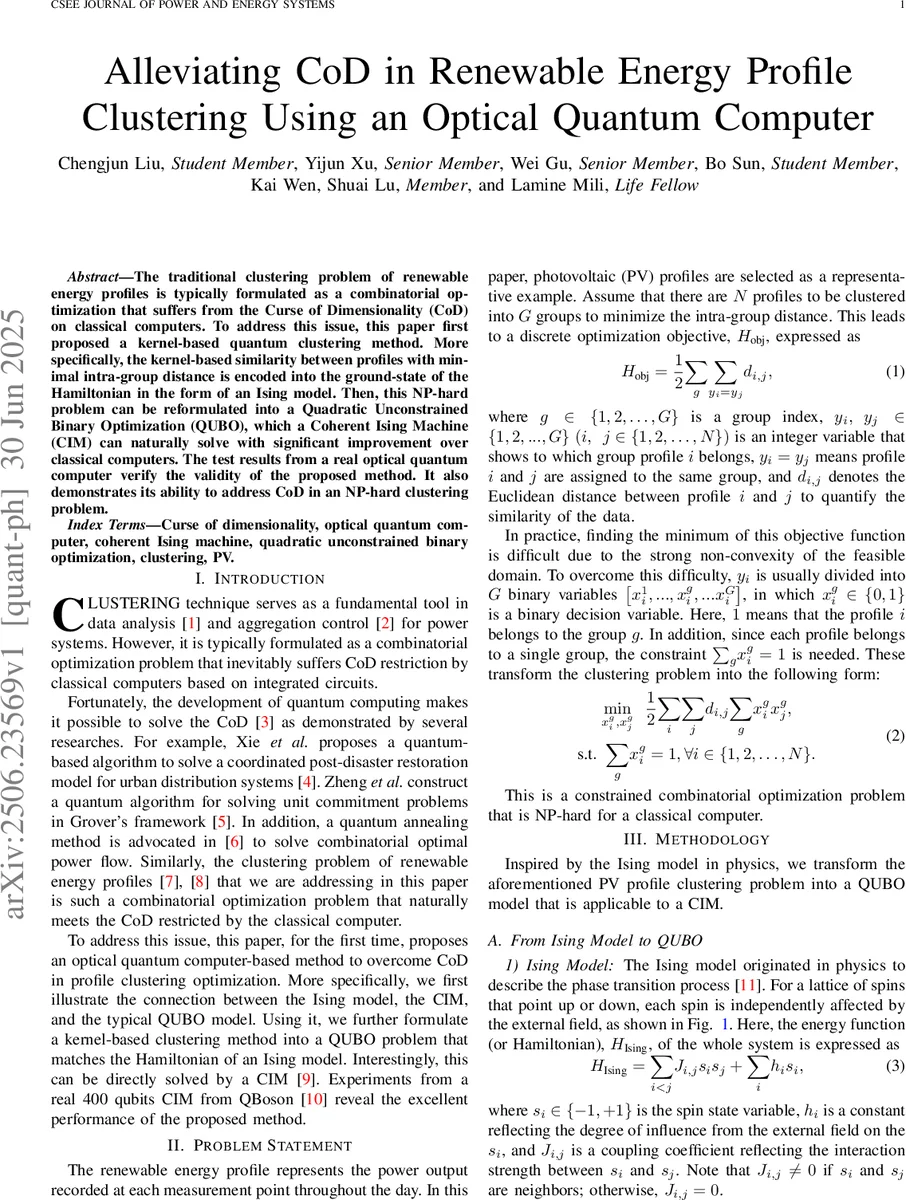
The traditional clustering problem of renewable energy profiles is typically formulated as a combinatorial optimization that suffers from the Curse of Dimensionality (CoD) on classical computers. To address this issue, this paper first proposed a kernel-based quantum clustering method. More specifically, the kernel-based similarity between profiles with minimal intra-group distance is encoded into the ground-state of the Hamiltonian in the form of an Ising model. Then, this NP-hard problem can be reformulated into a Quadratic Unconstrained Binary Optimization (QUBO), which a Coherent Ising Machine (CIM) can naturally solve with significant improvement over classical computers. The test results from a real optical quantum computer verify the validity of the proposed method. It also demonstrates its ability to address CoD in an NP-hard clustering problem.
💡 Research Summary
The paper tackles the NP‑hard problem of clustering renewable‑energy (specifically photovoltaic) generation profiles, which suffers from the curse of dimensionality (CoD) on classical digital computers. The authors first reformulate the clustering objective—minimizing intra‑group Euclidean distance—into a binary‑variable quadratic form. Each profile i is assigned to one of G groups using binary variables x_{g,i} with the constraint Σ_g x_{g,i}=1 enforced by a penalty term λ_i. This yields a constrained quadratic objective that can be expressed as a Quadratic Unconstrained Binary Optimization (QUBO) problem.
To improve the representation of similarity in high‑dimensional space, the authors replace the Euclidean distance d_{i,j} with a Gaussian kernel‑based similarity g_{i,j}=k_{i,j}−… where k_{i,j}=exp(−‖p_i−p_j‖²/(2σ²)). The kernel matrix G is decomposed into diagonal and upper‑triangular parts, and the final QUBO matrix is constructed as Q = (−G_diag−2G_u)⊗I + Λ⊗(2O−I). This QUBO is isomorphic to an Ising Hamiltonian H_Ising = Σ_{i<j} J_{i,j}s_i s_j + Σ_i h_i s_i, enabling direct mapping onto a Coherent Ising Machine (CIM).
A CIM is an optical quantum computer built from a network of degenerate optical parametric oscillators (DOPOs). Each DOPO encodes a spin (±1) and the coupling coefficients J_{i,j} are injected via a measurement‑feedback loop. The system naturally evolves toward the spin configuration that minimizes the Ising Hamiltonian, and the physical time for a photon pulse to complete a round‑trip in the fiber cavity (≈3 ms) determines the total solving time, which is essentially independent of the problem size.
The authors evaluate the method on a 400‑qubit CIM provided by QBoson. Four test cases are considered: clustering 50, 60, 70, and 80 PV profiles into 2, 3, 4, and 5 groups respectively, resulting in QUBO sizes of 100, 180, 280, and 400 binary variables. Baselines include MATLAB K‑means, K‑medoids, simulated quantum annealing (SQA) via OpenJij, and a classical Gurobi branch‑and‑bound solver on a standard desktop (i5‑13400F, 32 GB RAM).
Results show that the CIM solves all instances in roughly 3 ms, with negligible variation as the number of variables grows. In contrast, classical algorithms exhibit a steep increase in runtime; SQA requires orders of magnitude longer due to bit‑level simulation, and Gurobi fails to converge within a 300‑second limit for the 280‑ and 400‑variable instances, yielding large optimality gaps (84 % and 127 %). The CIM attains zero optimality gap, matching the global optimum found by Gurobi on smaller instances.
Clustering quality is assessed using the silhouette coefficient. The CIM’s scores are comparable to K‑means and K‑medoids, slightly lower because the kernel‑based objective optimizes intra‑group similarity in a transformed feature space rather than raw Euclidean distance. Nevertheless, intra‑group distances are more compact, and the method remains robust across a reasonable range of the kernel bandwidth σ, with peak performance around σ ≈ 0.5.
The discussion acknowledges current hardware limitations: the number of spins (qubits) limits problem size, and optical loss and decoherence affect scalability. The authors propose hybrid strategies such as Benders decomposition, ADMM, and sub‑QUBO partitioning to split large problems into smaller sub‑QUBOs solvable on existing CIMs. They also suggest integrating machine‑learning‑based preprocessing to further improve scalability.
From an application perspective, the millisecond‑scale solving speed of CIM makes it attractive for real‑time power‑system tasks such as dynamic load aggregation, fast demand‑response control, and other time‑critical optimization problems where traditional algorithms would be too slow. Moreover, the kernel‑based formulation enables handling of non‑convex, high‑dimensional data that can challenge distance‑based methods like K‑means.
In conclusion, the paper makes three primary contributions: (1) a kernel‑enhanced QUBO formulation for renewable‑energy profile clustering, (2) a demonstration that an optical quantum computer (CIM) can solve the resulting QUBO in constant, sub‑millisecond time, effectively bypassing the curse of dimensionality, and (3) experimental validation on a real 400‑qubit CIM showing competitive clustering quality and superior scalability compared to classical solvers. While current hardware restricts problem size, the authors anticipate that advances in qubit count and error‑correction will enable the approach to tackle larger, more complex power‑system optimization problems in the near future.
Comments & Academic Discussion
Loading comments...
Leave a Comment