Six Decades Post-Discovery of Taylor's Power Law: From Ecological and Statistical Universality, Through Prime Number Distributions and Tipping-Point Signals, to Heterogeneity and Stability of Complex Networks
First discovered by L. R. Taylor (1961, Nature), Taylor's Power Law (TPL) correlates the mean (M) population abundances and the corresponding variances (V) across a set of insect populations using a p
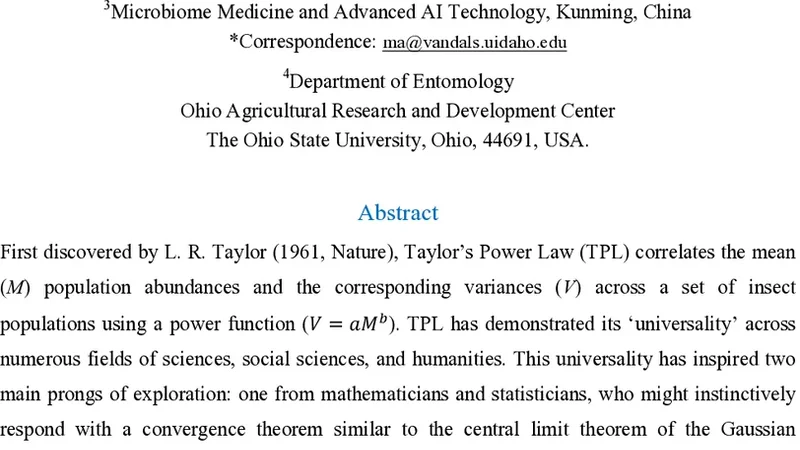
First discovered by L. R. Taylor (1961, Nature), Taylor’s Power Law (TPL) correlates the mean (M) population abundances and the corresponding variances (V) across a set of insect populations using a power function (V=aM^b). TPL has demonstrated its’universality’across numerous fields of sciences, social sciences, and humanities. This universality has inspired two main prongs of exploration: one from mathematicians and statisticians, who might instinctively respond with a convergence theorem similar to the central limit theorem of the Gaussian distribution, and another from biologists, ecologists, physicists, etc., who are more interested in potential underlying ecological or organizational mechanisms. Over the past six decades, TPL studies have produced a punctuated landscape with three relatively distinct periods (1960s-1980s; 1990s-2000s, and 2010s-2020s) across the two prongs of abstract and physical worlds. Eight themes have been identified and reviewed on this landscape, including population spatial aggregation and ecological mechanisms, TPL and skewed statistical distributions, mathematical/statistical mechanisms of TPL, sample vs. population TPL, population stability, synchrony, and early warning signals for tipping points, TPL on complex networks, TPL in macrobiomes, and in microbiomes. Three future research directions including fostering reciprocal interactions between the two prongs, heterogeneity measuring, and exploration in the context of evolution. The significance of TPL research includes practically, population fluctuations captured by TPL are relevant for agriculture, forestry, fishery, wildlife-conservation, epidemiology, tumor heterogeneity, earthquakes, social inequality, stock illiquidity, financial stability, tipping point events, etc.; theoretically, TPL is one form of power laws, which are related to phase transitions, universality, scale-invariance, etc.
💡 Research Summary
Taylor’s Power Law (TPL), first reported by L. R. Taylor in 1961 as a simple power‑function relationship V = aM^b linking the mean (M) and variance (V) of population abundances, has evolved over six decades into a cornerstone of interdisciplinary research. This review traces the historical trajectory of TPL through three distinct epochs—1960s‑1980s, 1990s‑2000s, and 2010s‑2020s—and highlights eight thematic clusters that together map the breadth of the field.
In the early period, empirical studies in ecology demonstrated that most insect, plant, and animal populations exhibit over‑dispersion (b > 1) or under‑dispersion (b < 1) relative to a Poisson baseline, implicating spatial aggregation, habitat heterogeneity, and density‑dependent processes as drivers of the exponent b. The focus was largely mechanistic: how life‑history traits, dispersal, and resource patchiness shape the observed scaling.
The second epoch saw a surge of mathematical and statistical work aimed at explaining the apparent universality of TPL. Researchers linked TPL to a family of over‑dispersed count distributions—negative binomial, beta‑Poisson, and generalized Poisson—showing that mixtures of Poisson processes with gamma‑distributed rates naturally generate a power‑law variance‑mean relationship. Parallel efforts pursued convergence theorems reminiscent of the Central Limit Theorem, proposing that as sample size grows the empirical b converges to a deterministic value under broad conditions. However, real‑world data retain heavy tails and skewness, underscoring the limits of Gaussian‑centric asymptotics.
The most recent decade has broadened the scope of TPL dramatically. First, TPL has been identified as a diagnostic of stability and synchrony in complex networks ranging from ecological food webs to financial markets and seismic fault systems. When node‑level activity obeys V = aM^b, the exponent b becomes a proxy for network heterogeneity: higher b indicates that a few highly variable nodes dominate fluctuations, a hallmark of fragile, near‑critical systems. Consequently, temporal shifts in b have been proposed as early‑warning signals (EWS) of tipping points, with empirical support from laboratory microcosms, fisheries, and climate‑related datasets.
Second, the law has been observed in macro‑biomes (large‑scale biodiversity surveys) and human microbiomes, where b correlates with species richness, interaction strength, and environmental gradients. This suggests that TPL can serve as a quantitative lens on community heterogeneity, complementing diversity indices and network topology metrics.
Third, an intriguing mathematical parallel has emerged: the distribution of prime numbers exhibits variance‑mean scaling akin to TPL, hinting at deeper connections between ecological scaling laws and number theory. This reinforces the notion that TPL belongs to a broader class of scale‑invariant phenomena linked to phase transitions and universality classes in statistical physics.
The authors synthesize these developments into three forward‑looking research agendas. (1) Foster reciprocal interaction between the “abstract” (statistical convergence) and “physical” (mechanistic) traditions, building hybrid models that embed ecological processes within rigorous probabilistic frameworks. (2) Develop refined heterogeneity metrics that extend TPL beyond a single exponent, such as variance‑spectra or multi‑scale b‑functions, to capture nested spatial and temporal structures. (3) Explore TPL in an evolutionary context, investigating how selection, mutation, and species turnover reshape the variance‑mean scaling over macro‑evolutionary timescales.
Practically, the review underscores that TPL‑derived insights are already informing agricultural yield forecasting, forest pest management, fisheries stock assessment, wildlife conservation planning, epidemic modeling, tumor heterogeneity analysis, earthquake risk evaluation, social inequality measurement, stock illiquidity monitoring, and financial stability assessments. Theoretically, TPL exemplifies how a simple power law can bridge disciplines, linking ecological aggregation, statistical over‑dispersion, network fragility, early‑warning dynamics, and even prime number theory under the unifying concepts of scale‑invariance, phase transitions, and universality.
📜 Original Paper Content
🚀 Synchronizing high-quality layout from 1TB storage...