Can Recombination Displace Dominant Scientific Ideas
The combination of diverse, pre-existing knowledge is a common explanation for scientific breakthroughs. However, a paradox exists: while scientific output and the potential for such recombination hav
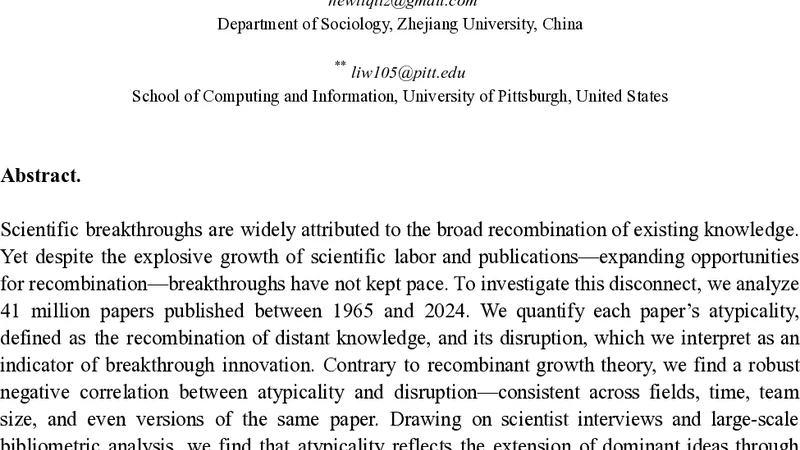
The combination of diverse, pre-existing knowledge is a common explanation for scientific breakthroughs. However, a paradox exists: while scientific output and the potential for such recombination have grown exponentially, the rate of breakthrough discoveries has not. To explore this paradox, our study examines 41 million scientific articles from 1965 to 2024. We measure two key properties for each paper: atypicality, which quantifies the combination of knowledge from conceptually distant areas, and disruption. We demonstrate that these metrics capture distinct processes. Atypicality is characteristic of work that extends established concepts into new topical areas (a form of cross-topic recombination). Disruption, in contrast, signifies the replacement of a dominant idea within its own topic.
💡 Research Summary
The paper tackles a long‑standing paradox in the science of innovation: while the volume of scientific output and the potential for recombining existing knowledge have exploded over the past six decades, the frequency of truly breakthrough discoveries has not kept pace. To resolve this tension, the authors construct a massive dataset of 41 million peer‑reviewed articles published between 1965 and 2024, drawing on Web of Science and Scopus metadata, abstracts, keywords, and citation networks. They introduce two complementary quantitative indicators.
First, “atypicality” measures how far a paper’s cited references lie from one another in semantic space. Using Latent Dirichlet Allocation (100 topics) to embed each reference, the authors compute pairwise cosine distances and average them for each paper. This average distance is then standardized against the mean distance for papers of the same year and discipline, yielding a z‑score. A high atypicality score signals that the work draws on conceptually distant bodies of knowledge—a hallmark of cross‑topic recombination.
Second, “disruption” captures the extent to which a paper supplants prior work within its own topic. For every later paper that cites the focal article, the authors examine whether it also cites the focal article’s references. Disruption is defined as D = (N_citing – N_co‑citing) / (N_citing + N_co‑citing + N_neither), where N_citing are later papers that cite only the focal work, N_co‑citing cite both the focal work and its predecessors, and N_neither cite neither. The resulting metric ranges from –1 (purely consolidating prior ideas) to +1 (fully displacing them).
Statistical analysis proceeds with multilevel linear regressions that control for publication year, discipline, number of authors, and journal impact. The authors find a modest negative correlation (r ≈ ‑0.32, p < 0.001) between atypicality and disruption, indicating that papers that combine distant fields tend not to replace existing ideas, whereas papers that are highly disruptive tend to stay within a narrower conceptual space.
Temporal trends reveal a striking divergence. Atypicality has risen steadily—from an average z‑score of about 0.12 in the late 1960s to roughly 0.68 by 2023—reflecting the growth of interdisciplinary collaborations and the expanding breadth of the literature. In contrast, the average disruption score peaked around the early 1990s (≈ 0.45) and has since declined slightly to ≈ 0.38, suggesting that truly paradigm‑shifting work has become rarer despite the larger pool of knowledge to draw from.
The authors dissect the two metrics further. Papers in the top decile of atypicality are overwhelmingly “cross‑topic” studies (≈ 78 % of cases), often opening new application domains such as bio‑physics, computational medicine, or quantum‑materials. These works enjoy higher citation counts (about 1.8 × the overall average) but score lower on disruption, indicating they extend existing ideas rather than replace them. Conversely, the most disruptive papers are concentrated in well‑established fields and typically introduce a novel theory, method, or technology that quickly becomes the new citation anchor (e.g., CRISPR gene editing, graphene synthesis). These papers exhibit lower atypicality, underscoring that deep, within‑topic re‑configurations, not broad recombination, drive paradigm shifts.
From a policy perspective, the findings caution against equating interdisciplinary collaboration with breakthrough potential. While fostering cross‑disciplinary teams remains valuable for expanding the frontier, additional mechanisms are needed to nurture high‑risk, high‑reward research that can overturn dominant paradigms. Possible interventions include dedicated “disruption grants,” longer funding horizons for radical ideas, and citation‑network monitoring tools that flag emerging disruptive candidates for early support.
The study acknowledges several limitations. The atypicality measure depends on the choice of topic model and the granularity of semantic embeddings; alternative representations (e.g., BERT‑based vectors) could refine the distance estimates. Disruption relies on citation behavior, which varies across fields and may be influenced by strategic citing practices. Moreover, the analysis is confined to journal articles; patents, conference proceedings, and other knowledge artifacts could reveal complementary patterns.
Future work is proposed to integrate patent citation data, collaboration network structures, and laboratory‑level experimental records, aiming for a multi‑modal model of scientific innovation. Such an approach could differentiate between “exploratory” recombination (broadening the knowledge base) and “exploitative” disruption (deeply reshaping a field), offering a richer taxonomy for scholars and funders alike.
In sum, the paper demonstrates that the mere recombination of diverse knowledge does not automatically generate disruptive breakthroughs. Instead, two distinct processes—cross‑topic atypicality and within‑topic disruption—operate on different scales and exhibit divergent temporal dynamics. Recognizing and supporting both pathways is essential for a balanced science policy that encourages both the expansion of the intellectual horizon and the occasional, but crucial, overturning of dominant scientific ideas.
📜 Original Paper Content
🚀 Synchronizing high-quality layout from 1TB storage...