An Annotated Translation of D. Bernoulli's'A New Theory on the Motion of Waters Through Channels of Any Kind'
This paper presents an annotated English translation of Daniel Bernoulli's 1727 work A New Theory on the Motion of Waters through Channels of Any Kind, originally published in the Commentarii Academia
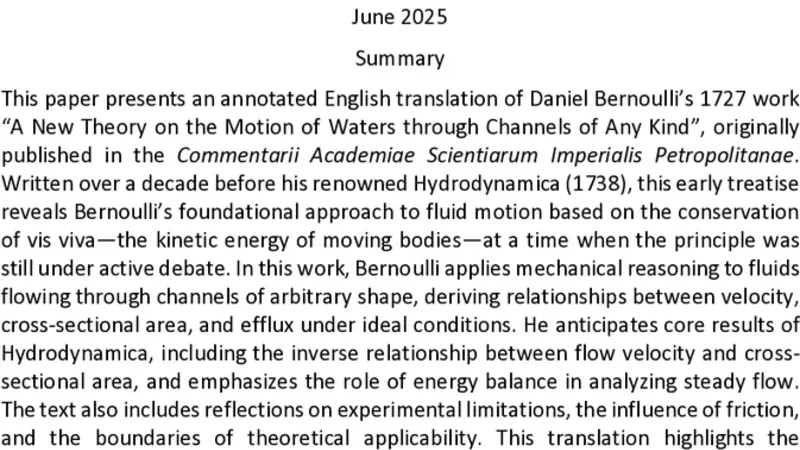
This paper presents an annotated English translation of Daniel Bernoulli’s 1727 work A New Theory on the Motion of Waters through Channels of Any Kind, originally published in the Commentarii Academiae Scientiarum Imperialis Petropolitanae. Written over a decade before his renowned Hydrodynamica (1738), this early treatise reveals D. Bernoulli’s foundational approach to fluid motion based on the conservation of vis viva-the kinetic energy of moving bodies-at a time when the principle was still under active debate. In this work, D. Bernoulli applies mechanical reasoning to fluids flowing through channels of arbitrary shape, deriving relationships between velocity, cross-sectional area, and efflux under ideal conditions. He anticipates core results of Hydrodynamica, including the inverse relationship between flow velocity and cross-sectional area, and emphasizes the role of energy balance in analyzing steady flow. The text also includes reflections on experimental limitations, the influence of friction, and the boundaries of theoretical applicability. This translation highlights the historical and conceptual significance of the 1727 paper as a precursor to D. Bernoulli’s mature hydrodynamic theory.
💡 Research Summary
The paper under review is an annotated English translation of Daniel Bernoulli’s 1727 treatise “A New Theory on the Motion of Waters Through Channels of Any Kind,” originally printed in the Commentarii Academiae Scientiarum Imperialis Petropolitanae. Although it predates his celebrated Hydrodynamica by more than a decade, the 1727 work already contains the essential ingredients of modern fluid‑mechanical theory. The translation not only renders the Latin‑French original into contemporary English but also supplies extensive footnotes that place Bernoulli’s reasoning in the context of early‑18th‑century physics, where the concept of vis viva (the kinetic energy of moving bodies) was still contested.
The treatise opens with a clear statement of assumptions that mirror what later became the ideal‑fluid model: the water is incompressible, the flow is steady, the channel walls are perfectly smooth, and external body forces (gravity, for example) are neglected in the primary analysis. Within this framework Bernoulli derives a continuity relationship, asserting that the product of cross‑sectional area and velocity is constant along the channel ( (v_1A_1 = v_2A_2) ). He arrives at this result by arguing that, in the absence of compression, the same volume of fluid must pass any two sections in the same time interval.
The core of the paper is Bernoulli’s energy‑balance argument. He treats pressure as a form of “force of the fluid” and postulates that, for an ideal flow, the sum of pressure work per unit mass and kinetic energy per unit mass remains unchanged from one section to another. In modern notation this is expressed as
\
📜 Original Paper Content
🚀 Synchronizing high-quality layout from 1TB storage...